Bidspirit auction | [MEDICINE & PHARMACY ] -
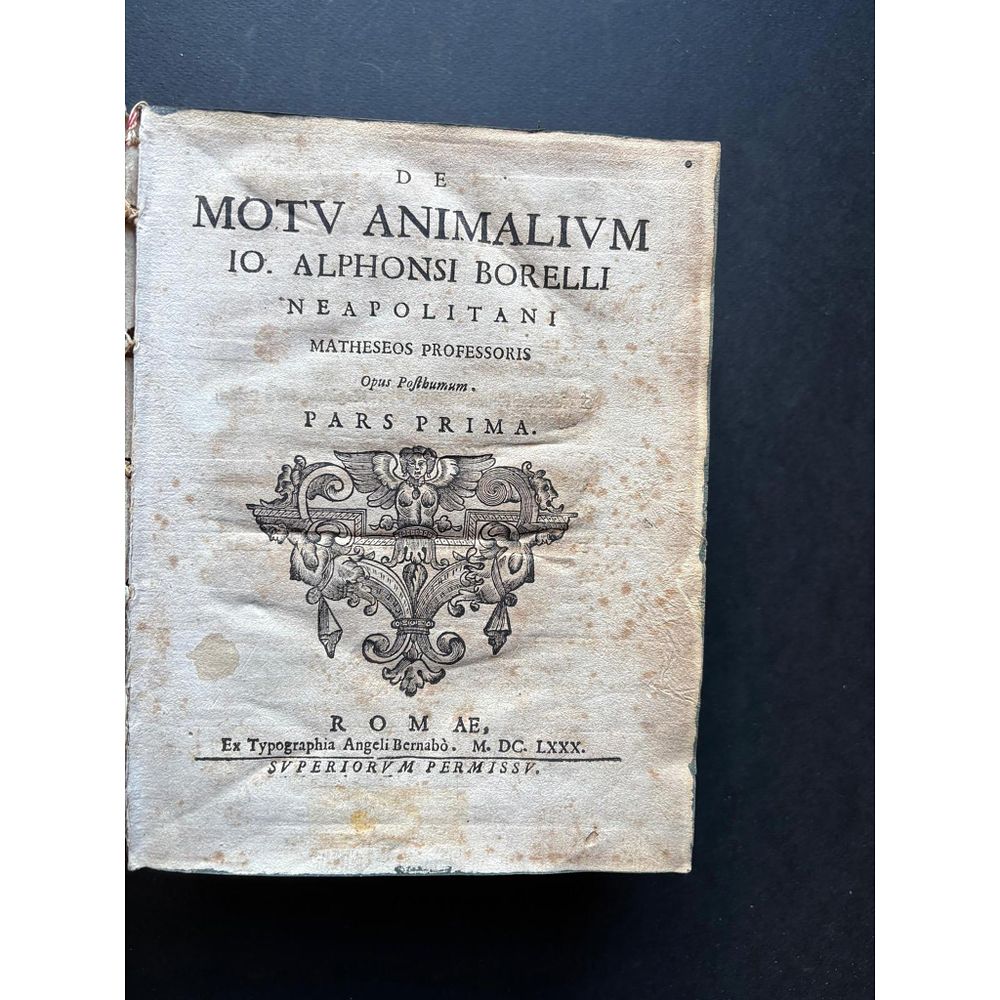
[MEDICINE & PHARMACY ] - BORELLI, Giovanni Alfonso (1608–1679) - De motu animalium - BORELLI, Giovanni Alfonso (1608–1679) De motu animalium Io. Alphonsi Borelli Neapolitani matheseos professoris opus posthumum. Romae: typis Angeli Bernabò, 1680–81. Two volumes, 4to. Pars Prima: [12], 376, [12] pp., 14 engraved plates; Pars Altera: [4], 520 pp., 4 further engraved plates, numbered 15 to 18 in continuation of the first volume — eighteen engraved folding plates in all. Typographic device to each title-page, woodcut initials. Contemporary full stiff vellum, the two volumes bound by different hands roughly a year apart, the endpaper stocks differing in watermark though drawn from the same paper mill, edges of both volumes stained blue. FIRST EDITION, POSTHUMOUSLY PUBLISHED, OF BORELLI'S DE MOTU ANIMALIUM, THE FOUNDATIONAL TREATISE OF BIOMECHANICS, IN WHICH THE MECHANICS OF GALILEO WERE FOR THE FIRST TIME SYSTEMATICALLY APPLIED TO THE MOVEMENT OF LIVING BODIES. Trained as a mathematician and physicist, Borelli turned to the study of animal motion under the influence of his colleague Marcello Malpighi, with whom he helped found the Accademia del Cimento in Florence. De motu animalium treats the body, in both its external and internal workings, as a mechanical system governed by the same physical laws as any machine: the first part analyses the action of muscles and bones in walking, running, jumping, swimming and flight, while the second turns to what would now be called physiology — the heartbeat, the circulation of the blood, respiration, the secretion of urine, and the other internal motions of the body. Borelli was the first to argue that the heartbeat is a simple muscular contraction and that the circulation operates on essentially hydraulic principles, laying the groundwork for the iatromechanical school of physiology. The eighteen engraved plates, inventive and often strikingly close in spirit to the anatomical and mechanical drawings of Leonardo da Vinci, illustrate the forces at work in animal and human movement; among them is one of the earliest printed depictions of a closed-circuit breathing apparatus for underwater use. Borelli died in poverty before the work could appear, and its publication was made possible by the patronage of the former Queen Christina of Sweden, to whom the book is dedicated. The binding is in good condition, with a few scattered wormholes to the margins of some leaves, and light oxidation spotting to the title-page of the second volume; otherwise an excellent copy. A cornerstone of the history of physiology and biomechanics, marking the moment at which the mechanistic philosophy of Galileo was extended, systematically and for the first time, to the motion of living creatures.