Bidspirit auction | [MEDICINE & PHARMACY ] -
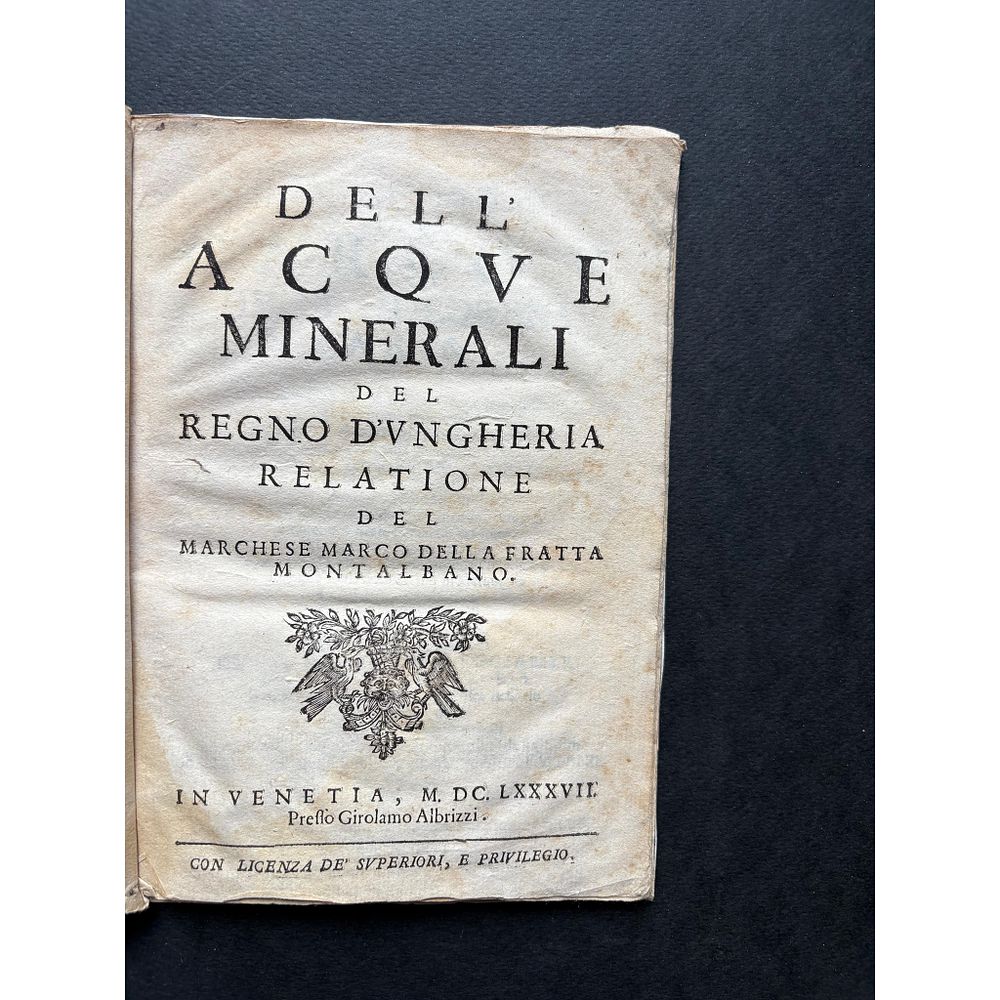
[MEDICINE & PHARMACY ] - DELLA FRATTA MONTALBANO, Marco Antonio (1635–1695) - Dell'acque minerali del regno d'Ungheria - ***Note: This lot is located in Italy and requires an Italian export licence. We will manage the full application process for you. An additional fee of £50 applies.*** DELLA FRATTA MONTALBANO, Marco Antonio (1635–1695). Dell’acque minerali del regno d’Ungheria. Relatione del Marchese Marco Della Fratta Montalbano. Venice: Girolamo Albrizzi, 1687. 4to (207 × 140 mm). [8], 27, [1] pp. Woodcut ornament to title-page. Some staining to title; traces of an erased or faded stamp on the half-title. Modern marbled-paper boards. FIRST EDITION OF THIS RARE AND LITTLE-KNOWN SEVENTEENTH-CENTURY ACCOUNT OF THE MINERAL WATERS OF HUNGARY, WRITTEN BY AN EXPERIENCED MINING ENGINEER WITH FIRST-HAND KNOWLEDGE OF CENTRAL EUROPE. A fascinating early contribution to the literature of mineral springs, hydrotherapy and natural resources, devoted to a region which had already acquired considerable fame for the extraordinary abundance and variety of its thermal and mineral waters. Marco Antonio Della Fratta Montalbano was a Bolognese nobleman, mining expert and author whose professional activities brought him into direct contact with the great mining districts of Central and Eastern Europe. His experience extended to Hungary, Austria, Poland and Moldavia, and his writings reflect the practical knowledge of a man accustomed to examining mines, minerals, subterranean waters and the techniques employed in their exploitation. In the present short but highly interesting Relatione, Della Fratta turns his attention specifically to the mineral waters of the Kingdom of Hungary, describing a territory celebrated since antiquity for its thermal phenomena and for the exceptional richness of its springs. The work belongs to the important seventeenth-century tradition in which mineral waters were studied simultaneously as natural curiosities, geological phenomena and substances possessing potential medicinal properties. The treatise is particularly appealing as an Italian scientific account of Hungary at the end of the seventeenth century, combining natural history, mineralogy, medicine and travel observation. It may also be viewed in the wider context of Della Fratta’s better-known writings on mining and metallurgy, in which he gathered the technical knowledge acquired during his travels through the principal mining regions of Europe. A rare and unusual work on Hungarian mineral and thermal waters, and an attractive document of the growing seventeenth-century interest in hydrogeology and therapeutic springs.