Bidspirit auction | [BOTANY & NATURAL HISTORY] -
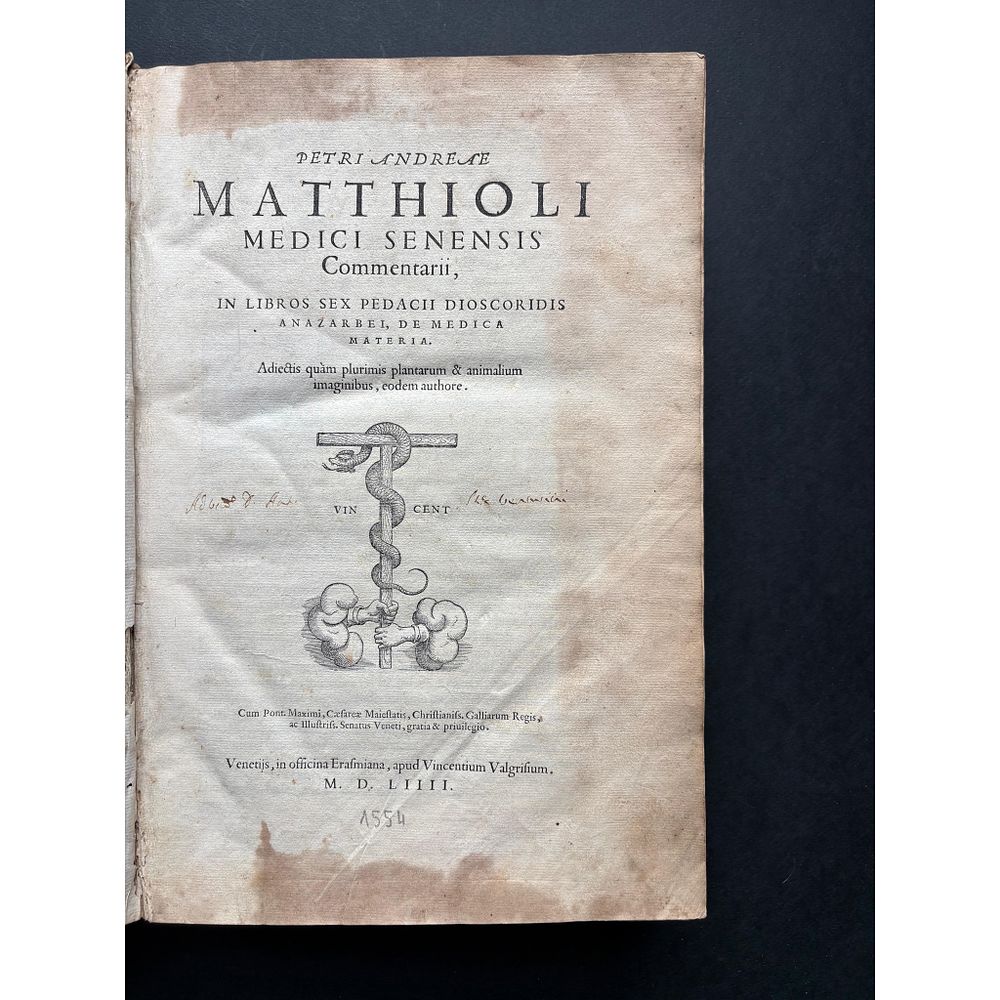
[BOTANY & NATURAL HISTORY] - MATTIOLI, Pietro Andrea (1501–1577) - Commentarii in libros sex Pedacii Dioscoridis - ***Note: This lot is located in Italy and requires an Italian export licence. We will manage the full application process for you. An additional fee of £50 applies.*** MATTIOLI, Pietro Andrea (1501–1577). Commentarii, in libros sex Pedacii Dioscoridis Anazarbei, de medica materia. Adiectis quam plurimis plantarum & animalium imaginibus, eodem authore. Venice: in officina Erasmiana, apud Vincentium Valgrisium, 1554. FIRST LATIN EDITION AND, OF EXCEPTIONAL IMPORTANCE, THE FIRST ILLUSTRATED EDITION OF MATTIOLI’S GREAT COMMENTARY ON DIOSCORIDES — ONE OF THE LANDMARKS OF RENAISSANCE BOTANY, PHARMACOLOGY AND NATURAL HISTORY. Folio (315 × 215 mm). [48], 707, [1 blank] pp. Vincenzo Valgrisi’s celebrated woodcut serpent device on title-page. Profusely illustrated with 564 woodcuts throughout the text, including approximately 506 representations of plants and flowers, together with numerous images of animals, fishes, crustaceans, amphibians, reptiles, insects, birds and quadrupeds, as well as several scenes connected with the preparation and use of natural substances. Contemporary stiff vellum, manuscript title to spine and a second early paper title-label applied beneath. Contemporary ownership inscription on title-page. Early underlining and manuscript annotations throughout, providing attractive evidence of the volume’s active use by an early reader. Title-page somewhat browned at margins; occasional light browning and staining, somewhat more noticeable on quires Y–Y3 and leaves 2m6 and 2t6; dampstaining in the inner margin of quires 2f–2h, with some weakening of the paper and loss of a few letters; occasional foxing and other minor marginal defects. Nevertheless a genuine, complete and generally well-preserved copy, retaining its contemporary binding and early scholarly annotations. THE FIRST ILLUSTRATED MATTIOLI The 1554 Commentarii represents a decisive moment in the history of botanical publishing. Mattioli had first published his Italian translation and commentary on Dioscorides in 1544. During the following decade he repeatedly revised and enlarged the work, but it was with the present edition that his commentary appeared for the first time in Latin and for the first time accompanied by an extensive programme of botanical and zoological illustration. The adoption of Latin immediately transformed the geographical reach of the work. What had begun as a practical Italian commentary for physicians and apothecaries became accessible to the international republic of European scholars. The combination of an authoritative classical text, Mattioli’s vast commentary and hundreds of illustrations turned the book into one of the most influential botanical publications of the sixteenth century. 564 WOODCUTS: A NEW VISUAL LANGUAGE FOR BOTANY The extraordinary series of woodcuts is the defining feature of this edition. For the first time Mattioli’s commentary was accompanied by hundreds of images intended to permit the reader to recognise plants visually rather than relying solely upon verbal description. The botanical subjects are rendered with remarkable attention to the overall habit of the plant, its leaves, roots, flowers and fruit, while the zoological cuts extend the visual scope of the book far beyond the conventional herbal. The result is not merely decorative. Illustration becomes an essential instrument of scientific identification. The 1554 edition introduced more than five hundred woodcuts, enormously increasing the practical and visual appeal of Mattioli’s work. Later editions would employ newly enlarged blocks, including the celebrated monumental series associated with Giorgio Liberale and Wolfgang Meyerpeck, but the present edition marks the crucial first appearance of a comprehensive illustrated programme in Mattioli’s Dioscoridean commentary. FROM DIOSCORIDES TO RENAISSANCE BOTANY Pedanius Dioscorides’ De materia medica, composed in the first century AD, had remained for more than a millennium the fundamental Western authority on medicinal plants and natural substances. Mattioli, however, did far more than simply translate the ancient author. He compared Dioscorides’ descriptions with plants actually observed in sixteenth-century Europe, assembled synonyms in different languages, incorporated contemporary medical practice and folk knowledge, and added descriptions of plants unknown to the classical author. His work consequently transformed Dioscorides from an ancient pharmacological authority into the foundation of a living Renaissance encyclopaedia of plants, medicines and natural history. Mattioli is credited with describing around a hundred plants beyond those treated by Dioscorides, while greatly expanding the discussion of many others.