Bidspirit auction | [BOTANY & NATURAL HISTORY] -
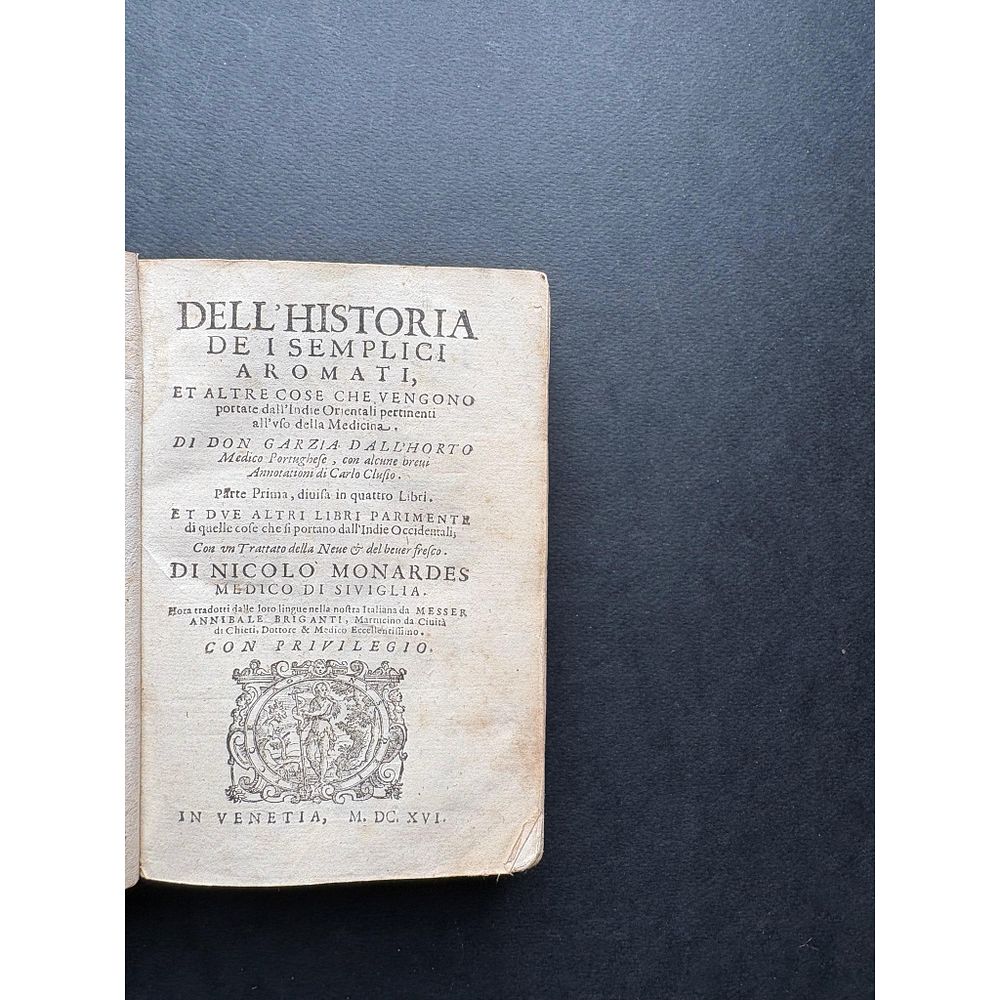
[BOTANY & NATURAL HISTORY] - ORTA, Garcia da (c. 1501–1568) – MONARDES, Nicolás (c. 1512–1588) - Dell'historia de i semplici aromati - ORTA, Garcia da (c. 1501–1568) – MONARDES, Nicolás (c. 1512–1588) Dell’historia de i semplici aromati, et altre cose che vengono portate dall’Indie Orientali pertinenti all’uso della medicina. Di Don Garzia dall’Horto ... con alcune brevi annotationi di Carlo Clusio. [Together with:] Delle cose che vengono portate dall’Indie Occidentali pertinenti all’uso della medicina ... di Nicolò Monardes; con un trattato della neve & del bever fresco. Translated into Italian by Annibale Briganti. Venice: Giovanni Salis, 1616. 8vo. [32], 525, [3] pp. Woodcut printer’s device on title, ornamental initials and numerous woodcut illustrations throughout the text, depicting medicinal plants, fruits and other natural substances from Asia and the Americas. Contemporary vellum, manuscript title to spine. A very attractive copy, without significant defects. AN IMPORTANT EARLY-SEVENTEENTH-CENTURY ITALIAN EDITION OF TWO OF THE FOUNDATIONAL WORKS ON THE MEDICINAL PLANTS, DRUGS AND NATURAL PRODUCTS OF ASIA AND THE NEW WORLD — INCLUDING THE CELEBRATED EARLY ACCOUNT AND WOODCUT OF TOBACCO. This remarkable volume brings together two fundamental sources for European knowledge of exotic materia medica: Garcia da Orta’s pioneering study of the drugs and medicinal plants of India and Nicolás Monardes’s celebrated account of the natural products arriving in Europe from the Americas. Garcia da Orta had spent many years in Portuguese India, principally at Goa, where he studied local plants and drugs at first hand and questioned Indian physicians, merchants and practitioners concerning their properties and medical uses. His Colóquios dos simples e drogas da India, first published at Goa in 1563, was the first major European work devoted to Indian materia medica and one of the earliest scientific books printed in Asia. Unlike many earlier European writers on oriental drugs, Orta relied extensively upon personal observation and direct contact with indigenous medical knowledge. He discusses such commodities as cinnamon, pepper, cloves, nutmeg, cardamom, ginger, tamarind and numerous other substances which had entered European commerce but whose origins and medicinal properties remained imperfectly understood. The work also contains important observations on diseases encountered in India, including the celebrated description of cholera, and has consequently been recognised as a landmark in the early history of tropical medicine. The Italian text derives from Charles de l’Écluse (Carolus Clusius), whose Latin abridgement and annotations were instrumental in disseminating Orta’s discoveries throughout Europe. Annibale Briganti subsequently translated this material into Italian, thereby making it accessible to a broader medical and pharmaceutical readership. Bound into the same volume is the equally important work of the Sevillian physician Nicolás Monardes, devoted to the medicines and natural substances newly arriving from the West Indies and the Americas. Monardes discusses products that were transforming European pharmacy and commerce, including tobacco, guaiacum, sassafras, various gums, resins, medicinal roots and bezoar stones. His reports constitute some of the earliest substantial European medical discussions of these New World substances. Of particular importance is the substantial chapter “Del tabaco, & sue grandi virtù” (pp. 388–406), accompanied by a large woodcut of the tobacco plant. Monardes describes its cultivation and medicinal uses and records Native American practices associated with the plant. The woodblock employed in the present edition was derived from that used in the Venetian edition of 1575 and remains one of the most celebrated early printed representations of tobacco. The volume also contains Monardes’s fascinating treatise on snow and cold drinks, examining the medical effects and practical use of ice and chilled beverages — a subject of considerable contemporary interest in Mediterranean medicine and social life. Taken together, the works of Orta and Monardes form an extraordinary record of the globalisation of materia medica during the sixteenth century. Asian spices and medicinal plants, American drugs and indigenous remedies entered European medical discourse through direct observation, colonial travel and an expanding international trade in natural products. The 1616 edition contains 28 woodcut illustrations, including representations derived from earlier editions of both Orta and Monardes, and thus combines textual testimony with an important visual record of exotic medicinal plants and commodities. The present copy is particularly appealing in its contemporary vellum binding with manuscript spine title, remaining clean, genuine and without significant defects. A HANDSOME CONTEMPORARY-BOUND COPY OF A FUNDAMENTAL WORK IN THE HISTORY OF PHARMACY,