Bidspirit auction | [BOTANY & NATURAL HISTORY] -
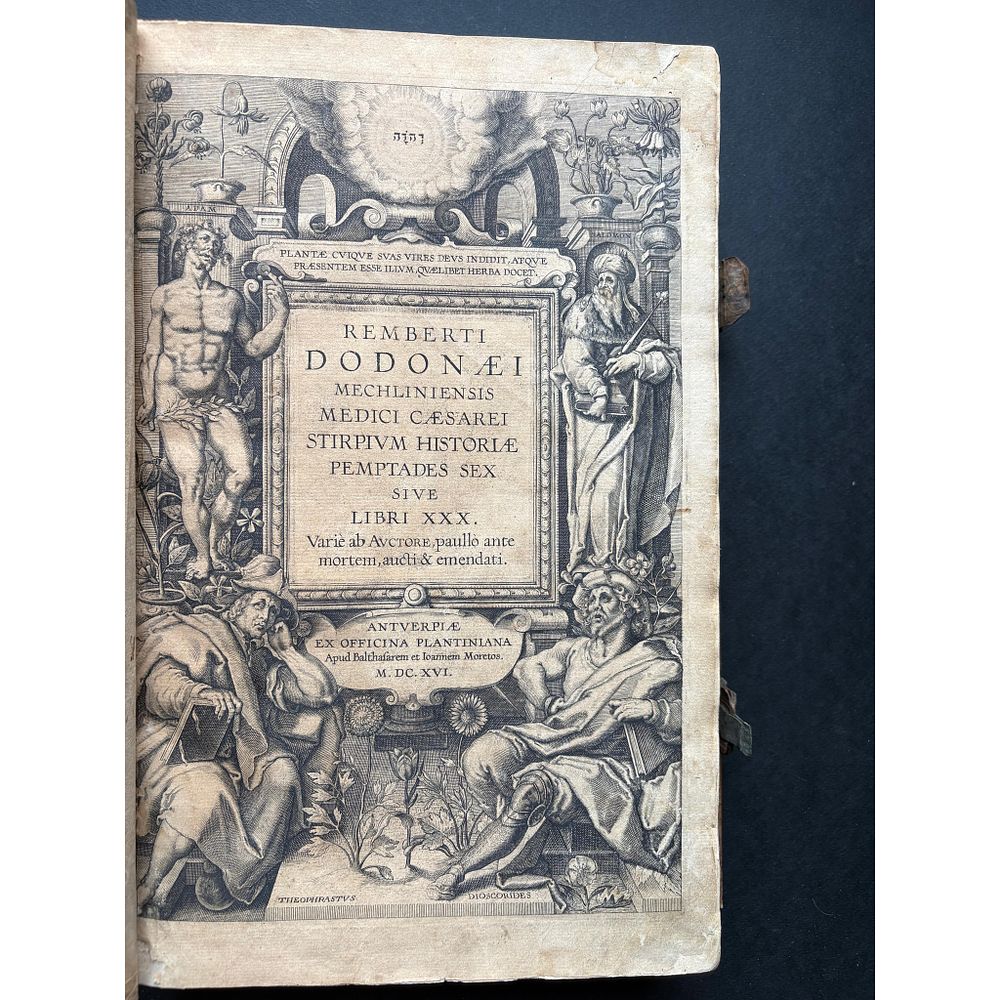
[BOTANY & NATURAL HISTORY] - DODOENS, Rembert (1517–1585) - Stirpium historiae pemptades sex - DODOENS, Rembert (1517–1585). Stirpium historiae pemptades sex, sive libri XXX. Varie ab auctore, paullo ante mortem, aucti & emendati. Antwerp: Ex Officina Plantiniana, apud Balthasarem et Ioannem Moretos, 1616. THE BEST, REVISED AND ENLARGED EDITION OF DODOENS’ LAST AND MOST COMPREHENSIVE BOTANICAL WORK, PROFUSELY ILLUSTRATED WITH THE CELEBRATED PLANTIN BOTANICAL WOODCUTS. Folio (350 × 220 mm). [14], 872, [66] pp. Fine engraved architectural title-page; more than 1,300 woodcuts of plants throughout the text; Plantin’s woodcut device at the end. Some browning, largely due to the quality of the paper; discreet early restorations to leaves 2–4, otherwise a good copy. Contemporary blind-stamped pigskin over wooden boards, gauffered edges; catches lacking. SECOND AND DEFINITIVE EDITION, substantially revised and enlarged from the first edition of 1583, of what Hunt describes as Dodoens’ “last and most comprehensive botanical work.” THE CULMINATION OF DODOENS’ BOTANICAL WORK Rembert Dodoens was one of the great Flemish botanists of the sixteenth century, together with Carolus Clusius and Matthias de Lobel, and one of the most influential figures in the development of Renaissance botany. The Stirpium historiae pemptades sex represents the culmination of more than three decades of botanical study. It incorporated, reorganised and greatly expanded material from Dodoens’ earlier works, including the celebrated Cruydeboeck of 1554, and presented his botanical knowledge in a comprehensive Latin synthesis intended for an international scholarly readership. The work is divided into six pemptades, or groups of five books, and reflects Dodoens’ continuing attempt to impose greater order upon the immense variety of the plant world. Although still rooted in the traditional medicinal and descriptive approach inherited from Dioscorides and other ancient authors, Dodoens moved increasingly towards a more systematic consideration of botanical affinities and plant morphology. The Pemptades consequently occupies an important position in the long development from the Renaissance herbal towards a more recognisably systematic science of botany. THE PLANTIN BOTANICAL WOODCUTS The exceptional richness of its illustration is one of the great attractions of the book. The edition contains more than 1,300 woodcuts, representing one of the most extensive programmes of botanical illustration produced by the Plantin press. Bibliographical authorities differ slightly in their enumeration: Christie’s records 1309 woodcuts, while Anderson’s count, cited by Christie’s, gives 1341. A substantial proportion of the blocks were produced by or after the designs of Pieter van der Borcht, one of the leading botanical illustrators associated with Christopher Plantin. Plantin had also acquired earlier blocks connected with editions of Dodoens and other botanists, thereby assembling an extraordinary visual archive which could be reused and expanded across his great botanical publications. The result is not simply an illustrated herbal, but one of the most ambitious visual records of European plant knowledge produced before the great botanical publications of the later seventeenth century. A GREAT PLANTIN–MORETUS BOTANICAL BOOK The 1616 edition was issued by Balthasar and Jan Moretus, heirs to Christopher Plantin’s celebrated Antwerp printing house. Its magnificent engraved architectural title derives from the plate originally used for Clusius’ Rariorum plantarum historiaof 1601 and was adapted for the present work. The composition includes figures associated with the ancient and biblical traditions of natural history, within an architectural framework surrounded by plants. The volume thus brings together two of the defining achievements of the Plantin–Moretus press: sophisticated scholarly typography and an extraordinary corpus of botanical illustration. THE DEFINITIVE EDITION The 1616 Pemptades became the principal form in which Dodoens’ mature botanical work was transmitted to later generations. It contains corrections and additions made by the author before his death and adds illustrations not present in the 1583 edition. For this reason it has traditionally been regarded as the definitive and most desirable edition of the work. Hunt specifically characterises it as the “best revised and enlarged edition.” Its importance lies not only in the scale of the text but also in the combination of authoritative botanical description, systematic ambition and one of the richest collections of Renaissance plant illustrations ever assembled in a single volume. The present copy is especially appealing for retaining its handsome contemporary blind-stamped pigskin binding over wooden boards with gauffered edges, giving the volume the imposing appearance appropriate to one of the monumental botanical productions of the Plantin tradition.