Bidspirit auction | [BOTANY & NATURAL HISTORY] -
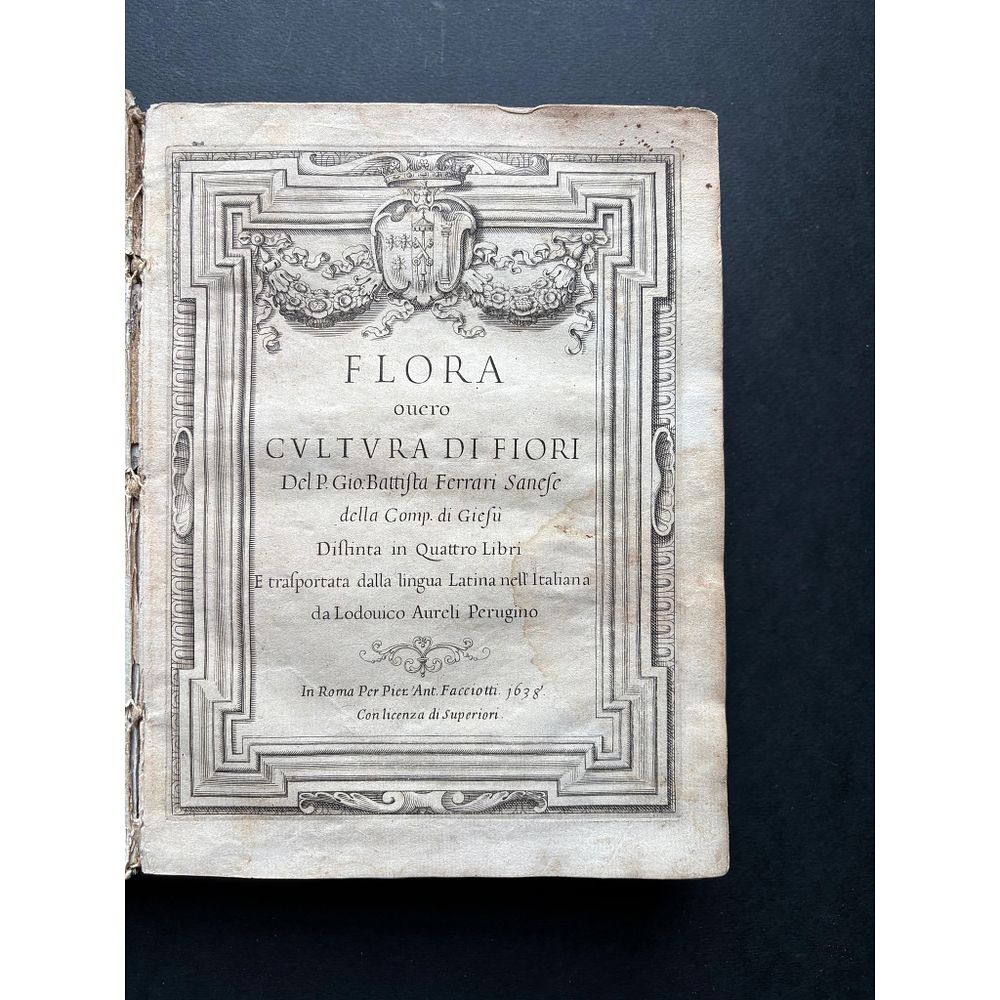
[BOTANY & NATURAL HISTORY] - FERRARI, Giovanni Battista (1584–1655) - Flora overo Cultura di fiori - ***Note: This lot is located in Italy and requires an Italian export licence. We will manage the full application process for you. An additional fee of £50 applies.*** FERRARI, Giovanni Battista (1584–1655). Flora overo Cultura di fiori del P. Gio. Battista Ferrari sanese della Compagnia di Giesù, distinta in quattro libri e trasportata dalla lingua latina nell’italiana da Lodovico Aureli Perugino. Rome: Pier Antonio Facciotti, 1638. 4to (228 × 174 mm). [16], 520, [28] pp. Engraved title with the arms of Anna Colonna Barberini, to whom the Italian edition is dedicated; allegorical engraved frontispiece bound before p. 1; 45 further full-page engraved plates depicting flowers, garden plans, horticultural instruments and floral compositions. Contemporary vellum. Some staining to the engraved title, defect affecting the plate at p. 407, occasional light browning; otherwise a complete and attractive copy. First Italian edition, translated by Lodovico Aureli from Ferrari’s De florum cultura of 1633. One of the most beautiful and influential illustrated books devoted to flowers and ornamental gardening in seventeenth-century Italy, and a remarkable synthesis of botany, horticulture, garden design and Baroque visual culture. Giovanni Battista Ferrari, Jesuit scholar and botanist closely connected with the Barberini circle in Rome, conceived the work as a complete guide to the cultivation and aesthetic use of flowers. The text is divided into four books dealing respectively with the planning and equipment of gardens, the characteristics of individual flowers, their propagation and cultivation, and finally their ornamental and decorative uses. Ferrari treats the flower garden not merely as a botanical collection but as a carefully designed environment in which science, architecture and visual display converge. The work discusses garden layouts, horticultural tools, soils, bulbs and propagation, while also describing roses, lilies, narcissi, anemones, tulips and a number of exotic plants recently introduced into European cultivation. Particularly significant are the references to plants from the New World and to specimens cultivated in the Barberini gardens, evidence of the rapid expansion of European botanical knowledge during the seventeenth century. The magnificent engraved illustrations are central to the importance of the book. They include formal garden plans, horticultural implements, individual plants, elaborate arrangements of flowers in vases and baskets, and allegorical representations of Flora. The visual programme belongs fully to the artistic world of Baroque Rome. The designs for the principal allegorical plates were supplied by leading artists associated with the Roman Baroque, including Andrea Sacchi, Guido Reni and Pietro da Cortona, and were engraved by Johann Friedrich Greuter and Claude Mellan. Anna Maria Vaiani, artist and correspondent of Galileo, also contributed to the illustrative programme. The collaboration of artists of such distinction transforms the Flora from a practical horticultural manual into one of the major illustrated botanical books of its period. The volume is also important in the history of garden design. Ferrari’s engraved plans present the geometrically ordered garden as an extension of architecture, with flowerbeds, paths, fountains and ornamental arrangements forming a unified visual composition. In this respect the book provides an exceptional record of the ideals of the Italian Baroque garden. The 1638 edition is the first in Italian, following the Latin De florum cultura published in Rome in 1633. By translating the work into the vernacular, Lodovico Aureli considerably broadened its readership and helped establish Ferrari’s treatise as an important reference for gardeners, collectors and lovers of flowers beyond the learned Latin-reading world. The present edition contains an engraved title and forty-six full-page engraved illustrations in all, including the allegorical frontispiece, matching the standard bibliographical description of the work. A highly attractive first Italian edition of one of the great seventeenth-century books on flowers and garden culture, combining practical horticulture with the artistic language of the Roman Baroque and distinguished by an exceptional series of engravings after some of the leading artists of the age. References: Nissen BBI 620; Pritzel 2877; Cicognara 2030; Graesse II, 571; De Backer-Sommervogel III, 678.