Bidspirit auction | [BOTANY & NATURAL HISTORY] -
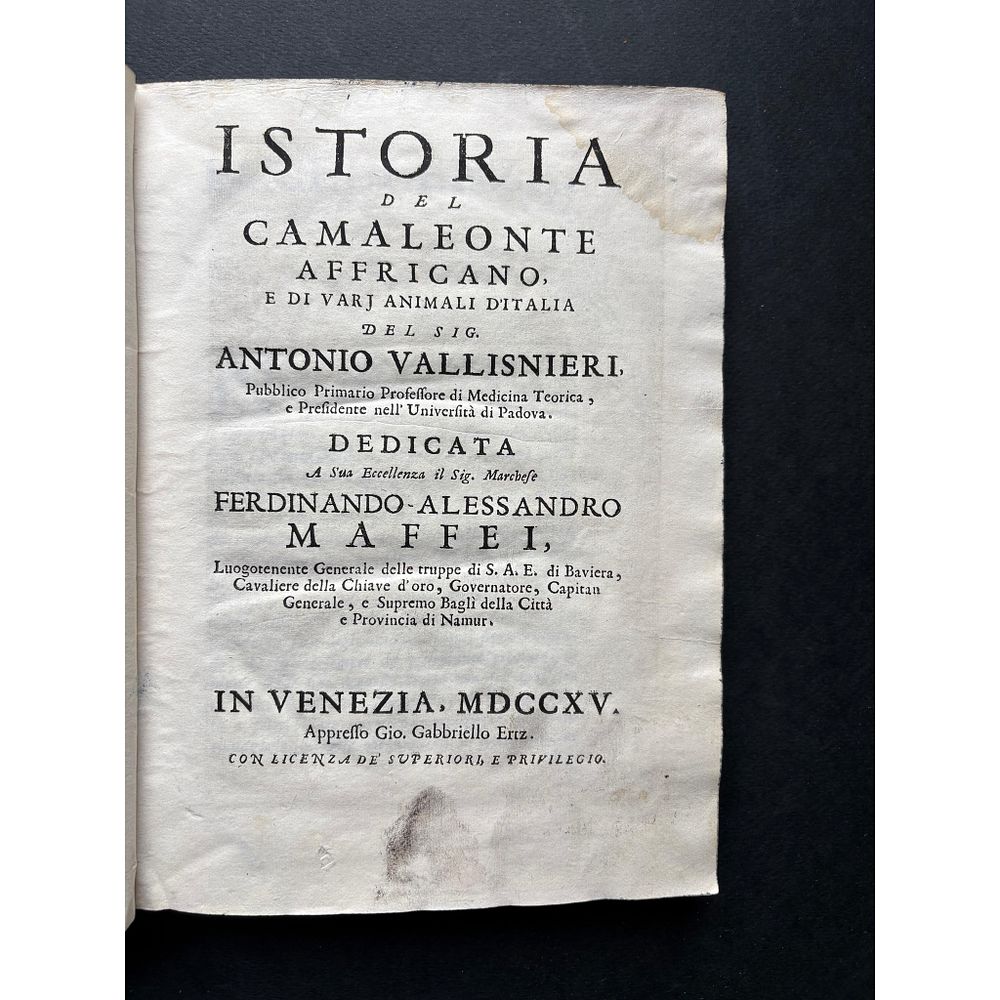
[BOTANY & NATURAL HISTORY] - VALLISNERI, Antonio (1661–1730) - Opere diverse del sig. Antonio Vallisnieri - VALLISNERI, Antonio (1661–1730). Opere diverse del sig. Antonio Vallisnieri, cioè: I. Istoria del Camaleonte Affricano, e di varj Animali d’Italia. II. Lezione Accademica intorno all’Origine delle Fontane. III. Raccolta di varj Trattati accresciuti con Annotazioni, e con Giunte. Venice: Giovanni Gabriele Hertz, 1715. Three parts in two volumes, 4to (238 × 173 mm). [12], 200 pp.; [8], 87, [1] pp.; [4], 261, [3] pp. Engraved portrait of the author in the first volume and 29 engraved plates, mostly folding, illustrating zoological, anatomical and natural-historical subjects. Contemporary vellum, manuscript titles to spines, sprinkled edges. Ex-libris. Small wormhole affecting a few leaves and some light staining towards the end of one volume; otherwise a handsome set. First edition of this important collection of scientific writings by Antonio Vallisneri, one of the leading Italian naturalists and physicians of the early eighteenth century and a major representative of the experimental tradition derived from Galileo, Redi and the Accademia del Cimento. The Opere diverse bring together three substantial investigations covering zoology, hydrology, comparative anatomy and natural history, and offer an excellent demonstration of Vallisneri’s insistence upon direct observation and experiment rather than the repetition of inherited authority. The first part, Istoria del Camaleonte Affricano, is an exceptionally detailed experimental study of the African chameleon and other animals. Vallisneri examined living specimens obtained through his friend and fellow naturalist Diacinto Cestoni, recording their anatomy, feeding habits, behaviour and celebrated ability to change colour. The question of the chameleon’s changing appearance allowed Vallisneri to engage directly with contemporary theories of light and colour, including those associated with Malebranche and Newton. The result is one of the most remarkable early eighteenth-century examples of a traditional zoological curiosity being subjected to systematic experimental investigation. The same section also incorporates Cestoni’s observations on the kermes insect, an organism of considerable scientific and commercial importance because of the brilliant red dye extracted from it. The second part, Lezione Accademica intorno all’Origine delle Fontane, is among Vallisneri’s most important contributions to the emerging science of hydrology. Drawing upon extensive personal observations made during arduous journeys through the Tuscan-Emilian Apennines and the mountains of Garfagnana, Vallisneri attacked the long-established theory that perennial springs were supplied by seawater passing through subterranean channels and being filtered or distilled within mountains. Instead, he argued on empirical grounds that springs derive essentially from precipitation, snow and ice infiltrating the earth and subsequently re-emerging at lower levels. This explanation represented a significant step towards the modern understanding of the hydrological cycle. Vallisneri’s combination of field observation, geological reasoning and experimental evidence has made the Lezione a particularly celebrated example of the Galilean method applied to the study of the Earth. The third and largest section, Raccolta di varj Trattati, gathers and expands a series of Vallisneri’s scientific investigations previously dispersed through learned journals. These essays range across zoology, entomology, anatomy, medicine and natural history and demonstrate the remarkable breadth of his scientific interests. Vallisneri was professor of medicine at the University of Padua and one of the most influential Italian naturalists of his generation. Throughout his career he opposed explanations based upon spontaneous generation and inherited scholastic doctrine, insisting instead upon repeated observation, experiment and the close study of living organisms in their natural environment. The engraved plates are an essential component of the work, providing detailed visual documentation of anatomical structures, animals, insects and natural phenomena and reinforcing the strongly empirical character of Vallisneri’s investigations. The Opere diverse of 1715 consequently occupy an important position in the development of Enlightenment natural science in Italy: they record the passage from Renaissance natural history towards a more rigorous experimental and observational science of living organisms and of the physical Earth. A handsome set in contemporary vellum of the first edition of one of Vallisneri’s principal scientific collections, richly illustrated and encompassing some of his most significant work in zoology and hydrology.