Bidspirit auction | [ARCHITECTURE, ENGINEERING & TECHNOLOGY] -
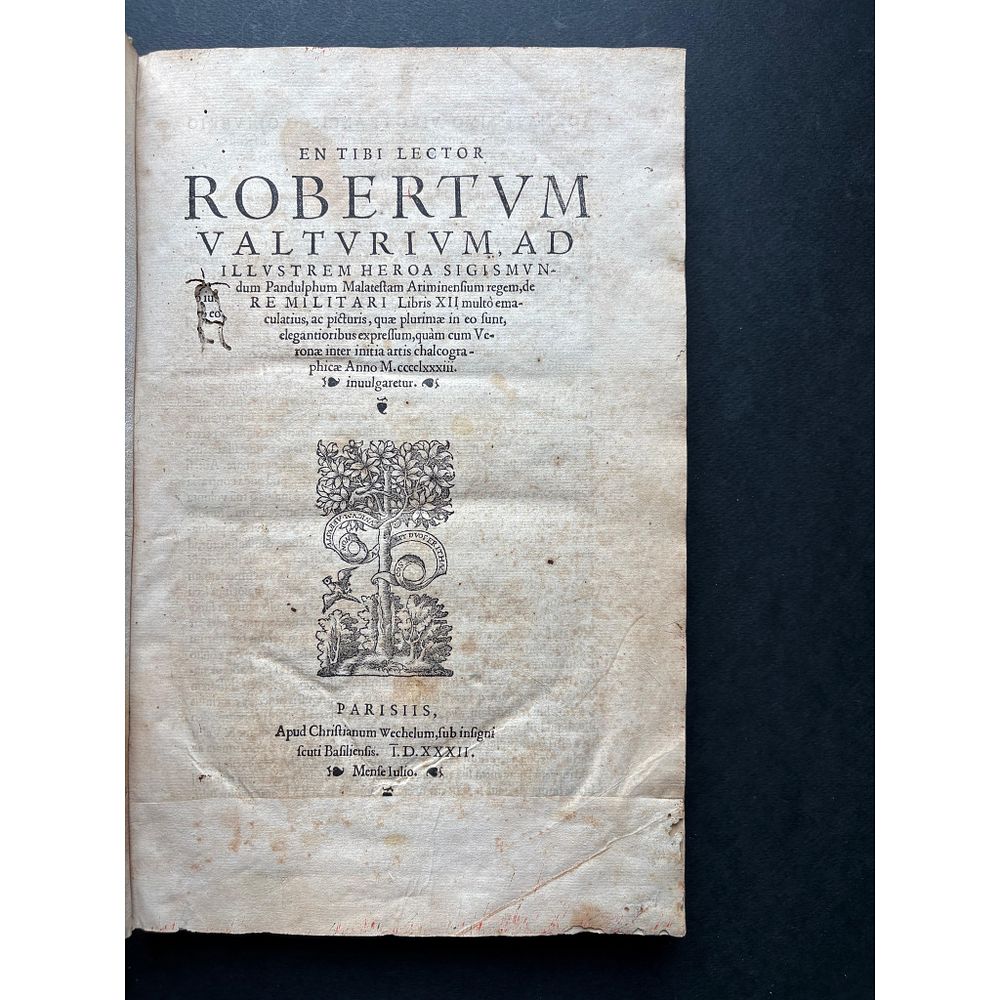
[ARCHITECTURE, ENGINEERING & TECHNOLOGY] - VALTURIO, Roberto (1413–1483) - De re militari libris XII - VALTURIO, Roberto (1413–1483) De re militari libris XII, multo emaculatius, ac picturis, quae plurimae in eo sunt, elegantioribus expressum… Paris: Christian Wechel, July 1532. Folio, [12], 383, [1] pp. With approximately one hundred woodcut illustrations (97 recorded), many full-page, together with the printer’s device. Contemporary full vellum. FIRST EDITION OF VALTURIO’S CELEBRATED WORK TO BE PRINTED IN FRANCE, AND ONE OF THE GREAT ILLUSTRATED MILITARY BOOKS OF THE SIXTEENTH CENTURY. Valturio’s De re militari, originally published at Verona in 1472, is one of the earliest printed treatises devoted to military science and technology. Written for Sigismondo Pandolfo Malatesta, it describes the organisation and conduct of warfare while devoting particular attention to military machines, fortifications, artillery, bridges, siege engines and other ingenious devices. The present Paris edition, printed by Christian Wechel, is especially important for its extraordinary programme of woodcut illustration. The blocks are reversed copies of those employed for the celebrated Verona edition of 1483 and reproduce the remarkable machines described by Valturio, combining ancient military technology with Renaissance inventions and imaginative reconstructions. The illustrations include catapults, siege engines, bridges, artillery, naval devices and other mechanical constructions. The copy is in a notably fresh state, retaining the contemporary full-vellum binding. There is a wormhole affecting the first eight leaves, continuing through the upper margin of several subsequent leaves and eventually appearing towards the outer margin; the damage remains marginal and does not affect the printed text. Minor age-toning and occasional staining, consistent with the age of the book. A particularly attractive copy of this important French Renaissance edition, remarkable for its extensive series of technical woodcuts and for its place in the early printed history of military engineering and mechanical invention.