Bidspirit auction | [ARCHITECTURE, ENGINEERING & TECHNOLOGY] -
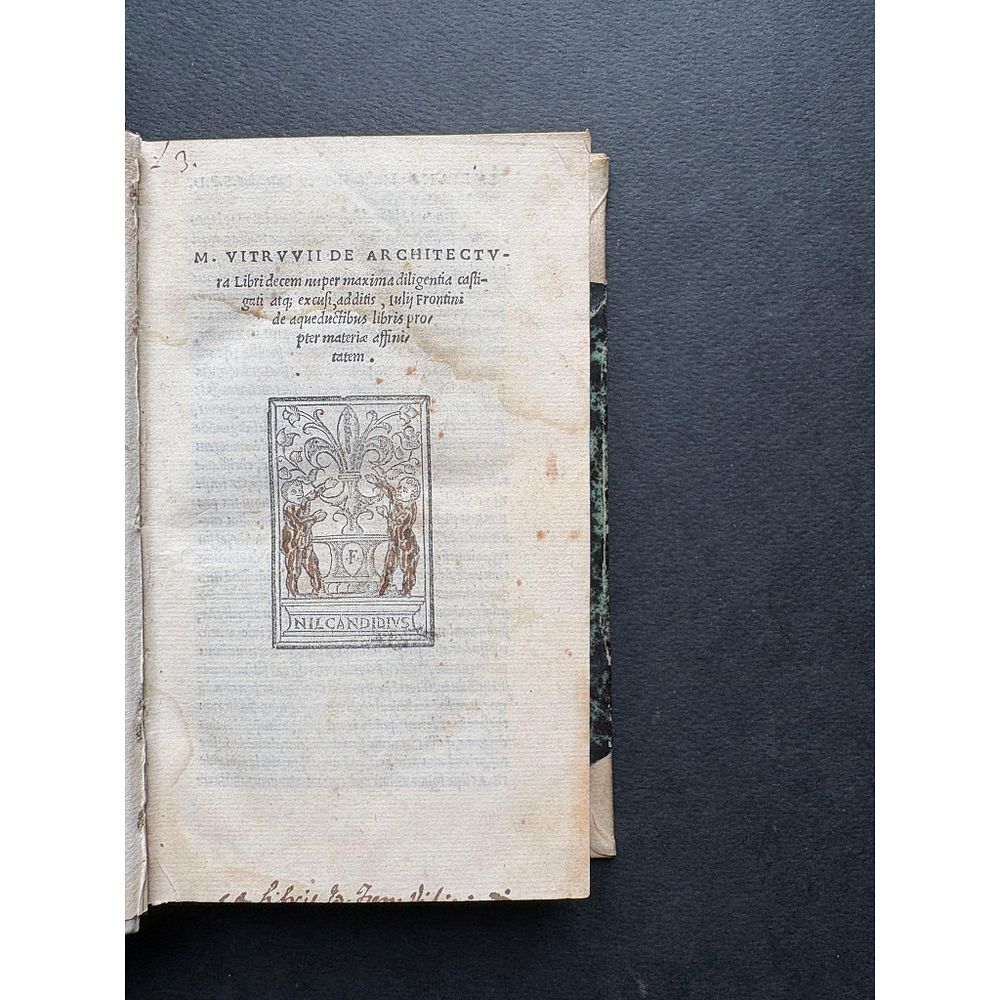
[ARCHITECTURE, ENGINEERING & TECHNOLOGY] - VITRUVIUS POLLIO, Marcus (fl. 1st century BC) - M. Vitruvii De architectura libri decem - VITRUVIUS POLLIO, Marcus (fl. 1st century BC). M. Vitruvii De architectura libri decem nuper maxima diligentia castigati atque excusi, additis Iulii Frontini De aquaeductibus libris propter materiae affinitatem. Florence: Heirs of Filippo Giunta, 1522. 8vo. 192, 24, [20] leaves. Printed predominantly in italic type, with numerous woodcut diagrams and illustrations throughout; Giunta device on the title-page and at the end of the Vitruvian text. Five of the woodcut illustrations bear manuscript annotations and additional sketches in pen. Nineteenth-century binding, with title on a red leather label to the spine. AN IMPORTANT EARLY RENAISSANCE EDITION OF THE FOUNDATIONAL TEXT OF WESTERN ARCHITECTURE, EDITED IN THE TRADITION OF FRA GIOVANNI GIOCONDO AND ILLUSTRATED WITH THE WOODCUTS CREATED FOR THE FIRST GREAT ILLUSTRATED VITRUVIUS. WITH FRONTINUS’ CLASSICAL TREATISE ON THE AQUEDUCTS OF ROME. Vitruvius’ De architectura is the only substantial architectural treatise to have survived from classical antiquity and one of the most influential technical texts ever written. Composed during the age of Augustus, its ten books encompass virtually the entire theoretical and practical world of the ancient architect: the education and responsibilities of the architect, the planning of cities, temples and public buildings, systems of proportion, the classical orders, building materials and construction methods, domestic architecture, water supply, astronomy, surveying, machinery and military engineering. Its rediscovery and dissemination during the Renaissance fundamentally altered the development of European architecture. For architects and humanists seeking to recover the principles of antiquity, Vitruvius offered not simply a record of ancient building practice but an intellectual system in which architecture was grounded in mathematics, geometry, proportion, nature and the human body. His concepts became central to the architectural culture of Renaissance Italy and ultimately to the classical tradition throughout Europe. The present Florence edition of 1522 belongs to the extraordinarily influential editorial tradition established by the Veronese architect, engineer and humanist Fra Giovanni Giocondo (1433–1515). Giocondo's Venetian edition of 1511 was a landmark in the history of architectural publishing: the first illustrated edition of Vitruvius. Confronted with a notoriously difficult and frequently corrupt ancient text, Giocondo combined philological scholarship with his own practical experience as an architect and engineer, supplying an extensive series of woodcuts intended not merely to decorate Vitruvius but to make his descriptions intelligible to practising architects, engineers and readers. The illustrations transformed the printed reception of De architectura. Architectural plans and details, systems of proportion, construction techniques, hydraulic devices, surveying instruments and machines were translated into visual form, creating one of the earliest systematic relationships between architectural text and technical illustration in Renaissance printing. A reduced-format edition was subsequently printed by Filippo Giunta in Florence in 1513. The present 1522 edition, printed by Giunta’s heirs, retains the woodcut blocks of that edition while presenting the Vitruvian text in a newly set italic type. More significantly, modern bibliographical study has demonstrated that the text was revised and improved rather than simply reprinted unchanged from the 1513 edition. The presence in the present copy of manuscript additions and sketches in pen to five of the printed woodcuts is particularly evocative. Whether made by an architect, builder or learned reader, these interventions demonstrate the practical manner in which illustrated editions of Vitruvius could be studied: the printed diagrams serving as points of departure for further graphic thought. They give this copy an individual character as a working rather than merely collected architectural book. Of particular significance is the addition, already announced on the title-page, of Sextus Julius Frontinus’ De aquaeductibus urbis Romae. Written by the Roman senator and administrator who served as curator aquarum under the emperor Nerva, Frontinus’ treatise is the principal surviving ancient account of the Roman aqueduct system. It describes the sources, routes, dimensions, capacities, maintenance and administration of the aqueducts that supplied imperial Rome, preserving an extraordinary record of one of antiquity’s greatest engineering achievements. The decision to print Frontinus together with Vitruvius was therefore intellectually deliberate — as the title itself explains, propter materiae affinitatem, “on account of the affinity of the subject matter.” Vitruvius’ theoretical and technical treatment of water,