Bidspirit auction | [ARCHITECTURE, ENGINEERING & TECHNOLOGY] -
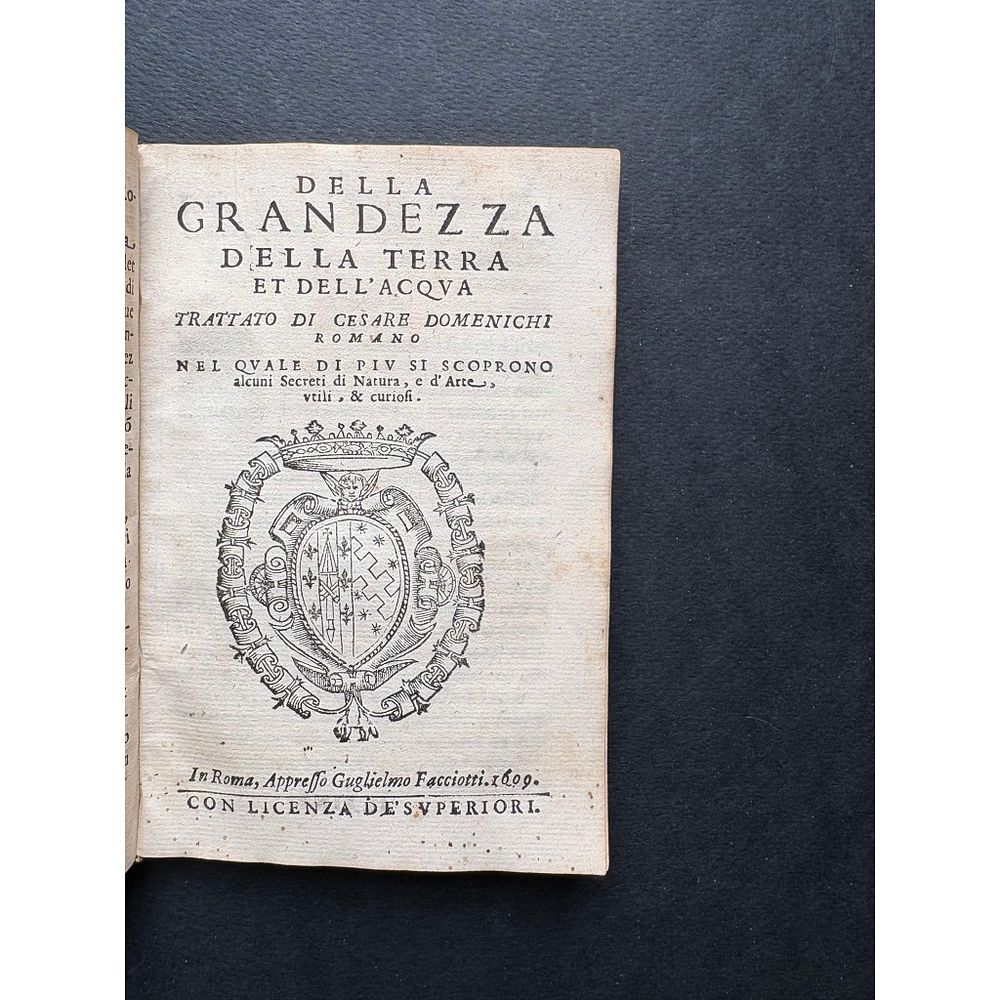
[ARCHITECTURE, ENGINEERING & TECHNOLOGY] - DOMENICHI, Cesare. - Della innondatione del Tevere et del suo rimedio - ***Note: This lot is located in Italy and requires an Italian export licence. We will manage the full application process for you. An additional fee of £50 applies.*** DOMENICHI, Cesare. Della innondatione del Tevere et del suo rimedio. Trattato di Cesare Domenichi Romano. Rome: Guglielmo Facciotto, 1609. 8vo. 40 pp. Bound with: DOMENICHI, Cesare. Della grandezza della terra et dell’acqua. Trattato di Cesare Domenichi Romano, nel quale di più si scoprono alcuni secreti di natura, e d’arte utili, & curiosi. Rome: Guglielmo Facciotto, 1609. 8vo. 72 pp. Two rare Roman scientific treatises of 1609, closely related in conception, in which Cesare Domenichi moves from the practical problem of controlling the floods of the Tiber to broader questions of hydraulics, physical geography, natural philosophy and optics. The first work, Della innondatione del Tevere et del suo rimedio, belongs to the intense technical and political debate that followed the catastrophic flood of Rome on 24 December 1598, one of the most destructive inundations in the city’s early modern history. Domenichi examines and rejects several contemporary explanations for the recurrent flooding of the Tiber. He questions theories that attributed the phenomenon to extraordinary inflows from distant tributaries, to the waters descending from the region of Rieti and the Marmore, or to the action of the sirocco wind. He likewise criticizes a number of proposed engineering solutions, including the artificial lowering of the riverbed, the diversion of part of the river, the enlargement of bridge arches and the straightening of the Tiber’s course. In their place he advances a strikingly ambitious hydraulic project. Above Ponte Molle, modern Ponte Milvio, he proposes the construction of a large artificial channel, sufficiently wide and deep to receive the excess waters of the Tiber and conduct them by a shorter route towards the sea. He further envisages a substantial barrier across the valley near the bridge, pierced by arches through which the ordinary river flow would pass, while exceptional floodwaters would be restrained and redirected. The treatise is therefore much more than a contemporary account of a natural disaster. It is an early seventeenth-century contribution to the long history of attempts to regulate the Tiber and protect Rome through large-scale hydraulic engineering. The work was sufficiently significant to be included in modern historical exhibitions devoted specifically to the floods of the Tiber. The second work, Della grandezza della terra et dell’acqua, develops several of the physical questions raised in the earlier treatise and broadens them into a discussion of the relative proportions of land and water on the globe. From problems of rivers and seas Domenichi proceeds to more general investigations concerning the structure of the natural world. As the title itself announces, the book also reveals a number of “secrets of nature and art”, moving beyond hydrography into problems of physics and optics. Read together, the two works reveal an author characteristic of the scientific culture of the late Renaissance: practical engineering questions lead naturally to broader speculation concerning the physical constitution of the Earth, the behaviour of water and the observation of natural phenomena. Their publication in Rome by Guglielmo Facciotto is also significant. Facciotto was one of the principal Roman printers of the period and issued several works dealing with the Tiber in the years following the disastrous flood of 1598; Treccani specifically records Domenichi’s 1609 treatise among his publications on the subject. A rare and highly appealing pair of early seventeenth-century Roman scientific works, documenting contemporary attempts to understand and control the Tiber while also illustrating the close relationship between hydraulic engineering, physical geography and natural philosophy in the age immediately preceding the Scientific Revolution.