Bidspirit auction | [ARCHITECTURE, ENGINEERING & TECHNOLOGY] -
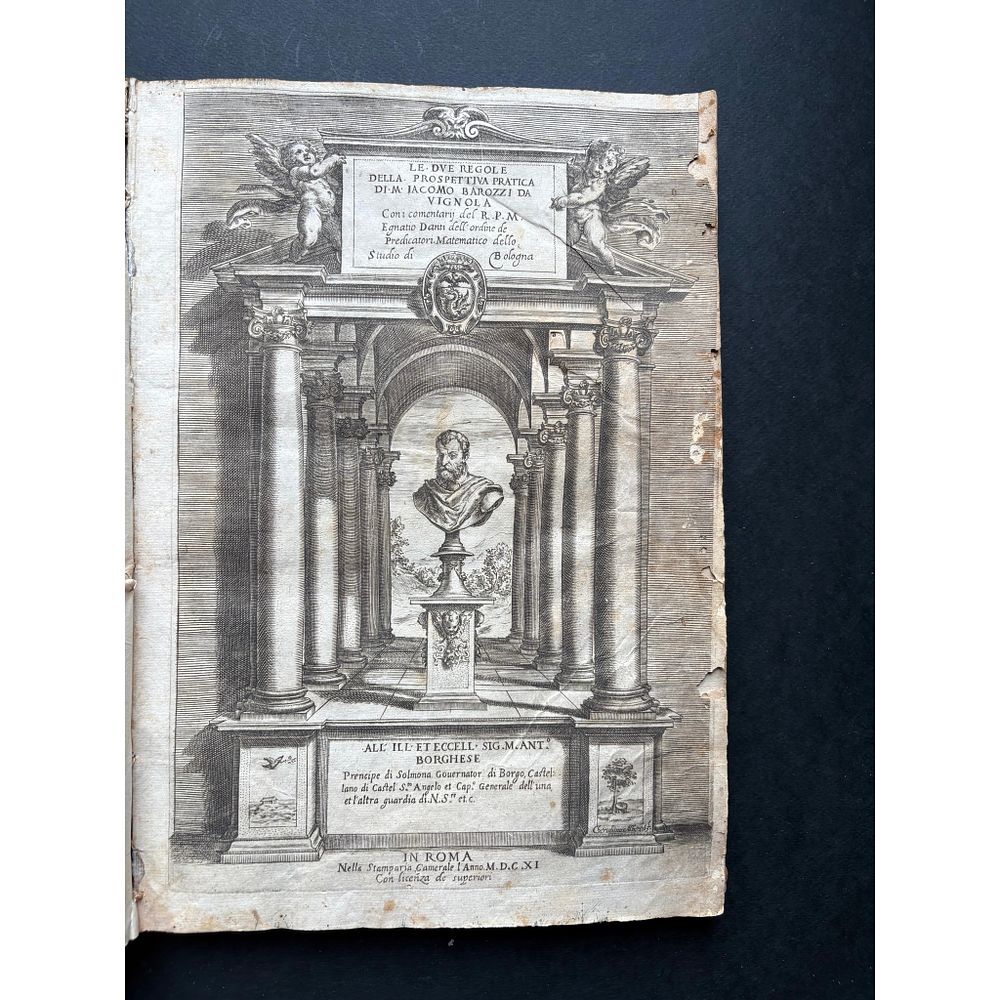
[ARCHITECTURE, ENGINEERING & TECHNOLOGY] - VIGNOLA, Giacomo Barozzi da (1507–1573) - Le due regole della prospettiva pratica - ***Note: This lot is located in Italy and requires an Italian export licence. We will manage the full application process for you. An additional fee of £50 applies.*** VIGNOLA, Giacomo Barozzi da (1507–1573). Le due regole della prospettiva pratica di M. Iacomo Barozzi da Vignola, con i commentarii del R. P. M. Egnatio Danti dell’Ordine de’ Predicatori, matematico dello Studio di Bologna. Rome: Stamperia Camerale, 1611. Folio (345 × 245 mm). Engraved title by Cherubino Alberti, eight full-page engraved plates and numerous geometrical and perspective illustrations in the text. Contemporary vellum, with minor losses. Wormholes to the margin of the title; old repair to the lower margin of leaf O with loss of a few letters; some dampstaining to the inner margins of several leaves. Provenance: Marabitti, early ownership inscription. Second edition, revised and enlarged from the first edition of 1583. An important and extensively illustrated Renaissance treatise on perspective by Giacomo Barozzi da Vignola, enlarged and substantially developed through the commentary of the Dominican mathematician, astronomer and cosmographer Egnazio Danti. The work presents Vignola’s practical system for the construction of linear perspective, reducing the subject to two principal rules and offering a method intended to be both geometrically rigorous and readily applicable by painters, architects and draughtsmen. Vignola’s approach was notable for its clarity and economy. Rather than multiplying geometrical procedures, he sought to provide a concise and practical method for determining recession, diminution and the correct projection of forms in space. His system favours the controlled construction of one-point perspective and the use of the principal and distance points as the essential tools of pictorial representation. The first edition appeared posthumously in Rome in 1583 under the supervision of Egnazio Danti. Danti did far more than merely prepare Vignola’s text for publication: his extensive commentary places the practical rules within a broader mathematical and theoretical framework, discussing optics, geometry, the nature of vision and the relationship between the eye, the picture plane and represented space. The 1611 edition preserves and further consolidates this enlarged form of the work. WorldCat describes the treatise as an authoritative summary of sixteenth-century perspective theory, while the Metropolitan Museum records both Vignola and Danti as the central intellectual figures behind the edition. The engraved and woodcut illustrations are essential to the book. They transform abstract geometrical principles into visual demonstrations and provide practical models for the construction of receding pavements, architectural forms, planes and spatial relationships. The engraved title, designed with the elegance characteristic of Roman late-Renaissance book production, was executed by Cherubino Alberti, one of the leading engravers of the period. Vignola’s treatise occupies an important place in the history of architectural and artistic theory. Together with his Regola delli cinque ordini d’architettura, it contributed decisively to the codification of visual and architectural practice and remained influential well into the seventeenth century. A rare and important second edition of one of the fundamental Renaissance treatises on practical perspective, distinguished by Egnazio Danti’s extensive mathematical commentary and by its rich and highly instructive illustrative apparatus.