Bidspirit auction | [ARCHITECTURE, ENGINEERING & TECHNOLOGY] -
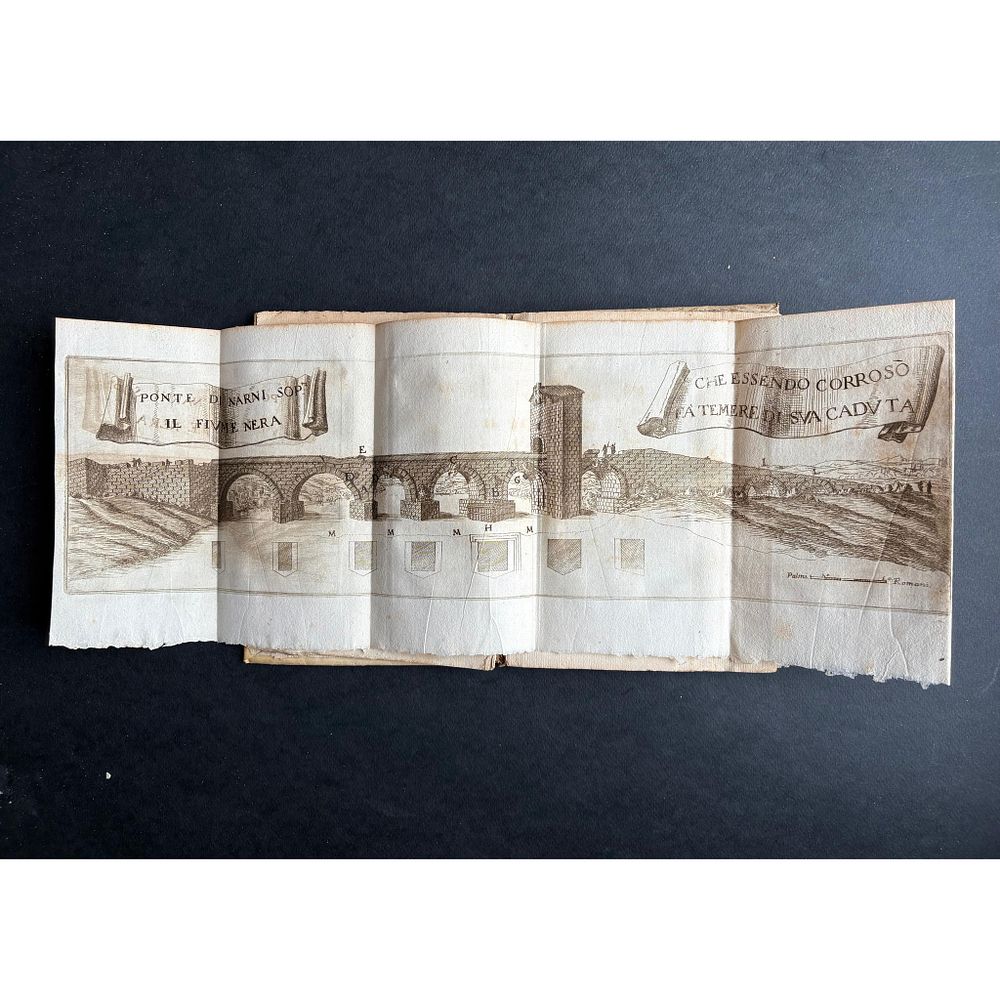
[ARCHITECTURE, ENGINEERING & TECHNOLOGY] - MARTINELLI, Agostino. - Descrittione di diversi ponti esistenti sopra li fiumi Nera e Tevere - ***Note: This lot is located in Italy and requires an Italian export licence. We will manage the full application process for you. An additional fee of £50 applies.*** MARTINELLI, Agostino. Descrittione di diversi ponti esistenti sopra li fiumi Nera, e Tevere, con un discorso particolare della navigatione da Perugia a Roma. Rome: Nicolò Angelo Tinassi, 1676. 4to (205 × 150 mm). [8], 58, [2] pp. Woodcut ornament on title; engraved portrait frontispiece of Pope Innocent XI Odescalchi, the dedicatee; with an extensive series of engraved and woodcut plates, most folding, illustrating bridges, river courses, hydraulic works and topographical features along the Nera and Tiber. The plates are associated with Agostino Martinelli, Alberto Gnoli and Michel Angelo Marinari. Contemporary vellum, with losses to spine. A few wormholes to the inner margin of the first gathering and occasional light browning. The plates exceptionally fresh and well preserved. First edition. A rare and remarkably illustrated seventeenth-century work on bridge construction, hydraulic engineering and river navigation, documenting the principal bridges and waterways along the Nera and Tiber from Umbria towards Rome. Martinelli’s investigation originated in a practical engineering emergency: the deteriorating condition of the bridge over the Nera near Narni, described as so badly eroded that its collapse was feared. From this immediate problem he expanded his study into a broader examination of the river system, recording the principal bridges that facilitated communication across the Nera and Tiber and analysing their construction, condition and relationship with the surrounding landscape. The result is one of the most attractive Italian books on bridge engineering of the later seventeenth century. Its numerous plates combine architectural elevation, hydraulic observation and topographical description, preserving valuable visual evidence for structures that were subsequently altered, damaged or destroyed. Among the most striking illustrations are those devoted to the bridges around Narni, including the remains of the celebrated Roman bridge traditionally associated with Augustus, as well as the dramatic representation of the Cascata delle Marmore near Terni. Other plates record bridges along the Tiber and structures approaching and within Rome itself. Martinelli’s interests extended well beyond antiquarian description. He was concerned with the practical behaviour of rivers, the effects of currents upon foundations, the deterioration and repair of bridge structures and the possibilities offered by hydraulic intervention. The work therefore provides direct evidence of contemporary Italian civil-engineering practice at a period when control of waterways was fundamental to transport, agriculture and territorial administration. Of particular importance is the concluding Discorso della navigatione da Perugia a Roma. Here Martinelli considers the possibility of exploiting the connected waterways of Umbria and Lazio as a navigable route towards Rome, placing the study within the broader seventeenth-century ambition to improve internal communication through the engineering of rivers and canals. The finely executed plates are central to the importance of the book. Far from being merely decorative, they constitute a technical and topographical record of bridges, foundations, riverbeds, diversions and hydraulic landscapes, and reveal much about contemporary methods of surveying and structural analysis. The work was dedicated to Pope Innocent XI, whose portrait opens the volume, appropriately placing Martinelli’s project within the context of papal concern for roads, bridges, rivers and territorial infrastructure. A rare and visually compelling first edition, particularly desirable for the exceptionally fresh state of its plates, combining architecture, engineering, hydrology and topography in one of the most important seventeenth-century illustrated studies of the bridges and waterways of central Italy. References: Cicognara 940; Vinciana 1667; Riccardi II, 122–123; Rossetti 6710.