Bidspirit auction | [ARCHITECTURE, ENGINEERING & TECHNOLOGY] -
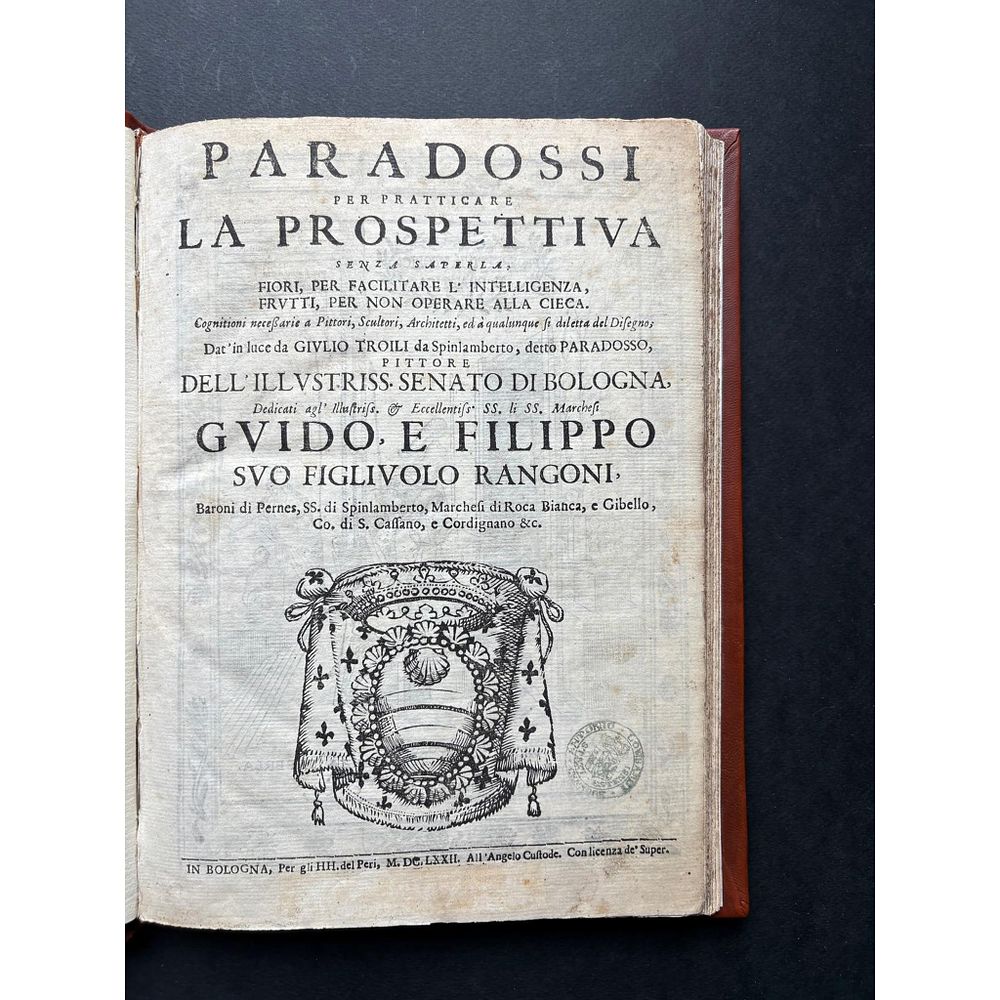
[ARCHITECTURE, ENGINEERING & TECHNOLOGY] - TROILI, Giulio (1613–1685) - Paradossi per pratticare la prospettiva senza saperla - ***Note: This lot is located in Italy and requires an Italian export licence. We will manage the full application process for you. An additional fee of £50 applies.*** TROILI, Giulio (1613–1685) Paradossi per pratticare la prospettiva senza saperla. Fiori, per facilitare l'intelligenza, frutti, per non operare alla cieca. Cognitioni necessarie à pittori, scultori, architetti, ed à qualunque si diletta di disegno. Bologna: per gli HH. del Peri, 1672; [Part III:] Bologna: Gioseffo Longhi, 1683. Folio (290 × 200 mm). 3 parts in one volume. [8], 120; [4], 64 pp. Woodcut arms of the dedicatees, the Marchesi Guido and Filippo Rangoni, on the first title, additional woodcut title, printer's device to the title of the third part, 68 full-page woodcut illustrations in all, together with diagrams and tables, the majority of the principal perspective illustrations set within elaborate decorative borders of fruit and flowers; woodcut initials and tailpieces. Occasional minor staining, otherwise internally a good and exceptionally complete copy. Modern leather binding. Provenance: Antonio Lombardi (1768–1847), Estense censor, ownership stamp. FIRST EDITION OF PARTS I–II, BOUND WITH THE FIRST EDITION OF THE THIRD PART, published eleven years later in 1683. An exceptionally complete copy of one of the landmarks in the history of architectural perspective and Baroque theatrical scenography, combining the original 1672 edition of Troili's first two parts with the separately issued first edition of the third part of 1683. The Fowler catalogue records precisely this 1672–1683 configuration and describes the work as comprising three parts and 98 leaves; the first two parts were subsequently reissued together with the third in 1683. Giulio Troili, known as “Il Paradosso”, was a painter, architect and specialist in perspective whose treatise sought to transform the geometrical theory of perspective into a practical working method for painters, architects, sculptors and theatrical designers. Published in Bologna in 1672, the Paradossi combined theoretical principles with direct, workshop-based instruction, demonstrating perspective through a remarkable sequence of large and highly legible woodcuts. The importance of the work lies particularly in its application of perspective to painted architecture and theatrical scenery. Rather than restricting himself to the representation of regular geometrical solids, Troili addressed the problems created when fictive architecture extended beyond the ideal optical cone of the spectator and explored the manipulation of space required to create convincing architectural illusion. Modern scholarship has stressed both the scientific and practical character of the treatise and its importance for quadratura and stage design. The book is particularly celebrated for its treatment of theatrical perspective. Troili describes the deliberate manipulation of the spectator's vision and the creation of an impression of increased depth by the oblique disposition of scenic wings, techniques that were already established in theatrical practice decades before Andrea Pozzo's celebrated perspective treatise. Contemporary bibliography has consequently described the work as one of the milestones in the development of theatrical scenery. Troili's influence was considerable. Ferdinando Galli Bibiena studied perspective under him, and University of Bologna scholarship identifies Troili as a master of both Ferdinando and Francesco Galli Bibiena, whose subsequent innovations in angled and multi-point perspective were to transform European Baroque stage design. The superb series of woodcuts gives the volume an importance extending well beyond the history of mathematical perspective. Geometrical constructions are translated into architecture, columns, vaults, interiors, gardens, fortifications and stage settings, often enlivened by diminutive human figures and framed by exuberant floral and fruit borders. The result is at once a technical manual and one of the most visually engaging Italian books on perspective of the seventeenth century. The third part, here in its first edition of 1683, extends Troili's investigations to subjects including shadows and fortification and completes the theoretical and practical programme begun in 1672. Fowler specifically records the third part as separately titled and notes that the first two parts were reissued with it later in the same year. A particularly desirable copy, preserving the original 1672 first edition of the first two parts together with the first edition of the third part of 1683: the complete form of one of the most influential and richly illustrated seventeenth-century Italian treatises on perspective, architectural illusion and theatrical scenography.