Bidspirit auction | [ARCHITECTURE, ENGINEERING & TECHNOLOGY] -
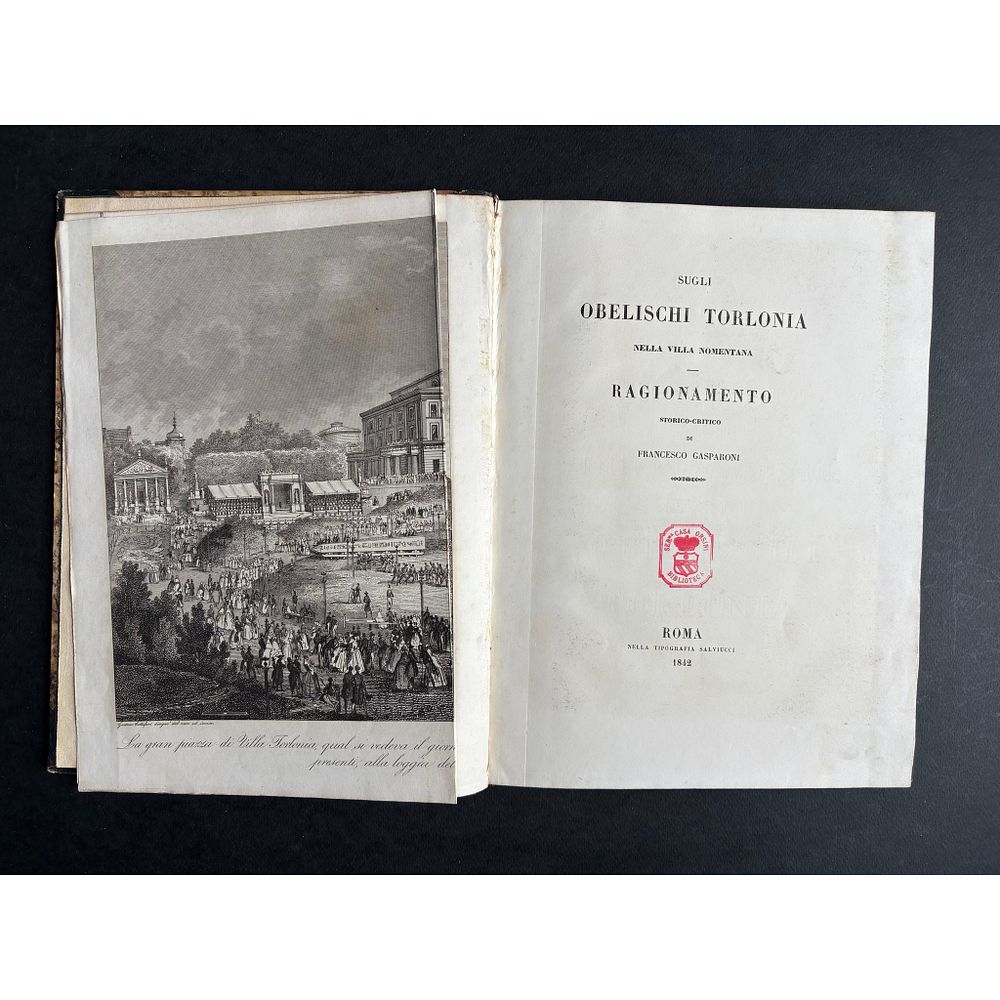
[ARCHITECTURE, ENGINEERING & TECHNOLOGY] - GASPARONI, Francesco (1802–1865) - Sugli obelischi Torlonia nella Villa Nomentana - ***Note: This lot is located in Italy and requires an Italian export licence. We will manage the full application process for you. An additional fee of £50 applies.*** GASPARONI, Francesco (1802–1865). Sugli obelischi Torlonia nella Villa Nomentana. Ragionamento storico-critico. Rome: Tipografia Salviucci, 1842. 4to (295 × 220 mm). [8], 81, [3] pp. Large folding engraved frontispiece by Gaetano Cottafavi depicting the ceremonial raising of the first obelisk at Villa Torlonia on 4 June 1842, together with 17 engraved plates, three of them folding, illustrating the quarrying, transport, preparation and erection of the two monuments. Plates protected by tissue guards. Contemporary half morocco over marbled paper boards, the Torlonia arms in morocco at the centre of the covers; spine richly gilt and lettered, marbled endpapers. Light rubbing, particularly to joints and extremities; occasional light foxing and some browning to the tissue guards. Provenance: Casa Orsini, private stamp on title. First edition. A rare and richly illustrated account of one of the most remarkable engineering and ceremonial enterprises undertaken in nineteenth-century Rome: the construction, transport and erection of the two monumental granite obelisks commissioned by Prince Alessandro Torlonia for the family villa on the Via Nomentana. The obelisks were conceived as memorials to Alessandro Torlonia’s parents, Giovanni Torlonia and Anna Maria Schultheiss. Rather than reusing ancient monuments, the prince commissioned two enormous new monoliths in red granite quarried at Baveno on Lake Maggiore, deliberately evoking the monumental language of ancient Egypt and imperial Rome. Gasparoni records the entire undertaking in detail, from the extraction and working of the granite to the extraordinary logistical operation required to bring the monoliths to Rome. The obelisks travelled from Baveno across Lake Maggiore, through canals and waterways to the Po, then by sea around the Italian peninsula and finally up the Tiber before being transported overland to Villa Torlonia. The engraved plates form an exceptional visual record of this operation. They illustrate the quarry at Baveno, the transportation of the massive stones by water and land, the technical apparatus devised for moving and raising them, and the final monuments in the grounds of the villa. The most spectacular image is the large folding frontispiece drawn and engraved by Gaetano Cottafavi. It depicts the crowded piazza of Villa Torlonia on 4 June 1842 at the moment when the first obelisk was raised, in the presence of Pope Gregory XVI and King Ludwig I of Bavaria. The engraving transforms an engineering operation into a great public spectacle and provides a vivid record of aristocratic and papal Rome during the nineteenth century. The bases of the obelisks were designed by the architect Quintiliano Raimondi, while the hieroglyphic inscriptions were composed by the Egyptologist Luigi Maria Ungarelli. Nicola Carnevali devised the machinery used for the erection of the monoliths. The work therefore occupies an unusual position at the intersection of architecture, engineering, Egyptomania and aristocratic self-representation. The obelisks were modern monuments executed in conscious imitation of antiquity, while their transport and erection demonstrated the technical capabilities of contemporary engineering. The present copy is particularly attractive for its contemporary binding bearing the Torlonia arms, directly linking the volume to the family whose great architectural enterprise it celebrates. A handsome and complete first edition of this richly illustrated record of one of nineteenth-century Rome’s most ambitious private monumental projects, preserving all 18 engraved plates and retaining a contemporary armorial binding associated with the Torlonia family. References: Graesse III, 33; Rossetti 5272; Schudt 1133.