Bidspirit auction | [ARCHITECTURE, ENGINEERING & TECHNOLOGY] -
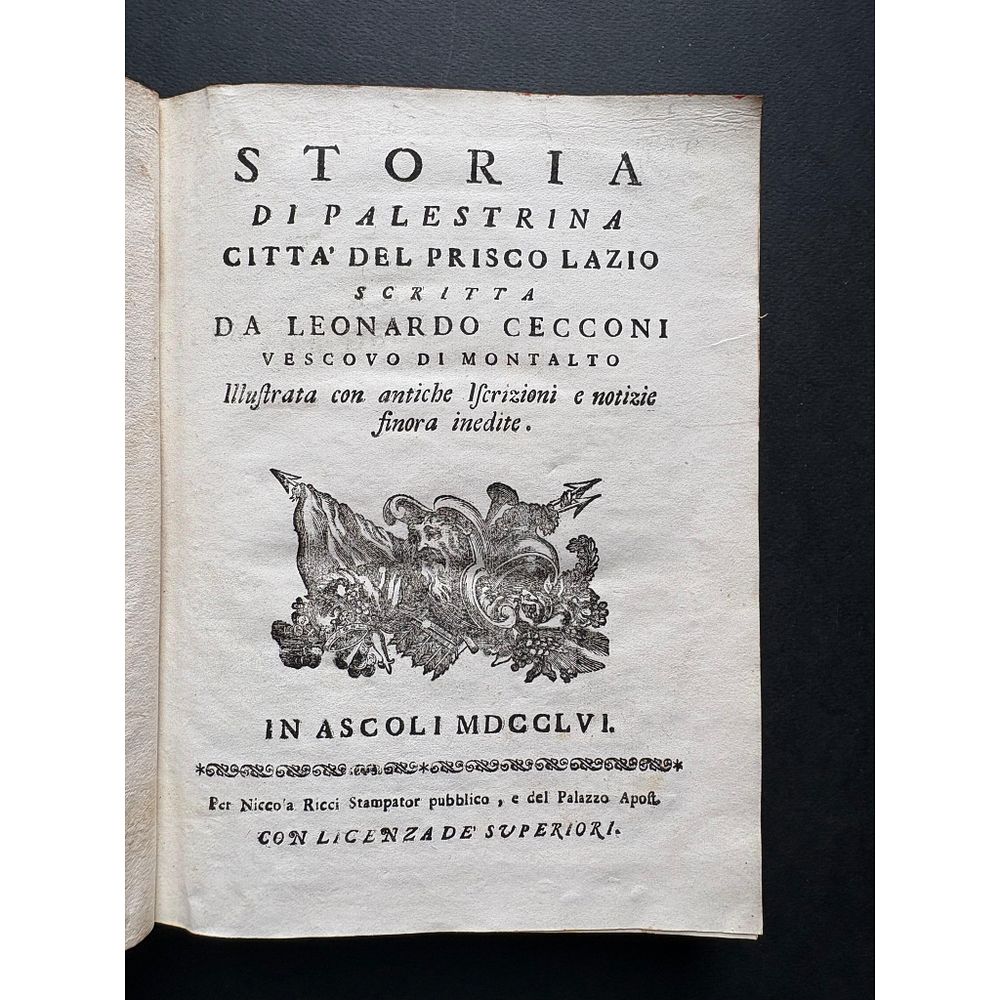
[ARCHITECTURE, ENGINEERING & TECHNOLOGY] - CECCONI, Leonardo (1691–1774) - Storia di Palestrina città del prisco Lazio - ***Note: This lot is located in Italy and requires an Italian export licence. We will manage the full application process for you. An additional fee of £50 applies.*** CECCONI, Leonardo (1691–1774). Storia di Palestrina città del prisco Lazio, illustrata con antiche iscrizioni e notizie finora inedite. Ascoli: Nicola Ricci, Stampatore Pubblico e del Palazzo Apostolico, 1756. 4to (230 × 170 mm). XVI, 431, [5] pp. Woodcut vignette on title, woodcut initials and tailpieces, with a large folding topographical map of the ancient and modern territory of Palestrina. After gathering b4 is preserved an unpaginated and unsigned bifolium containing the dedication of the topographical map commissioned by the author’s brother, together with a sonnet addressed to him. Contemporary vellum, gilt title to spine, red marbled edges. Tiny wormtracks to rear cover and minor defects. Large folding map with a tiny tear at inner margin; some light staining, browning and foxing. First edition. A fundamental eighteenth-century history of Palestrina and ancient Praeneste, written by Leonardo Cecconi, Bishop of Montalto and a native of the city. Cecconi’s work was the first substantial history of Palestrina to appear in Italian and remains an important source for the antiquities, monuments, inscriptions, ecclesiastical history and local traditions of one of the most celebrated cities of ancient Latium. Drawing upon earlier Latin antiquarian scholarship as well as local archives, inscriptions and direct observation, Cecconi attempted to reconstruct the history of Praeneste from antiquity through the medieval and modern periods. The work is especially valuable for its detailed treatment of the ancient city: its roads, temples, priesthoods, forum, basilicas, theatre, amphitheatre, villas and, above all, the Sanctuary of Fortuna Primigenia, whose monumental remains dominate the history and archaeology of Palestrina. The large folding map of the “Territorio Prenestino antico e moderno” provides an important visual synthesis of the region and is one of the principal attractions of the volume. The survival in the present copy of the additional bifolium relating to the dedication of the map is a notable bibliographical feature. Cecconi’s Storia is also an important witness to the eighteenth-century reception of works of art preserved at Palestrina. It contains the earliest known literary reference to the celebrated sculptural group later known as the Pietà di Palestrina, which Cecconi records in the Barberini chapel of Santa Rosalia and describes as an “abbozzo del celebre Buonarroti.” The passage would play a significant role in the later history of the sculpture’s attribution. Bound with the volume: CECCONI, Luigi (1772–1843). Aggiunta all’opuscolo del pavimento in musaico rinvenuto nel tempio della Fortuna Prenestina. Rome: Francesco Bourlié, 1828. An uncommon archaeological supplement devoted to the celebrated mosaic discovered at Palestrina and traditionally associated with the Sanctuary of Fortuna Primigenia. The work formed part of the lively nineteenth-century debate surrounding the interpretation of the great Nilotic mosaic, one of the most extraordinary survivals of Hellenistic-Roman mosaic art. Luigi Cecconi’s study belongs to the early scholarly literature devoted to the monument and was issued as an addition to his 1827 work Del pavimento in musaico rinvenuto nel tempio della Fortuna Prenestina. The Getty Research Institute records the Aggiunta bound with the preceding study and identifies its subject explicitly with the Temple of Fortuna Primigenia and the Nile Mosaic of Palestrina. Together, the two works form a particularly appropriate antiquarian ensemble devoted to Palestrina: Leonardo Cecconi’s great eighteenth-century historical survey of ancient and modern Praeneste, complemented by Luigi Cecconi’s nineteenth-century archaeological investigation of one of the city’s most celebrated monuments. A handsome and historically significant copy in contemporary vellum, complete with the large folding map and preserving the additional bifolium associated with its dedication. References: Lozzi 3331 (“Non comune”); Ranghiasci, p. 134.