Bidspirit auction | [ANTIQUITIES, ARCHAEOLOGY & FINE ARTS]
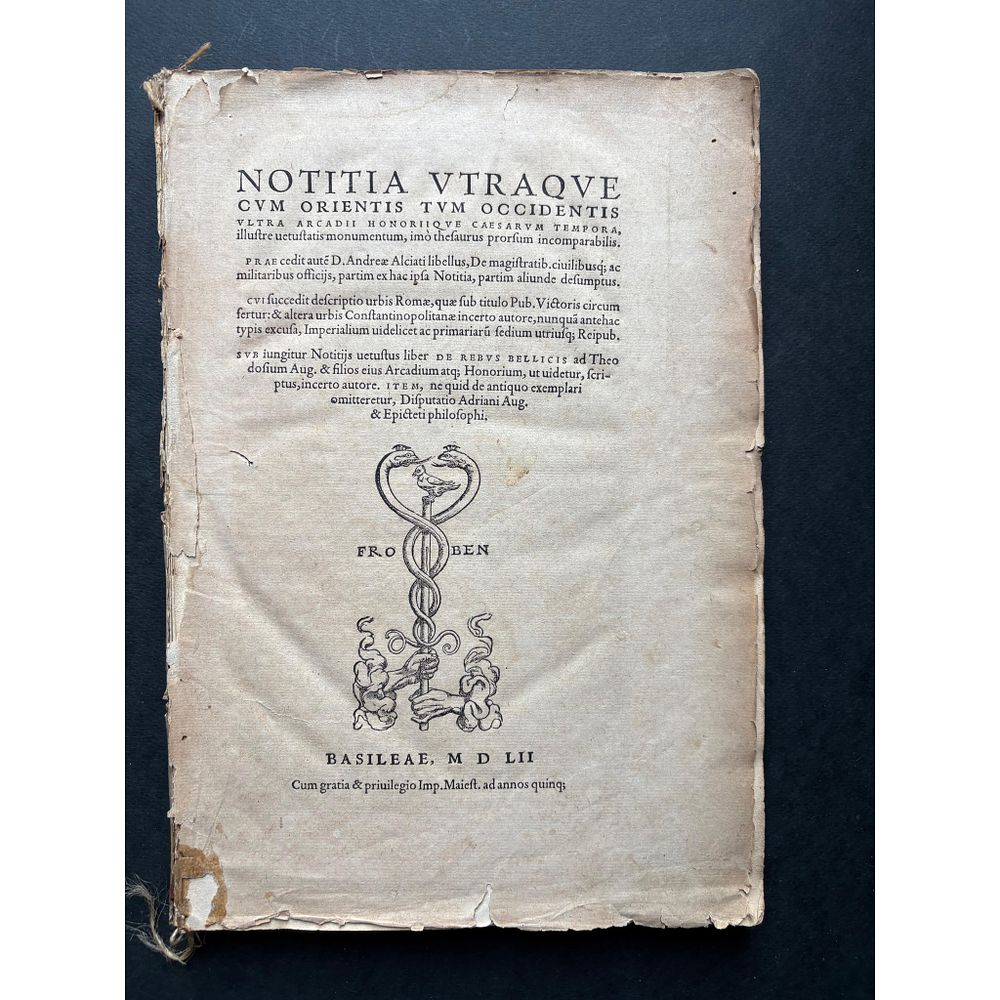
[ANTIQUITIES, ARCHAEOLOGY & FINE ARTS] - GELENIUS, Sigismund (1497–1554) - Notitia utraque cum Orientis tum Occidentis - GELENIUS, Sigismund (1497–1554), editor Notitia utraque cum Orientis tum Occidentis ultra Arcadii Honoriiq[ue] Caesarum tempora… Basel: Hieronymus Froben and Nicolaus Episcopius, 1552. Folio, [108] leaves, profusely illustrated with woodcuts. Contemporary vellum binding. IMPORTANT 1552 EDITION OF THE NOTITIA DIGNITATUM, ONE OF THE MOST IMPORTANT ILLUSTRATED SOURCES FOR THE ADMINISTRATIVE AND MILITARY ORGANIZATION OF THE LATE ROMAN EMPIRE. Edited by the distinguished Basel humanist Sigismund Gelenius, this edition brings together the Notitia dignitatum, the fundamental late-antique record of the civil and military hierarchy of the Eastern and Western Roman Empires, together with a remarkable group of related antiquarian and topographical texts. Among these are Andrea Alciati’s De magistratibus civilibus ac militaribus officiis, descriptions of Rome and Constantinople, the late-antique De rebus bellicis, and the Disputatio Adriani Augusti et Epicteti philosophi. The importance of the volume lies not only in the texts preserved but also in its extraordinary illustrative programme, comprising numerous woodcuts depicting Roman insignia, military equipment, buildings, costumes and other aspects of ancient life. The illustrations are among the most distinctive manifestations of Renaissance antiquarian interest in the material culture of the Roman world. Printed in Basel by Hieronymus Froben and Nicolaus Episcopius, the volume belongs to the great tradition of illustrated humanist printing established by the Froben press. The woodcuts transform the Notitia from a purely textual record into a visual reconstruction of Roman institutions and military organization, making the book an important monument of sixteenth-century antiquarian scholarship. The present copy is incomplete, with 106 leaves present, lacking leaves r3 and r4. The title-page is detached from the text block. The contemporary vellum binding is defective and lacks the front board. Despite these defects, the substantial surviving text and the extensive series of woodcuts make this a notable surviving example of the 1552 Basel edition. An important Renaissance edition of one of the principal documentary sources for the late Roman Empire, particularly valuable for its extensive cycle of woodcut illustrations and its role in the sixteenth-century recovery and visualization of Roman antiquity.