Bidspirit auction | [ANTIQUITIES, ARCHAEOLOGY & FINE ARTS]
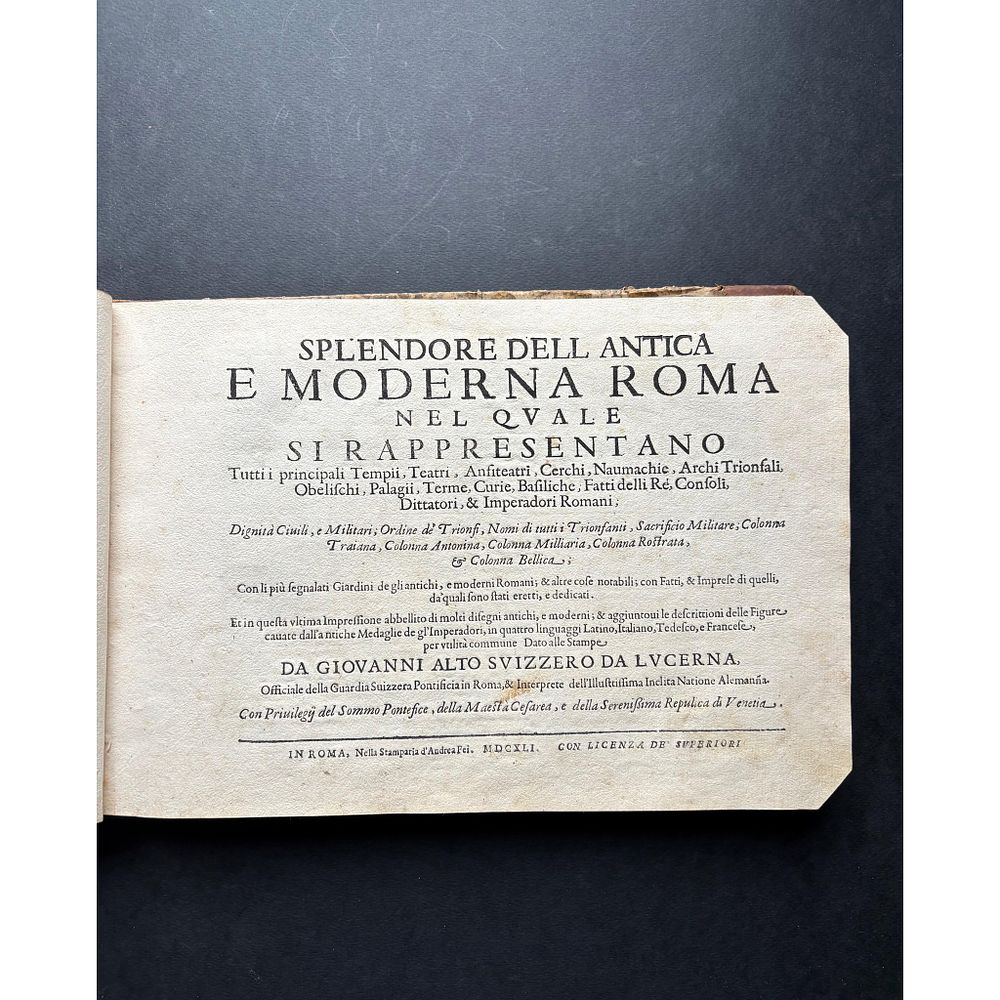
[ANTIQUITIES, ARCHAEOLOGY & FINE ARTS] - LAURO, Giacomo (c. 1583–c. 1650) - Antiquae Urbis Splendor - ***Note: This lot is located in Italy and requires an Italian export licence. We will manage the full application process for you. An additional fee of £50 applies.*** LAURO, Giacomo (c. 1583–c. 1650) Antiquae Urbis Splendor. Rome: [Andrea Fei], [seventeenth century; engraved title dated 1612]. Oblong 4to (226 × 330 mm). 4 parts two volume. 167 numbered engraved plates and 4 additional unnumbered plates or leaves, including the dedication to Pope Urban VIII. The series comprises engraved titles and an extensive sequence of views and reconstructions of the monuments of ancient and modern Rome, each accompanied by explanatory captions. Small loss to the blank margin of the dedication leaf, a wormhole in the lower blank corner of the first leaves of the second part, occasional staining. Eighteenth-century half calf with corners over woodblock-decorated paper boards. AN EXCEPTIONALLY COMPLETE COPY OF GIACOMO LAURO’S CELEBRATED MONUMENTAL SURVEY OF ANCIENT AND MODERN ROME, ONE OF THE MOST IMPORTANT AND INFLUENTIAL SEVENTEENTH-CENTURY SERIES OF ROMAN VIEWS. Lauro devoted many years to the creation of this extraordinary visual compendium of the Eternal City. Published in successive parts, the work combines archaeological reconstruction, topographical observation and antiquarian scholarship to present Rome both as the capital of the ancient world and as the monumental city inherited and transformed by the Renaissance and Baroque popes. The first three books, originally issued in 1612, 1613 and 1615, are principally devoted to the monuments of antiquity. The fourth part, first published in 1628 under the title Antiquae Urbis vestigia quae nunc extant, considerably broadened the scope of the work and brought the complete cycle to 167 subjects, adding surviving ruins together with important churches, palaces, villas and gardens of later Rome. The engravings include ideal reconstructions of some of the most celebrated buildings of the ancient city — temples, amphitheatres, circuses, triumphal arches, mausolea, baths and imperial structures — alongside views of monuments still visible in Lauro’s own time. Among them are representations of the Capitol, the Colosseum, the Pantheon, Castel Sant’Angelo and many other celebrated sites, creating an extraordinary visual encyclopaedia of Roman architecture and antiquity. Particularly important is Lauro’s method of presenting ancient monuments not merely as ruins but, whenever possible, reconstructed in their imagined original splendour. In this respect the Antiquae Urbis Splendor belongs to the great tradition of Renaissance and Baroque antiquarian reconstruction and became an important visual source for artists, architects, scholars and travellers seeking to understand the appearance of classical Rome. The work enjoyed considerable success throughout the seventeenth century and was repeatedly reissued in different combinations of plates, titles and dedications. Later collective issues brought together the complete four-part cycle and reorganised the engravings into a consecutively numbered sequence. The presence in the present copy of all 167 numbered plates, together with four additional unnumbered leaves or plates including the dedication to Urban VIII, makes it a particularly substantial and desirable example of the series. The engraved views are also of considerable documentary importance for the history of Rome itself. Lauro records not only celebrated ancient monuments but also the architectural appearance of the city during a period of profound transformation, thereby linking the imagined magnificence of imperial Rome with the renewed splendour of the papal capital. A remarkably complete copy of one of the great illustrated books on Rome of the seventeenth century, preserving the full sequence of 167 numbered engravings together with four additional unnumbered plates or leaves. References: Cicognara 3759–3761; Berlin Kat. 1858; Rossetti 6080; Thomas Ashby, “Un incisore antiquario del Seicento”, La Bibliofilia, XXVIII.