Bidspirit auction | [ANTIQUITIES, ARCHAEOLOGY & FINE ARTS]
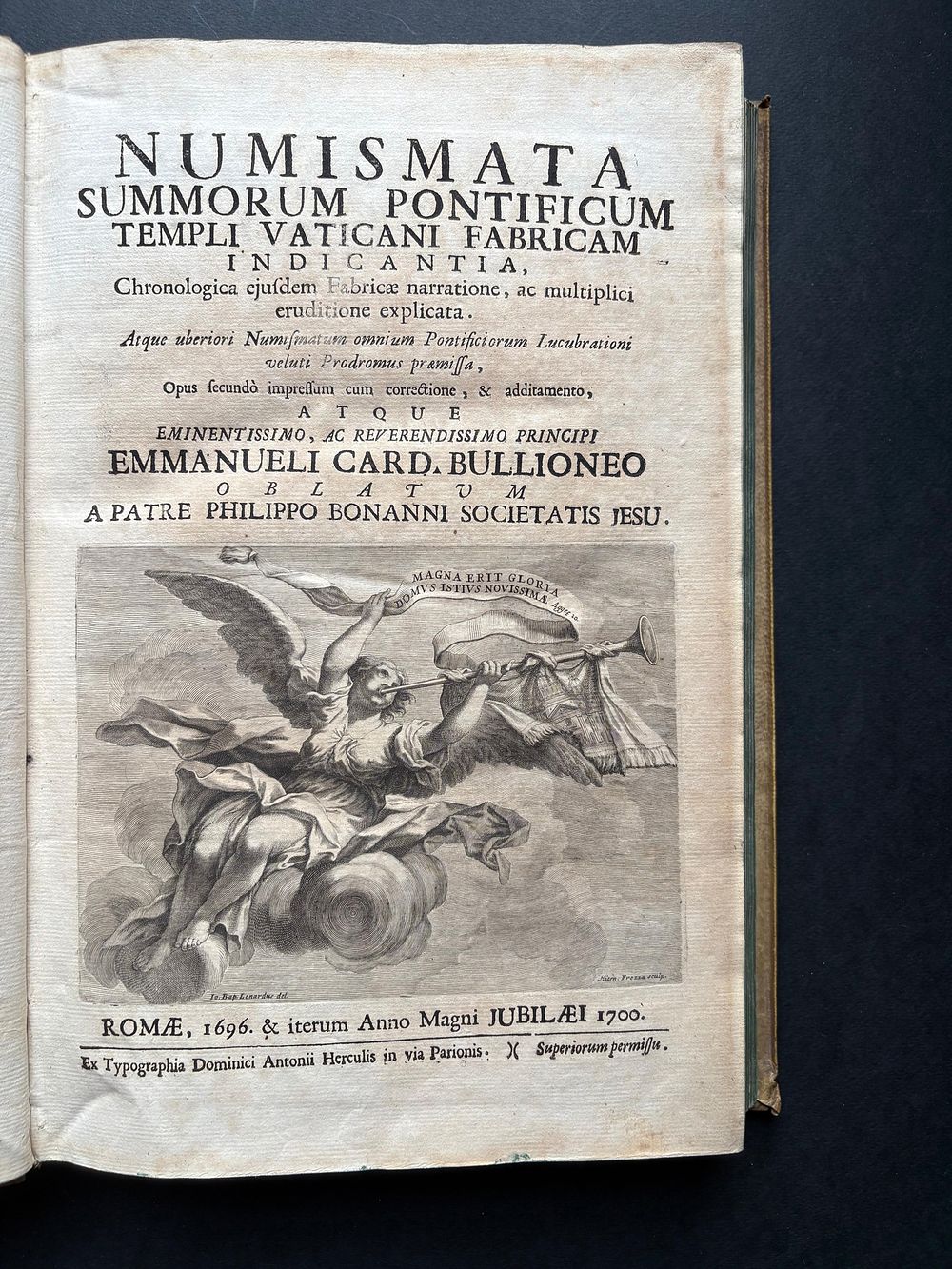
[ANTIQUITIES, ARCHAEOLOGY & FINE ARTS] - BUONANNI, Filippo (1638–1725) - Numismata Summorum Pontificum Templi Vaticani fabricam indicantia - ***Note: This lot is located in Italy and requires an Italian export licence. We will manage the full application process for you. An additional fee of £50 applies.*** BUONANNI, Filippo (1638–1725). Numismata Summorum Pontificum Templi Vaticani fabricam indicantia, chronologica ejusdem fabricae narratione, ac multiplici eruditione explicata... Opus secundò impressum cum correctione, & additamento. Rome: Felice Cesaretti and Domenico Antonio Ercole, 1700. THE IMPORTANT CORRECTED AND ENLARGED SECOND EDITION OF THIS MAGNIFICENTLY ILLUSTRATED HISTORY OF ST PETER’S BASILICA — ONE OF THE CLASSIC SEVENTEENTH-CENTURY SOURCES FOR THE ARCHITECTURE, MONUMENTS AND CONSTRUCTION OF THE VATICAN BASILICA. Folio (358 × 228 mm). [2], xii, 218 pp. Large engraved allegorical vignette on title-page, designed by Giovanni Battista Lenardi and engraved by Girolamo Frezza. Profusely illustrated throughout with an exceptional series of copper-engraved plates, including full-page, double-page and folding subjects, representing papal medals, architectural plans and sections, views of the Basilica, altars, chapels, sculpture, papal monuments and other details of the Vatican complex. The present copy contains 86 numbered plates, 2 unnumbered plates and a further group of 23 engraved plates bound at the end. Contemporary vellum, smooth spine with gilt-lettered label, green edges. Occasional marginal foxing, sporadic browning and a few minor defects, but a fresh and handsome copy in its contemporary binding. SECOND EDITION, CORRECTED AND ENLARGED, following the first edition of 1696, of Filippo Buonanni’s celebrated history of the construction and decoration of St Peter’s Basilica. Although its title places papal medals at the centre of the work, the Numismata Summorum Pontificum is in reality one of the most important early illustrated histories of St Peter’s in Rome. Buonanni uses the commemorative medals struck by successive pontiffs as documentary evidence from which to reconstruct the extraordinary architectural history of the Basilica, from its ancient predecessor to the monumental church created under the patronage of Renaissance and Baroque popes. The result is an exceptional synthesis of numismatics, architectural history, archaeology and papal history. A VISUAL HISTORY OF THE BUILDING OF ST PETER’S The extraordinary engraved apparatus constitutes the principal attraction of the volume. The plates record the long and complex development of the Vatican Basilica through plans, elevations, sections and architectural views, preserving visual evidence of successive phases of construction and, in several instances, projects subsequently altered or never fully realised. Through these engravings the reader can follow the transformation of St Peter’s under the great architects and patrons responsible for its creation. The book documents not only the architecture itself, but also the extraordinarily rich decorative programme of the Basilica: papal tombs, altars, chapels, statues, monuments and liturgical furnishingsappear alongside the medals commemorating their construction. The work therefore functions almost as an illustrated archive of the Vatican Basilica at the close of the seventeenth century. Among the artists and engravers involved are some of the finest practitioners active in Rome at the period, including Girolamo Frezza, Alessandro Specchi, Arnold van Westerhout, Jean-Charles Allet, Pietro Santi Bartoli and Carlo Patacchia. The Metropolitan Museum of Art likewise records Buonanni himself among the designers and engravers responsible for the plates. The illustrations encompass architecture associated with such towering figures as Michelangelo, Bernini, Carlo Maderno, Antonio da Sangallo and Baldassarre Peruzzi, making the volume an indispensable visual source for the history of one of the most important buildings of Western Christianity. MEDALS AS DOCUMENTS OF ARCHITECTURAL HISTORY Buonanni’s method is particularly ingenious. From the Renaissance onwards, popes frequently commemorated major architectural projects by issuing medals showing buildings, façades, domes or foundations. These medals could preserve the appearance of a project at a particular moment in its development — occasionally even recording designs later modified or abandoned. Buonanni collected and interpreted this numismatic evidence chronologically, using it to construct a history of the Basilica and of the successive pontificates responsible for its transformation. The Numismata is consequently much more than a catalogue of papal medals: it is an early attempt to reconstruct architectural history through material and visual evidence. Its plates preserve representations of the great dome, façades, chapels, the Chair of St Peter, the Vatican obelisk,