Bidspirit auction | [ANTIQUITIES, ARCHAEOLOGY & FINE ARTS]
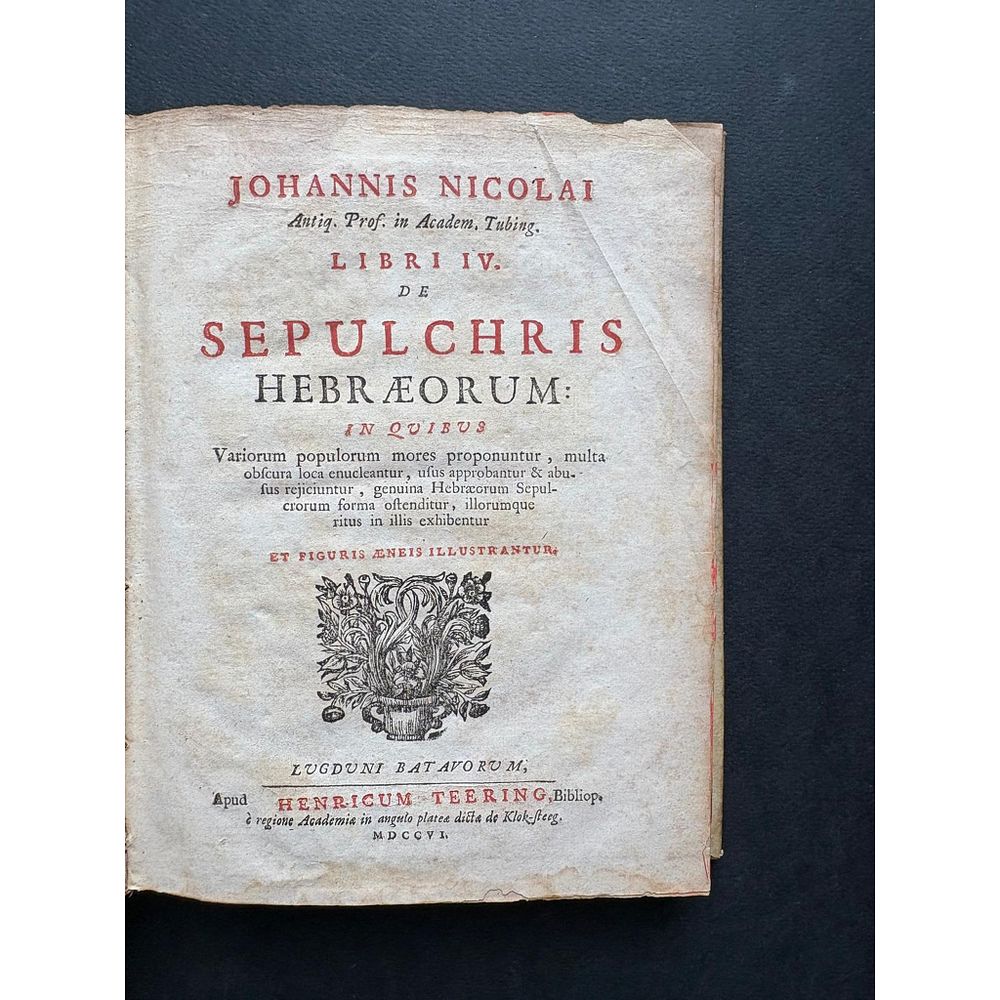
[ANTIQUITIES, ARCHAEOLOGY & FINE ARTS] - NICOLAI, Johann (1665–1708) - Libri IV de sepulchris Hebraeorum - NICOLAI, Johann (1665–1708) Johannis Nicolai Antiq. Prof. in Academ. Tubing. Libri IV. De Sepulchris Hebræorum: in quibus variorum populorum mores proponuntur, multa obscura loca enucleantur, usus approbantur & abusus rejiciuntur, genuina Hebræorum sepulcrorum forma ostenditur, illorumque ritus in illis exhibentur et figuris æneis illustrantur. Lugduni Batavorum [Leiden]: Henricum Teering, 1706. 4to, [16], 285, [3] pp., with 9 engraved plates, including folding plates and plates incorporating movable flaps. Title printed in red and black with engraved vignette, woodcut headpieces and initials, numerous woodcut and engraved illustrations in the text. Contemporary full vellum binding, slightly rubbed at the spine. FIRST EDITION OF ONE OF THE EARLIEST AND MOST AMBITIOUS SYSTEMATIC STUDIES OF JEWISH BURIAL CUSTOMS AND SEPULCHRAL ARCHITECTURE — AN EXCEPTIONALLY ILLUSTRATED WORK, INCLUDING REMARKABLE FOLDING AND MOVABLE PLATES REVEALING THE INTERIOR STRUCTURE OF ANCIENT JEWISH TOMBS. Johann Nicolai’s De Sepulchris Hebræorum is among the most substantial antiquarian investigations of Jewish funerary practices published in the early eighteenth century. Nicolai, a German antiquary and professor of Antiquities at Tübingen, devoted much of his scholarly activity to the reconstruction of ancient customs through the combined study of classical authors, Scripture, Jewish sources and material remains. He was born in 1665 and died in 1708, leaving a considerable body of antiquarian writings devoted to ancient religious, ceremonial and funerary practices. The work is conceived on an unusually broad scale. Rather than treating Jewish burial in isolation, Nicolai begins with the funerary customs of a wide range of peoples, examining Greek and Roman terminology and comparing the practices of Egyptians, Indians, Persians, Babylonians and other nations before turning progressively to the specific forms and usages of Hebrew sepulchres. The table of contents reveals the extraordinary range of the investigation, which extends from the nomenclature of graves and the legal and religious causes of burial to the ornamentation of tombs, burial chambers, epitaphs, pyramids, mausolea, funerary clothing and the burial of animals. The central portion of the book is devoted to Hebrew sepulchres, their different forms and their relationship to the biblical and rabbinical traditions. Nicolai discusses common and more elaborate tombs, the sepulchres of distinguished families, the internal arrangement of burial chambers and the terminology used in Jewish sources. Particularly noteworthy are the sections devoted to kokhim, the characteristic niches cut into the walls of Jewish burial chambers, and to the architectural forms of ancient tombs. The work is of exceptional interest for the history of the material culture of Judaism, since Nicolai does not confine himself to literary testimony. His descriptions are accompanied by a remarkable series of engraved representations of tombs, monuments, inscriptions and funerary architecture. Contemporary descriptions of the first edition record eight engraved plates together with two engravings incorporated into the text; other copies are described as containing ten full-page engravings, while the present copy is collated with nine separate engraved plates, including the elaborate folding and movable elements. These movable plates are among the most remarkable features of the book. Several engravings incorporate folding paper flaps which can be lifted to expose the supposed internal arrangement of burial chambers, transforming the otherwise static printed image into a rudimentary three-dimensional reconstruction. Such devices are particularly significant in the history of archaeological and antiquarian illustration: they allowed the reader not merely to see the exterior of a tomb but to visualize its internal organization. The plates also illustrate Jewish tombs and monuments associated with biblical figures and traditional sites. The work includes discussions and representations connected with such figures as Rachel, Samuel and David, while its extensive treatment of epitaphs extends to Jewish funerary inscriptions and tombstones. A particularly interesting section, at pp. 237–245, concerns Hebrew epitaphs and includes transcriptions of Jewish tombstone inscriptions, making the book valuable not only as a work of antiquarian scholarship but also as an early contribution to the study of Jewish epigraphy. Nicolai’s methodology reflects the scholarly culture of the late seventeenth and early eighteenth centuries. Biblical passages are placed alongside rabbinical literature and classical authorities, while Hebrew, Greek, Arabic and Syriac materials appear throughout the text.