Bidspirit auction | [ANTIQUITIES, ARCHAEOLOGY & FINE ARTS]
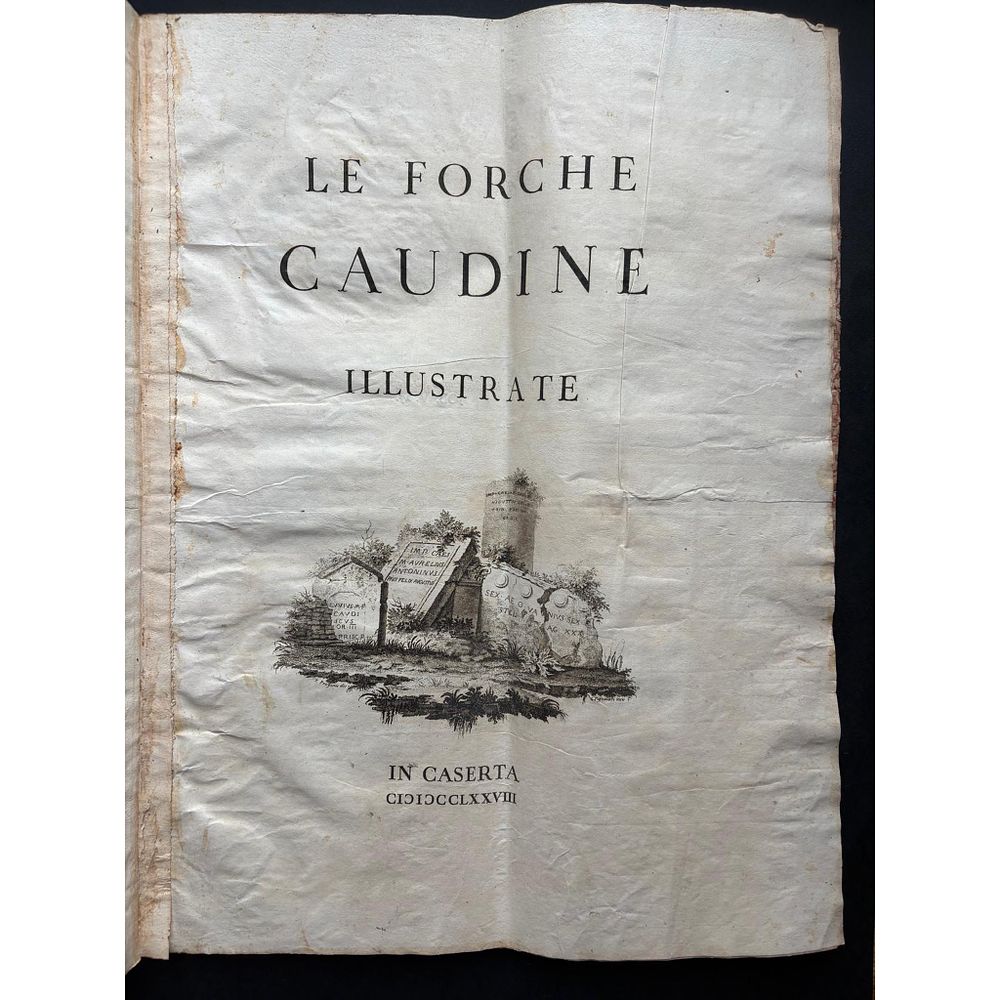
[ANTIQUITIES, ARCHAEOLOGY & FINE ARTS] - DANIELE, Francesco (1740–1812) - Le Forche Caudine illustrate - ***Note: This lot is located in Italy and requires an Italian export licence. We will manage the full application process for you. An additional fee of £50 applies.*** DANIELE, Francesco (1740–1812). Le Forche Caudine illustrate. Caserta, Giuseppe Campo, 1778. FIRST EDITION OF THIS SPLENDID AND RARE MONUMENTAL WORK ON THE CAUDINE FORKS, SUMPTUOUSLY PRINTED AND ILLUSTRATED WITH FIVE LARGE DOUBLE-PAGE ENGRAVINGS. Large folio (560 × 440 mm). [2], XXVI pp. Large engraved vignette on title-page, engraved headpiece and initial, and 5 fine copper-engraved plates on double pages, engraved by Francesco Progenie and Carmelo Pignatari after drawings by D. de Laurentiis. Contemporary decorated-paper binding with floral and geometrical motifs (defects). The volume has at some time been folded once across the centre, with the resulting crease still visible; nevertheless, it remains in excellent overall condition, the text well preserved and, most importantly, the large engraved plates remarkably fresh, clean and strongly impressed. FIRST EDITION. A magnificent archaeological and topographical dissertation devoted to one of the most celebrated episodes of Roman history: the humiliating defeat of the Roman army by the Samnites at the Caudine Forks in 321 BC, during the Second Samnite War. Francesco Daniele, antiquarian, historian and later Royal Historiographer of the Kingdom of Naples, approaches the famous episode through a combination of ancient literary sources, historical criticism and direct topographical investigation. He examines the accounts of Livy and other classical authors in an attempt to establish the precise location and physical configuration of the Furculae Caudinae, comparing the ancient descriptions with the landscape of the eighteenth century. The exceptional series of five large double-page engravings forms an essential part of the work. Executed with considerable refinement, the plates provide topographical and archaeological evidence for Daniele's reconstruction of the battlefield and its surrounding territory, combining ancient textual evidence with observations of the contemporary landscape. The work is a particularly fine example of the sophisticated archaeological publishing produced in the Kingdom of Naples during the Enlightenment, when the discoveries at Herculaneum and Pompeii and the renewed scholarly investigation of the ancient landscape placed southern Italy at the centre of European antiquarian studies. Cicognara 3995, who particularly admired the production, described the book as: ”impressa con ogni lusso, ed eleganza tipografica, e pregiatissima pel merito della dotta esposizione.” The lavish typography, monumental format and superb engraved apparatus fully justify Cicognara's enthusiastic assessment. A RARE AND IMPRESSIVE FIRST EDITION, PARTICULARLY DESIRABLE WITH ALL FIVE LARGE DOUBLE-PAGE ENGRAVINGS PRESENT AND IN FRESH, STRONGLY PRINTED CONDITION. Cicognara 3995; Lozzi 1987.