Bidspirit auction | [ANTIQUITIES, ARCHAEOLOGY & FINE ARTS]
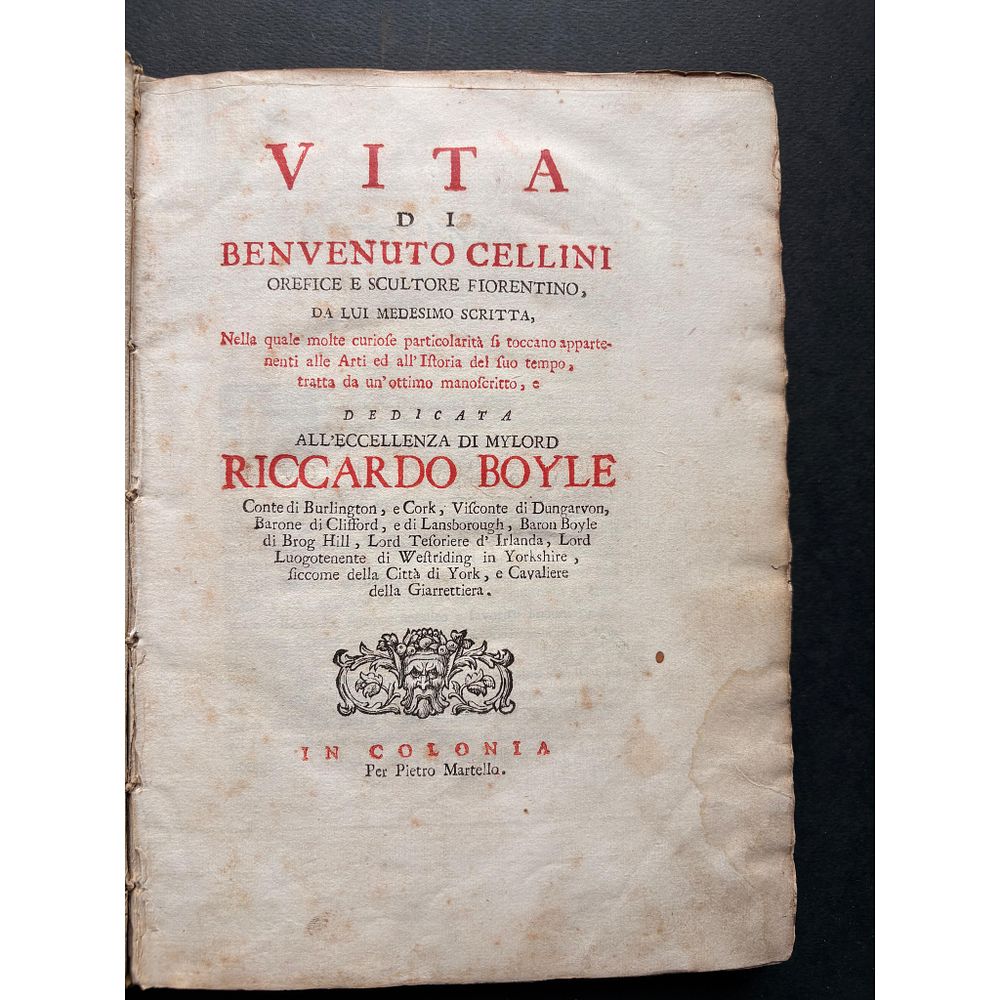
[ANTIQUITIES, ARCHAEOLOGY & FINE ARTS] - CELLINI, Benvenuto (1500–1571) - Vita di Benvenuto Cellini - ***Note: This lot is located in Italy and requires an Italian export licence. We will manage the full application process for you. An additional fee of £50 applies.*** CELLINI, Benvenuto (1500–1571). Vita di Benvenuto Cellini orefice e scultore fiorentino, da lui medesimo scritta, nella quale molte curiose particolarità si toccano appartenenti alle arti, ed all’istoria del suo tempo, tratta da un ottimo manoscritto. “Cologne: Pietro Martello” [i.e. Florence: Francesco Bartolini, c. 1792]. 4to (265 × 195 mm). [8], 318, [10] pp., including the index of names, here bound at the end. Title printed in red and black with woodcut ornament; woodcut initials. Contemporary vellum, red-sprinkled decoration, with a substantial loss of vellum at the lower corner of the rear board. An early and bibliographically interesting edition of one of the great autobiographies of Renaissance Europe, printed under the deliberately fictitious imprint “Cologne, Pietro Martello” and closely reproducing the celebrated first edition of Cellini’s Vita. The edition is generally identified as having been printed at Florence by Francesco Bartolini around 1792. The false imprint of “Pietro Martello” — the Italian equivalent of the fictitious Pierre Marteau imprint widely employed by European printers — deliberately perpetuated the bibliographical identity of the editio princeps, itself published with the same supposed Cologne imprint. Written principally between 1558 and 1566 but unpublished during Cellini’s lifetime, the Vita is one of the most extraordinary documents produced by the Italian Renaissance. Goldsmith, sculptor, medallist, soldier, courtier and adventurer, Cellini created an autobiography in which artistic achievement, court intrigue, violence, imprisonment, religion and an almost inexhaustible sense of personal destiny are woven into a narrative of remarkable immediacy. Among its celebrated episodes are Cellini’s experiences during the Sack of Rome, his service to Pope Clement VII and Francis I of France, his imprisonment and dramatic escape from Castel Sant’Angelo, his encounters with Michelangelo and other leading artists of his time, his bitter rivalry with Baccio Bandinelli, and the technically hazardous casting of his masterpiece, the bronze Perseus with the Head of Medusa. The work is therefore much more than an artist’s memoir. It provides an exceptional first-person portrait of the artistic and political world of sixteenth-century Italy and France, while simultaneously constructing one of the most powerful individual personalities in Renaissance literature. Cellini’s language — vigorous, direct, theatrical and often deliberately self-dramatizing — gives the Vita an almost novelistic quality. Its mixture of factual recollection, bravado, violence, supernatural episodes and artistic self-fashioning has made it a central text both in the history of autobiography and in the mythology of the Renaissance artist as an independent creative genius.The manuscript remained unpublished for more than a century and a half. The first printed edition, prepared with the involvement of the Florentine physician and scholar Antonio Cocchi, appeared with a fictitious Cologne imprint in the eighteenth century. The present edition deliberately imitates that publication and is itself an interesting episode in the complex bibliographical history and growing eighteenth-century reputation of Cellini’s autobiography. The index of names, frequently encountered among the preliminary matter of this edition, is in the present copy bound at the end. An attractive and bibliographically intriguing eighteenth-century edition of one of the supreme autobiographical works of European literature, preserving the famous fictitious “Pietro Martello” imprint of the original edition.