Bidspirit auction | [GEOGRAPHY, TRAVEL, EXPLORATION & CARTOGRAPHY]
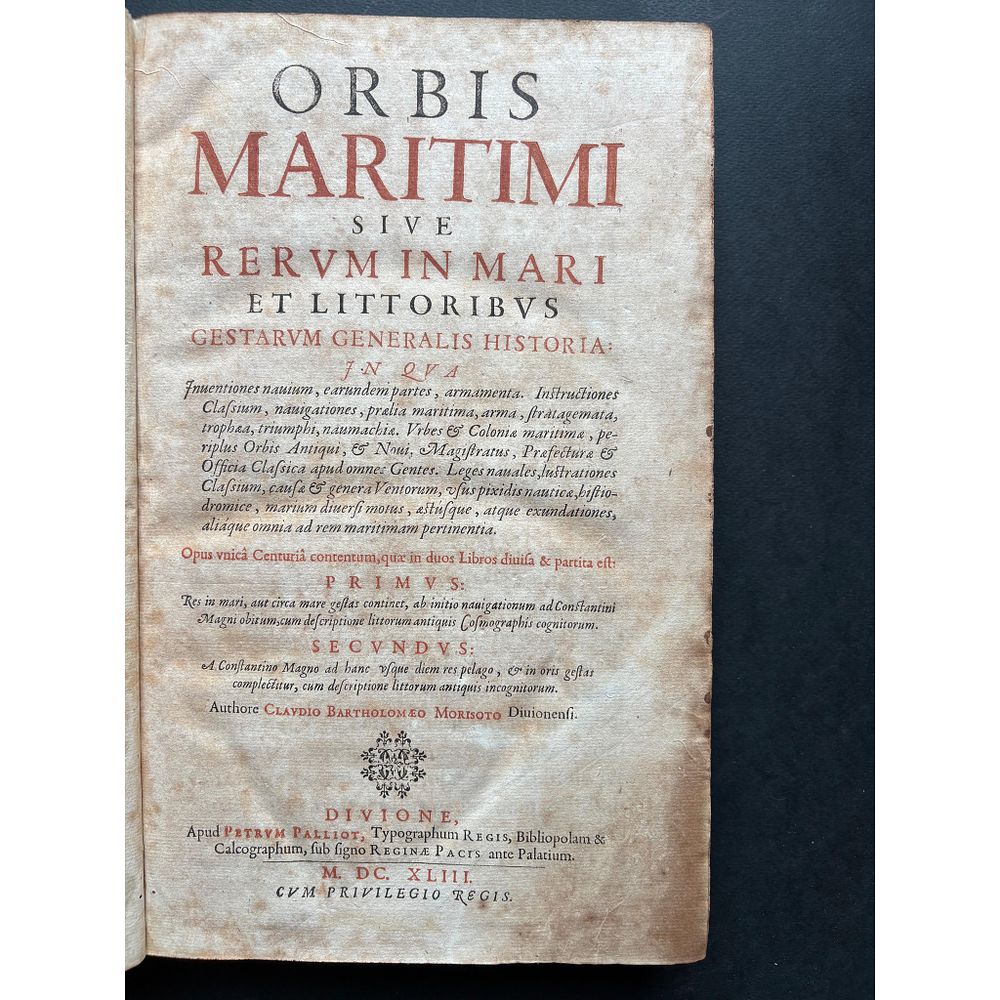
[GEOGRAPHY, TRAVEL, EXPLORATION & CARTOGRAPHY] - MORISOT, Claude Barthélemy (1592–1661) - Orbis maritimi sive rerum in mari et littoribus gestarum generalis historia - MORISOT, Claude Barthélemy (1592–1661) Orbis maritimi siue rerum in mari et littoribus gestarum generalis historia... Opus vnica centuria contentum, quae in duos libros diuisa & partita est... Authore Claudio Bartholomaeo Morisoto Diuionensi. Dijon: apud Petrum Palliot, typographum regis, bibliopolam & calcographum, sub signo Reginae Pacis ante Palatium, 1643. Folio, [24], 725, [19] pp. Engraved architectural title-page printed in red and black, signed by Louis Spirinx (Spierinckx); large folding engraved plate of an ancient naval battle (naumachia); forty-two engraved illustrations in the text, comprising maps of the ancient world, depictions of ancient coins and monuments, and representations of ships and vessels of every age and region. Contemporary full calf, spine with gilt-lettered morocco label. FIRST AND ONLY EDITION OF MORISOT'S ORBIS MARITIMI, THE FIRST ENCYCLOPAEDIA EVER DEVOTED TO THE MARITIME WORLD, RICHLY ILLUSTRATED WITH FORTY-TWO ENGRAVINGS BY LOUIS SPIRINX. Published at Dijon in 1643, the Orbis maritimi stands as one of the foundational texts of maritime historiography: Borba de Moraes described it as the first naval history and a veritable naval encyclopaedia. The work is divided into two books: the first surveys antiquity, opening with an engraving of an ancient naumachia — the staged naval battles once mounted in flooded amphitheatres — and proceeding through the mythical origins of navigation, the great sea-battles of Greece and Rome, and the ancient hydrography of the known world, coast by coast; the second book extends the survey into the modern era, ranging as far as the navigation of the Americas, the Far East and the Pacific. The illustrative programme — maps of the ancient world, engraved coins and monuments, and a remarkable series of ship-types from antique triremes and galleys to Japanese, Chinese and Guinean vessels — makes the volume as much a visual as a textual encyclopaedia of the sea. The engraved title-page and frontispiece are the work of Louis Spirinx (1596–1669), and the whole was printed by Pierre Palliot, printer to the king at Dijon. Bound in contemporary calf, somewhat dry, with a gilt-lettered morocco label to the spine; an excellent copy, with good margins. A handsome and complete copy of a landmark in the history of maritime literature, uniting text and image in one of the most ambitious encyclopaedic undertakings of its century.