Bidspirit auction | [GEOGRAPHY, TRAVEL, EXPLORATION & CARTOGRAPHY]
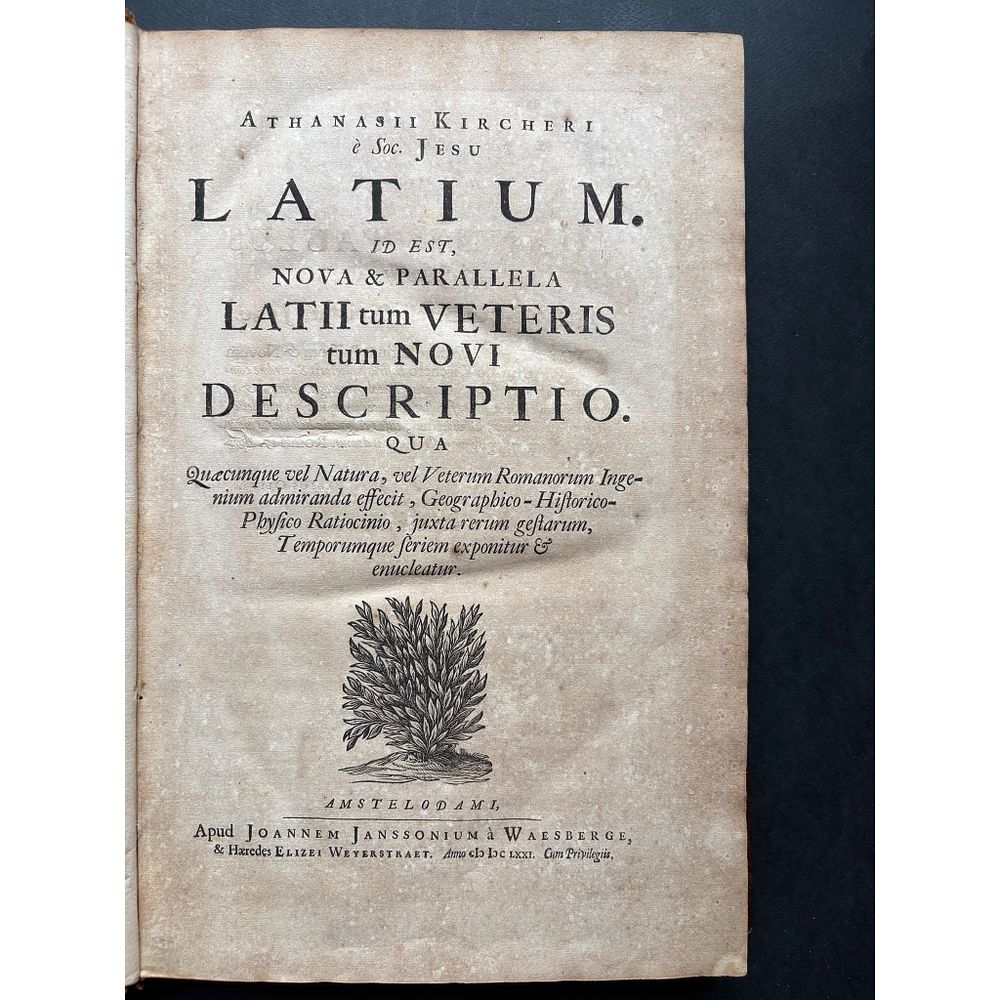
[GEOGRAPHY, TRAVEL, EXPLORATION & CARTOGRAPHY] - KIRCHER, Athanasius (1602–1680) - Latium, id est nova et parallela Latii tum veteris tum novi descriptio - ***Note: This lot is located in Italy and requires an Italian export licence. We will manage the full application process for you. An additional fee of £50 applies.*** KIRCHER, Athanasius (1602–1680). Latium, id est nova et parallela Latii tum veteris tum novi descriptio. Qua quaecunque vel natura, vel veterum Romanorum ingenium admiranda effecit, geographico-historico-physico ratiocinio, juxta rerum gestarum, temporumque seriem exponitur & enucleatur. Amsterdam: Johannes Janssonius van Waesberge and the heirs of Elizei Weyerstraet, 1671. Folio (380 × 245 mm). Engraved additional title by Romeyn de Hooghe; engraved portrait of Pope Clement X, to whom the work is dedicated; 25 further engraved plates, maps and plans, many double-page or folding, together with numerous engraved illustrations throughout the text, woodcut headpieces and initials. Gathering 3* bound after T, including the celebrated plan of Hadrian’s Villa, in accordance with recorded copies. Contemporary speckled calf, gilt spine with later lettering-piece, red-speckled edges. Some browning and marginal waterstaining; engraved frontispiece remounted. Joints and extremities rubbed. Provenance: De Vabenzi, armorial bookplate. First edition. A richly illustrated first edition of one of Athanasius Kircher’s most visually impressive works: an extraordinary antiquarian, geographical and archaeological survey of ancient and modern Latium, based in considerable part upon the author’s own exploration of Rome and the surrounding countryside. Kircher arrived in Rome in 1635 and remained there for most of the rest of his life. From the Collegio Romano he pursued an encyclopaedic programme of research extending from archaeology and languages to geology, optics, music and natural philosophy. Latium represents the application of this characteristically universal approach to the landscape surrounding Rome. Rather than presenting a conventional geographical description, Kircher sought to reconstruct the ancient region through a combination of classical literature, inscriptions, archaeological remains, local traditions, natural phenomena and personal observation. Ancient and modern Latium are constantly set in parallel, transforming the book into an attempt to recover the historical memory of the landscape itself. The work ranges through the principal cities, villas and sacred sites of the region, including Tivoli, Palestrina, Frascati, Tusculum, Albano, Ariccia, Castel Gandolfo and the territories of the Castelli Romani. Kircher discusses ruined temples, ancient roads, lakes, springs, aqueducts, villas and monuments alongside the natural history and physical characteristics of the landscape. The magnificent engraved apparatus is fundamental to the appeal and importance of the book. Large views and plans record monuments and landscapes of Latium at a moment when many ancient remains were considerably more visible than today, making the work an important visual document for the history of Roman and Lazio archaeology. Particularly notable is the large map Nova & Exacta Chorographia Latii, sive Territorii Romani, as well as the evocative views of the towns and landscapes surrounding Rome. Among the most celebrated illustrations is the extensive plan of Hadrian’s Villa at Tivoli. The plate itself associates the reconstruction with the antiquarian investigations of Pirro Ligorio and the subsequent work of Francesco Contini, whose great survey of the complex had appeared shortly before, in 1668. Kircher’s publication played an important role in disseminating this reconstruction of one of the most extraordinary architectural complexes of Roman antiquity. Hadrian’s Villa held a particular fascination for Renaissance and Baroque architects and antiquarians. Its vast remains provided a repertory of domes, curved spaces, water features and complex architectural forms that continued to stimulate European architectural imagination long after antiquity itself had disappeared. Latium also preserves Kircher’s distinctive conception of antiquarian scholarship. Archaeology, mythology, geography and natural philosophy are treated not as separate disciplines but as complementary means of reconstructing the past. Geological formations, lakes, springs and volcanic phenomena could be examined alongside inscriptions, ruined buildings and ancient historical accounts as parts of a single history of place. The result is one of the great seventeenth-century illustrated books devoted to the landscape and antiquities of Rome and Latium: simultaneously a geographical survey, archaeological repertory, visual record and learned reconstruction of the classical world. A handsome and complete copy of one of Kircher’s most desirable illustrated works, preserving the full series of maps,