Bidspirit auction | [GEOGRAPHY, TRAVEL, EXPLORATION & CARTOGRAPHY]
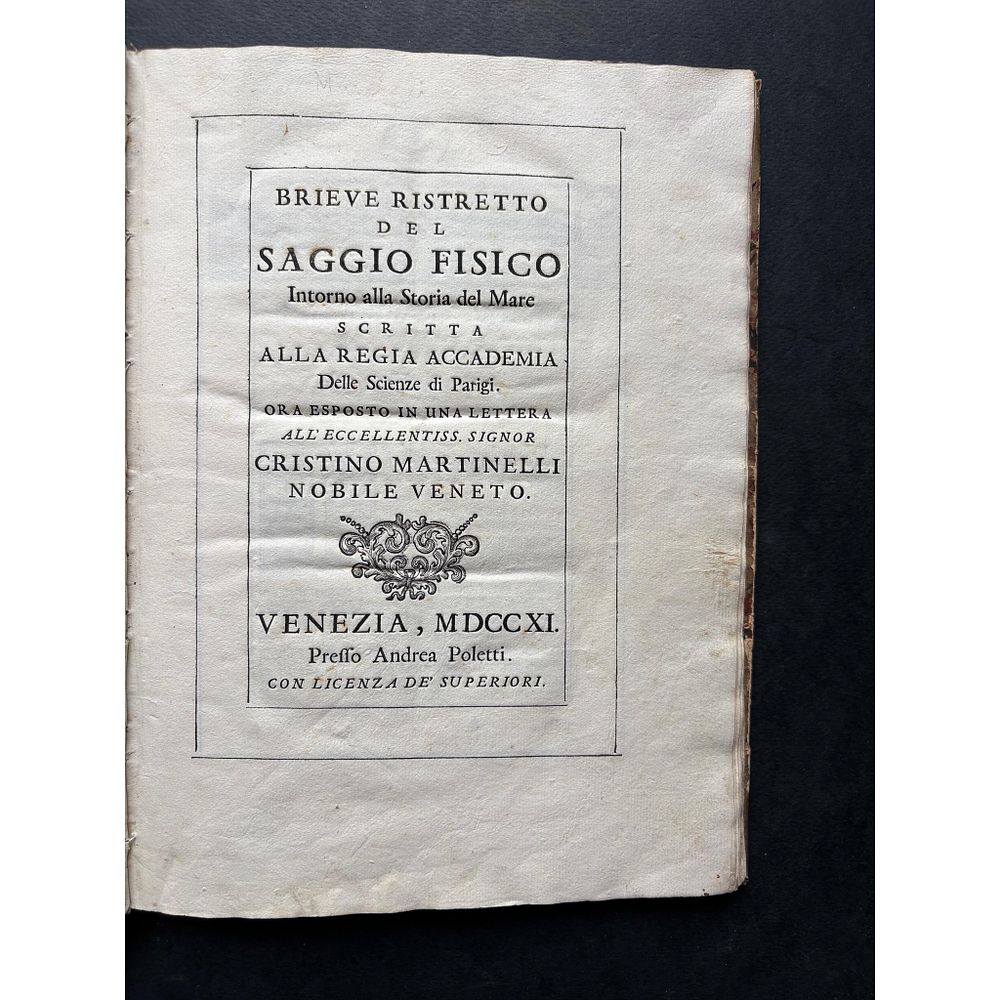
[GEOGRAPHY, TRAVEL, EXPLORATION & CARTOGRAPHY] - MARSIGLI, Luigi Ferdinando (1658–1730) - Brieve ristretto del saggio fisico intorno alla storia del mare - ***Note: This lot is located in Italy and requires an Italian export licence. We will manage the full application process for you. An additional fee of £50 applies.*** MARSIGLI, Luigi Ferdinando (1658–1730). Brieve ristretto del saggio fisico intorno alla storia del mare scritta alla Regia Accademia delle Scienze di Parigi, ora esposto in una lettera all’Eccellentissimo Signor Cristino Martinelli nobile Veneto. Venice: Andrea Poletti, 1711. 4to (260 × 190 mm). [4], 72, [4] pp. Three engraved plates printed on strong paper and finely coloured by a contemporary hand. Contemporary half vellum with corners over marbled paper boards, blue lettering-piece gilt to smooth spine. Binding somewhat worn. A few very light spots; otherwise an attractive copy, distinguished by the contemporary colouring of the plates. First edition. An important landmark in the early history of oceanography and marine biology, presenting Luigi Ferdinando Marsigli’s pioneering attempt to study the sea as a complex physical and biological system through direct observation, measurement and experiment. The work originated in investigations carried out by Marsigli along the Mediterranean coast and in a memoir on the physical history of the sea submitted to the Académie Royale des Sciences in Paris in 1706. The present Venetian publication of 1711 is its first printed form; Marsigli later greatly enlarged his investigations in the celebrated Histoire physique de la mer, published at Amsterdam in 1725. Marsigli examines a remarkably broad range of phenomena: the relationship between land and submarine relief, the composition and properties of seawater, currents and movements of the sea, temperature and salinity, marine vegetation and the organisms inhabiting the sea floor. His method was based upon repeated observation and the collection of specimens rather than inherited authority, anticipating the systematic physical study of the oceans that would emerge as a distinct science much later. Modern historians of science have consequently described Marsigli as a precursor, and even as the “father”, of physical oceanography. A recent historical survey notes that his work may be regarded as one of the earliest attempts to treat the sea itself as a coherent scientific subject. Particularly celebrated are Marsigli’s observations on coral. Working with freshly collected specimens, he observed the extraordinary structures that emerged from the coral when immersed in seawater and illustrated them in detail. Although he interpreted these organisms as the “flowers” of a marine plant rather than as animals, his observations were exceptionally accurate and became an important stage in the long scientific debate over the true nature of coral. The second part of the volume, addressed to the eminent physician and naturalist Antonio Vallisneri, concerns kermes, the scale insect historically collected from Mediterranean oaks and used to produce one of Europe’s most ancient and valuable crimson dyes. Marsigli investigates its natural history with the same observational approach applied to marine organisms. The two texts were deliberately issued together under the collective heading Osservazioni naturali intorno al Mare, ed alla Grana detta Kermes. The three engraved plates, here particularly desirable in contemporary hand-colour, provide visual documentation of Marsigli’s observations and considerably enhance the appeal of the present copy. A rare and important first edition of one of the foundational works in the scientific study of the sea, combining physical oceanography, marine natural history and experimental observation at the beginning of the eighteenth century.