Bidspirit auction | [GEOGRAPHY, TRAVEL, EXPLORATION & CARTOGRAPHY]
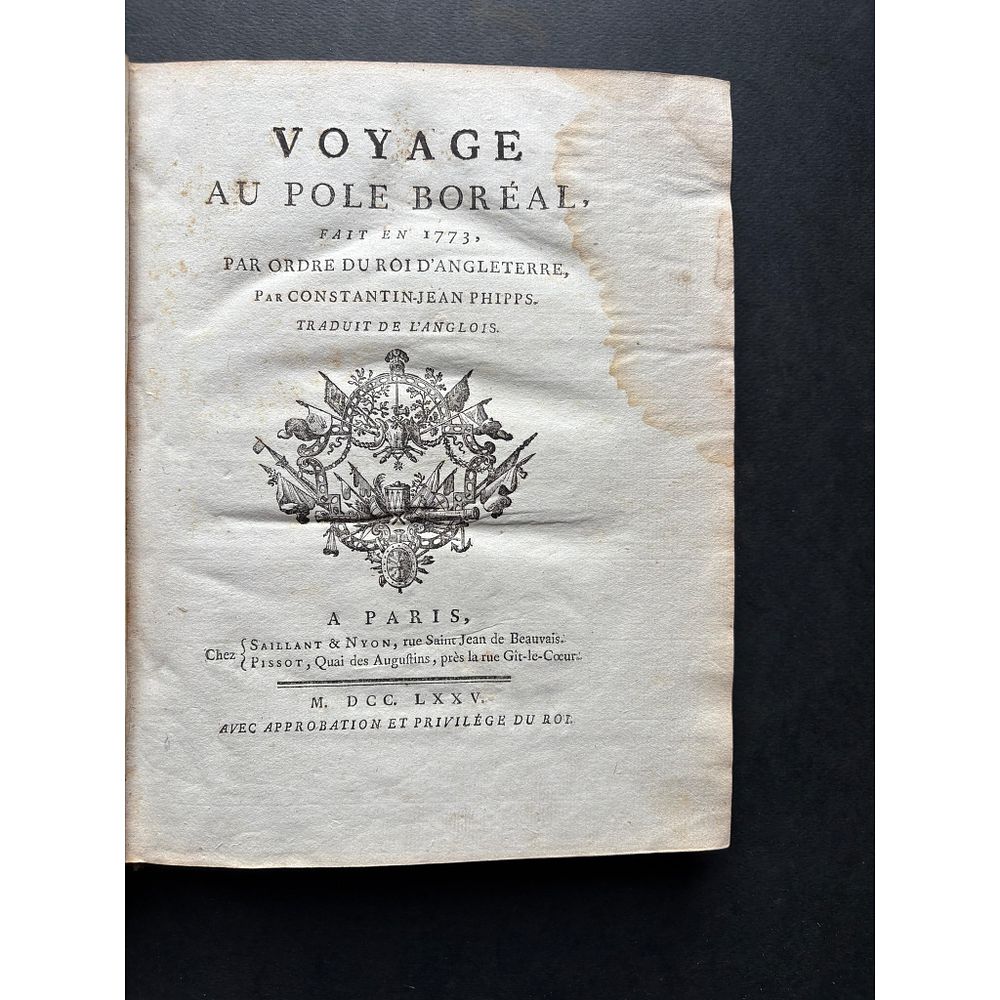
[GEOGRAPHY, TRAVEL, EXPLORATION & CARTOGRAPHY] - PHIPPS, Constantine John (1744–1792) - Voyage au Pôle Boréal - PHIPPS, Constantine John (1744–1792) Voyage au Pôle Boréal, fait en 1773, par ordre du Roi d’Angleterre. Traduit de l’Anglois. Paris: Saillant & Nyon, Pissot, 1775. 4to (255 × 195 mm). XII, 259 pp., [2] leaves. 12 folding engraved plates and maps, comprising 3 maps and 9 plates, together with 11 folding tables included in the pagination. The final leaves include the Avis au relieur. Occasional minor foxing. Contemporary mottled calf, spine with five raised bands, compartments richly decorated in gilt with floral tools and medallions, red morocco lettering-piece, partly defective and lifting; gilt ornamental border to covers, marbled endpapers, yellow edges. FIRST EDITION IN FRENCH OF ONE OF THE CLASSIC ACCOUNTS OF EIGHTEENTH-CENTURY ARCTIC EXPLORATION, RECORDING THE BRITISH EXPEDITION OF 1773 TOWARDS THE NORTH POLE AND ITS IMPORTANT SCIENTIFIC OBSERVATIONS ON NAVIGATION, ASTRONOMY AND ARCTIC NATURAL HISTORY. Commissioned by George III and supported by the British Admiralty, Phipps’s expedition was one of the most ambitious attempts of the eighteenth century to penetrate the high Arctic and investigate the possibility of an ice-free route towards the North Pole. The expedition sailed in June 1773 with two specially strengthened Royal Navy vessels, HMS Racehorse under Phipps and HMS Carcass under Skeffington Lutwidge. Proceeding northwards through the seas around Spitsbergen, the ships reached approximately 80° north before becoming dangerously enclosed by the polar ice. For a time the situation became sufficiently grave that preparations were made to abandon the ships and escape across the ice in boats. A change in conditions eventually allowed both vessels to extricate themselves and return safely to Britain. Although the expedition failed to reach the Pole, its scientific achievements were considerable. Phipps conducted systematic observations of latitude, temperature, atmospheric conditions, depth, magnetic variation and the performance of navigational instruments, producing one of the most scientifically rigorous Arctic voyage accounts of the eighteenth century. Particularly important is the extensive natural-history section, occupying pp. 187–208 of the present edition. Phipps recorded the fauna encountered during the voyage and his account is especially celebrated in the history of zoology for the description of the polar bear, Ursus maritimus, which Phipps distinguished scientifically as a separate species. The final plates include finely engraved representations of crustaceans, molluscs and other marine organisms. The twelve folding plates and maps provide an exceptional visual record of the expedition. They include charts of the Arctic seas, coastal profiles, scientific and navigational material, dramatic representations of the vessels among the ice, and natural-history subjects. The eleven folding tables preserve the extensive astronomical, meteorological and navigational observations made during the voyage. The expedition is also associated with a remarkable episode in the early career of Horatio Nelson, then a young midshipman serving aboard the Carcass. According to the celebrated account, Nelson ventured onto the ice in pursuit of a polar bear before being recalled — an incident which subsequently became part of the mythology surrounding his youth. The original English account, A Voyage towards the North Pole, appeared in London in 1774. This first French edition of 1775 brought the results of the expedition rapidly to a Continental scientific readership and was translated by Jean-Nicolas Démeunier and revised by the distinguished hydrographer and naval theorist Charles-Pierre Claret de Fleurieu. Beyond its importance as a narrative of exploration, Phipps’s work represents a significant stage in the transformation of polar travel into systematic scientific investigation, combining geographical discovery with astronomy, hydrography, meteorology, zoology and the testing of navigational instruments. A HANDSOME COPY IN CONTEMPORARY CALF OF THE FIRST FRENCH EDITION OF A LANDMARK OF ARCTIC EXPLORATION, COMPLETE WITH ITS 12 FOLDING PLATES AND MAPS AND 11 FOLDING SCIENTIFIC TABLES. References: Sabin 62574; Chadenat 661; Howgego P82; cf. Hill 1351 for the English first edition.