Bidspirit auction | [GEOGRAPHY, TRAVEL, EXPLORATION & CARTOGRAPHY]
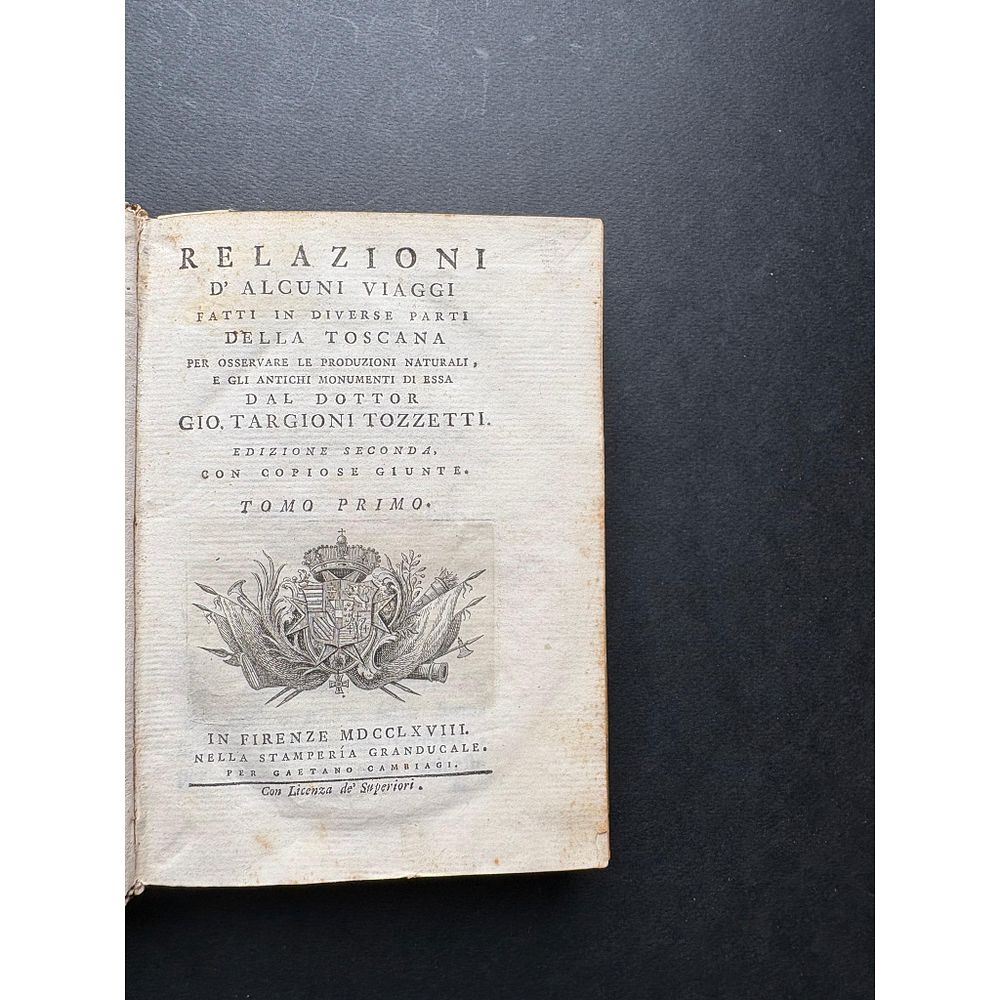
[GEOGRAPHY, TRAVEL, EXPLORATION & CARTOGRAPHY] - TARGIONI TOZZETTI, Giovanni (1712–1783) - Relazioni d'alcuni viaggi fatti in diverse parti della Toscana - ***Note: This lot is located in Italy and requires an Italian export licence. We will manage the full application process for you. An additional fee of £50 applies.*** TARGIONI TOZZETTI, Giovanni (1712–1783). Relazioni d'alcuni viaggi fatti in diverse parti della Toscana per osservare le produzioni naturali, e gli antichi monumenti di essa. Seconda edizione con copiose giunte. Florence: Stamperia Granducale, per Gaetano Cambiagi, 1768–1779. 12 volumes, 8vo. With the engraved Grand-Ducal arms on the title-pages and the complete series of engraved plates, maps, plans and views, several folding. A beautiful and exceptionally well-preserved set, complete with all plates. Contemporary full vellum bindings, gilt titles to spines. With occasional contemporary manuscript annotations in the margins. Second edition, greatly enlarged. The most important work of Giovanni Targioni Tozzetti and one of the great eighteenth-century descriptions of Tuscany, combining natural history, geography, geology, mineralogy, botany, agriculture, medicine, archaeology and local history in an extraordinarily ambitious survey of the region. Targioni Tozzetti, physician, botanist and naturalist, was one of the leading scientific figures of Enlightenment Tuscany. A pupil of the distinguished botanist Pier Antonio Micheli, he succeeded him as professor of botany and custodian of the Florentine botanical garden and later became prefect of the Biblioteca Magliabechiana. He was closely involved in the scientific and economic culture surrounding the Accademia dei Georgofili and the reforming government of the Grand Duchy. Between 1742 and 1745 Targioni undertook extensive scientific journeys throughout Tuscany, examining its landscape and natural resources at first hand. He travelled through the Arno valley, Volterra and the metalliferous hills, the Maremma, Lucca, Garfagnana and the Apuan Alps, recording minerals, geological formations, plants, waters, agricultural practices, ancient remains and the economic potential of the territories he visited. The resulting Relazioni are remarkable for the breadth of their conception. Targioni does not merely describe places: he attempts to understand the territory as an interconnected natural and historical system. Mountains, rivers, thermal springs, mines, quarries, forests and cultivated land are examined alongside inscriptions, ruins, churches, roads, towns and local traditions. Particular attention is devoted to Tuscany's mineral and geological resources, making the work an important document in the development of Italian geology and mineralogy before the emergence of these disciplines in their modern form. The celebrated marble districts of the Apuan Alps, the metalliferous regions of southern Tuscany, water systems, soils and agricultural resources are all treated with the eye of both a naturalist and an observer concerned with their practical economic use. The work is equally important for its documentation of the Tuscan landscape and its monuments. The engraved maps, plans and views — many based upon the work of the engineer and cartographer Ferdinando Morozzi — provide a valuable visual record of eighteenth-century Tuscany, including towns, territories, river systems and geological and topographical features. First published in six volumes between 1751 and 1754, the Relazioni were completely reconsidered for the present second edition. Issued over more than a decade between 1768 and 1779, the work was expanded to twelve volumes and enriched with extensive new material. Targioni incorporated further observations as well as accounts derived from the travels and manuscripts of his teacher Pier Antonio Micheli, transforming the new edition into a considerably broader scientific and historical survey. Dedicated to Grand Duke Pietro Leopoldo of Tuscany, the work belongs to the intellectual environment of the great reforming period of the Grand Duchy, in which the systematic study of natural resources was closely connected with projects for agricultural, economic and social improvement. The contemporary marginal annotations in the present copy add particular interest, providing evidence of an early reader's active engagement with this vast repertory of Tuscan natural and historical knowledge. A particularly desirable example: a complete twelve-volume set of this monumental work, preserving all its engraved plates, maps and views, uniformly bound in contemporary vellum with gilt titles to the spines. A fine and highly attractive copy of one of the foundational works on the natural, geographical and historical description of Tuscany, and an exceptional document of Italian Enlightenment science.