Bidspirit auction | [GASTRONOMY, AGRICULTURE & FOOD HISTORY]
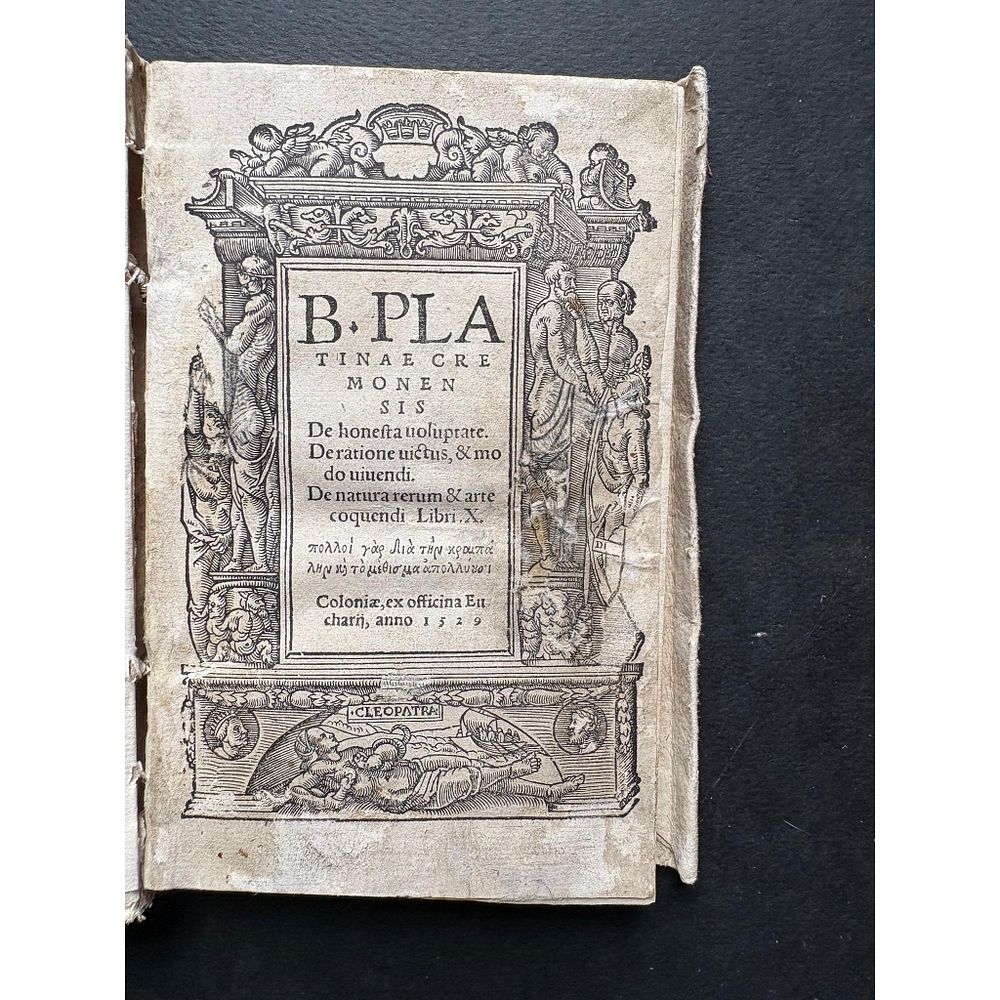
[GASTRONOMY, AGRICULTURE & FOOD HISTORY] - PLATINA, Bartolomeo Sacchi (1421–1481) - De honesta voluptate et valetudine - ***Note: This lot is located in Italy and requires an Italian export licence. We will manage the full application process for you. An additional fee of £50 applies.*** PLATINA, Bartolomeo Sacchi (1421–1481). De honesta voluptate. De ratione victus, & modo vivendi. De natura rerum et arte coquendi libri X. Cologne, Eucharius Cervicornus, for Gottfried Hittorp, 1529. AN EARLY SIXTEENTH-CENTURY EDITION OF ONE OF THE FOUNDATIONAL TEXTS OF WESTERN GASTRONOMY — THE CELEBRATED HUMANIST TREATISE WHICH BROUGHT THE RECIPES OF MAESTRO MARTINO INTO PRINTED EUROPEAN CULINARY CULTURE. 8vo (145 × 90 mm). [120] leaves. Title-page within a handsome figured woodcut border. Restorations to the verso of the title-page, to the lower margin of the second leaf and to the blank margin of the final leaf; otherwise a good copy. Plain boards, manuscript title to spine. An attractive early edition of Bartolomeo Platina’s celebrated De honesta voluptate et valetudine, one of the most influential books in the history of European food and dining. First composed in the fifteenth century, the work occupies a unique position between cookery book, dietary manual, humanist treatise and guide to the art of living well. Platina does not consider food merely as nourishment: gastronomy is placed within a broader philosophy of health, moderation, pleasure and cultivated living. At the heart of the work lies the extraordinary encounter between Renaissance humanism and the practical culinary knowledge of Maestro Martino da Como, one of the greatest cooks of the fifteenth century. Martino served Cardinal Ludovico Trevisan, Patriarch of Aquileia, and was the author of the celebrated manuscript Libro de arte coquinaria. Platina openly acknowledged his debt to Martino and incorporated and adapted a substantial number of his recipes into the De honesta voluptate, translating the practical language of the professional kitchen into elegant Latin and placing the recipes within a sophisticated framework of classical learning, medicine and dietetics. Modern scholarship consequently regards the work not as a simple recipe collection but as a remarkable fusion of Martino’s culinary practice with Platina’s humanist and medical culture. The ten books discuss the qualities of foods, their preparation and their effects upon the body, alongside an extraordinary range of recipes for meat, poultry, fish, vegetables, soups, sauces, pies, pastries and sweets. Platina repeatedly seeks a balance between gastronomic enjoyment and physical well-being: the honesta voluptas of the title is precisely the legitimate pleasure derived from food when governed by intelligence and moderation. The original fifteenth-century edition is generally recognised as the first printed cookbook, and the exceptional number of subsequent Latin and vernacular editions demonstrates the enormous European influence of the text. The Cologne edition of 1529 belongs to this early transmission of Platina’s culinary classic and preserves the work in its authoritative Latin form. The present edition was printed at Cologne in the workshop of Eucharius Cervicornus, with the colophon recording the involvement of Gottfried Hittorp, and is bibliographically collated in 120 leaves. A DESIRABLE EARLY EDITION OF ONE OF THE GREAT LANDMARKS OF CULINARY LITERATURE: THE BOOK WHICH TRANSFORMED THE PRACTICAL RECIPES OF MAESTRO MARTINO INTO A HUMANIST PHILOSOPHY OF FOOD, HEALTH AND CIVILISED PLEASURE, AND WHICH EXERTED A PROFOUND INFLUENCE ON EUROPEAN GASTRONOMY FOR MORE THAN A CENTURY.