Bidspirit auction | [GASTRONOMY, AGRICULTURE & FOOD HISTORY]
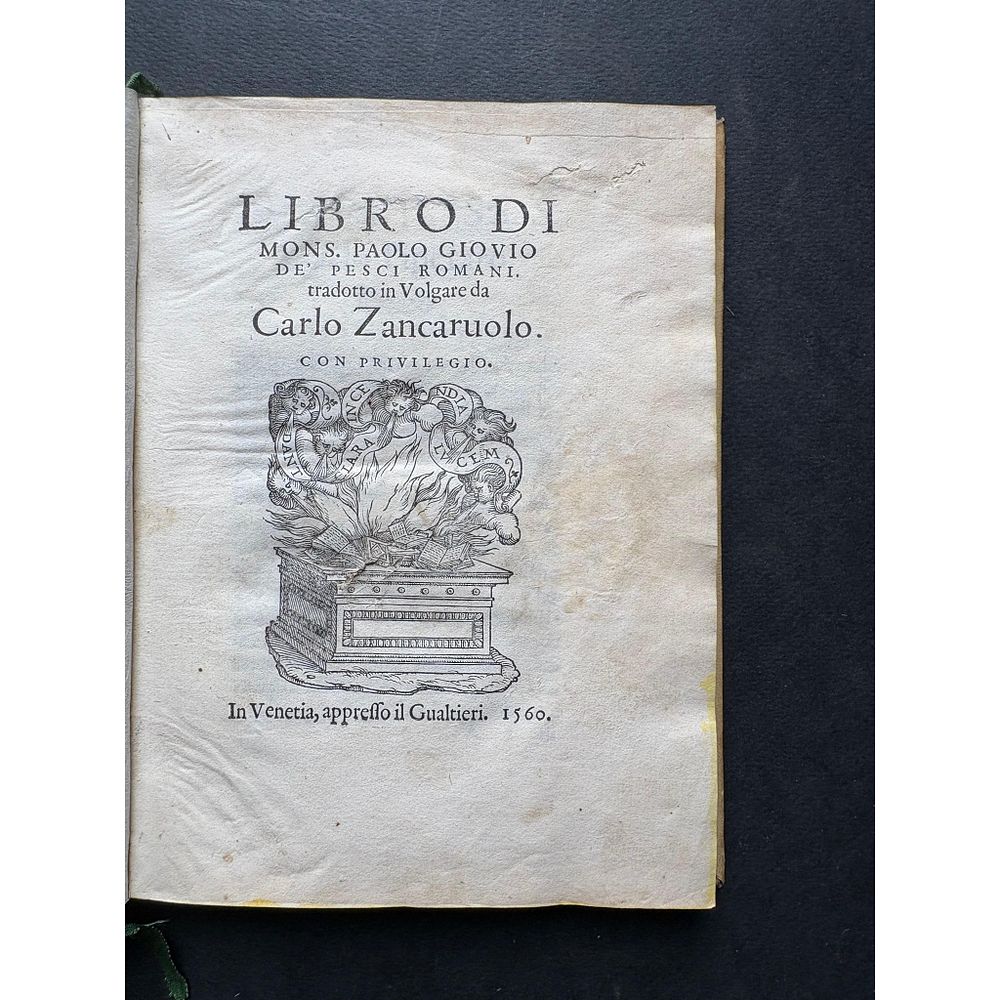
[GASTRONOMY, AGRICULTURE & FOOD HISTORY] - GIOVIO, Paolo (1483–1552) - Libro de' pesci romani - ***Note: This lot is located in Italy and requires an Italian export licence. We will manage the full application process for you. An additional fee of £50 applies.*** GIOVIO, Paolo (1483–1552). Libro de’ pesci romani. Translated into Italian by Carlo Zancaruolo. Venice, Gualtieri, 1560. FIRST COMPLETE ITALIAN EDITION OF ONE OF THE EARLIEST RENAISSANCE TREATISES DEVOTED EXCLUSIVELY TO FISH — A FASCINATING WORK SITUATED BETWEEN NATURAL HISTORY, GASTRONOMY AND THE CULINARY LIFE OF SIXTEENTH-CENTURY ROME. 4to (198 × 144 mm). 197, [3] pp. Printer’s device on title-page. Small holes to title-page with a delicate restoration; a few other minor defects. Seventeenth-century vellum, smooth spine with gilt title on lettering-piece. FIRST COMPLETE ITALIAN EDITION, translated by Carlo Zancaruolo from Giovio’s celebrated De Romanis piscibus libellus, first published in Latin at Rome in 1524. One of the most curious works of the great Renaissance historian, physician and humanist Paolo Giovio, the Libro de’ pesci romani is remarkable for combining direct observation of the natural world with classical erudition and an acute interest in the place of fish within contemporary food culture. Giovio examines approximately fifty species of fish, crustaceans and other aquatic creatures, discussing their physical characteristics, habitats, nomenclature and correspondence with the descriptions of ancient authors. At the same time, however, he is constantly attentive to their quality as food, their availability in Roman markets, methods of preservation, relative desirability and reputation at the table. The work therefore provides much more than a zoological catalogue. It offers an extraordinarily vivid picture of the fish consumed in Renaissance Rome, ranging from Mediterranean and freshwater species to preserved products brought to the city through long-distance trade. Giovio records, compares and attempts to identify the fishes known to classical authorities such as Pliny and Aristotle, while testing their terminology against specimens familiar from the markets and kitchens of his own day. In this respect the book stands at an important moment in the development of Renaissance natural history, when the authority of ancient texts was increasingly confronted with direct observation and empirical identification. His discussion of the sturgeon, for example, demonstrates the method particularly well: rather than accepting a superficial resemblance between ancient and contemporary names, Giovio critically compares the descriptions of classical authors with the actual animal. Equally fascinating are the numerous observations relating to consumption. Giovio describes preserved and imported fish circulating through Rome and provides evidence for the sophisticated commercial networks supplying the Renaissance city. Salted tuna, sardines, herrings and dried northern fish appear alongside the fresh species caught in Italian waters, transforming the work into an important document for the history of food, fisheries and Mediterranean trade. The original Latin De Romanis piscibus of 1524 occupies an important place in the history of zoological literature, appearing before the great specialist ichthyological works of the middle of the sixteenth century. The present 1560 Venetian edition brought this remarkable text for the first time to an Italian vernacular readership, making Giovio’s mixture of science, classical learning and gastronomic observation accessible beyond the world of learned Latin scholarship. A RARE AND HIGHLY APPEALING WORK AT THE CROSSROADS OF RENAISSANCE ICHTHYOLOGY AND GASTRONOMY — AN EARLY ATTEMPT TO DESCRIBE THE FISHES OF ROME BOTH AS NATURAL SPECIMENS AND AS PRODUCTS OF THE MARKET AND THE TABLE.