Bidspirit auction | [GASTRONOMY, AGRICULTURE & FOOD HISTORY]
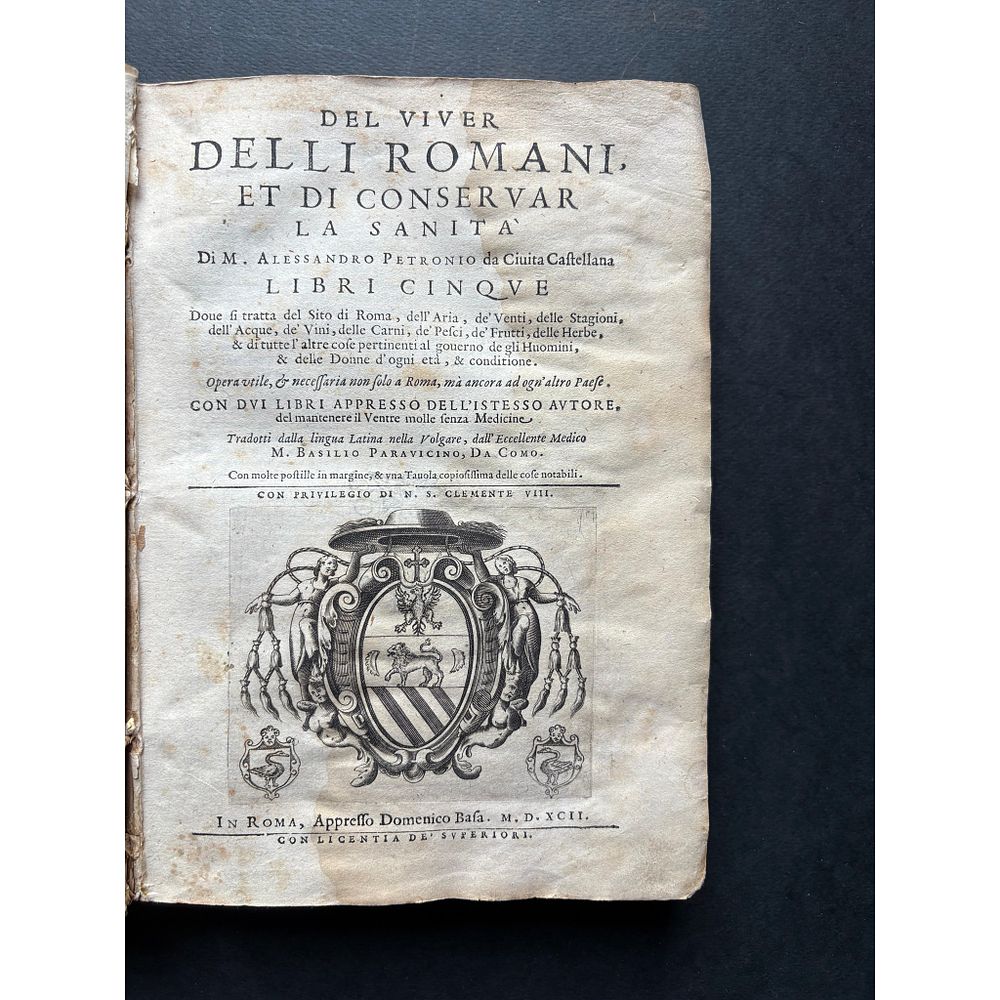
[GASTRONOMY, AGRICULTURE & FOOD HISTORY] - PETRONIO, Alessandro Traiano (c. 1510–1585) - Del viver delli Romani et di conservar la sanità - ***Note: This lot is located in Italy and requires an Italian export licence. We will manage the full application process for you. An additional fee of £50 applies.*** PETRONIO, Alessandro Traiano (c. 1510–1585). Del viver delli Romani, et di conservar la sanità. Libri cinque, dove si tratta del sito di Roma, dell’aria, de’ venti, delle stagioni, dell’acque, de’ vini, delle carni, de’ pesci, de’ frutti, delle herbe, & di tutte l’altre cose pertinenti al governo de gli huomini & delle donne d’ogni età & conditione... Con dui libri appresso dell’istesso autore, del mantenere il ventre molle senza medicine. Translated from the Latin by Basilio Paravicino. Rome, Domenico Basa, 1592. FIRST EDITION IN ITALIAN OF THIS IMPORTANT RENAISSANCE TREATISE ON FOOD, WINE, DIETETICS AND THE PRESERVATION OF HEALTH — AN EXTRAORDINARY COMPENDIUM OF GASTRONOMY AND MEDICAL ADVICE BY THE PHYSICIAN OF POPE GREGORY XIII. 4to (236 × 168 mm). [12], 416, [40] pp. Title-page with engraved arms of Cardinal Tolomeo Gallio, Cardinal of Como, to whom the Italian edition is associated; woodcut initials, head- and tailpieces, extensive marginal notes and a copious final index. Rare tiny marginal wormtracks; paper flaw to 3E1 partly affecting the text; a few small marginal tears; some waterstaining, foxing and browning, occasionally more pronounced. Contemporary limp vellum, manuscript title to spine; some staining and small losses, principally to the spine. FIRST EDITION IN ITALIAN, translated by the Como physician Basilio Paravicino from Petronio’s De victu Romanorum et de sanitate tuenda, first published in Latin at Rome in 1581. One of the most remarkable Italian works of Renaissance dietetics, Petronio’s treatise stands at the intersection of medicine, gastronomy, hygiene and the study of ancient Roman food culture. As physician and archiater to Pope Gregory XIII, Petronio approached diet not merely as a matter of nourishment or pleasure but as one of the principal instruments available to medicine for the preservation of health and the prolongation of life. The five books provide an extraordinarily extensive survey of the environmental and dietary factors believed to determine human health. Petronio discusses the site and climate of Rome, air, winds, seasons, water, wine, meat, fish, fruit, vegetables and herbs, together with the different dietary requirements of men and women according to age, constitution and condition. The full title itself reveals the encyclopaedic ambition of the work. Food occupies a central position throughout the treatise. Individual ingredients are examined not merely for flavour but according to their digestibility, nutritional qualities, humoral properties and effects upon the body. Petronio seeks to establish how particular foods should be selected and consumed in order to preserve health, delay physical decline and — in the language of contemporary medicine — “prolong life and defer old age.” Especially extensive is his discussion of wine, analysed according to quality, strength, age, colour, origin, temperature and suitability for different constitutions. Contemporary bibliographies have long valued the book for the wealth of information it preserves concerning wines known both to the Romans and to sixteenth-century Italians. Petronio likewise examines the much-debated question of drinking beverages hot or cold, mineral waters and their medicinal applications. The work is equally fascinating as a source for the history of Italian food and regional gastronomy. Petronio repeatedly refers not only to ancient Roman practices but to contemporary foods, wines and customs encountered in Rome and throughout various regions of Italy, creating a rich picture of sixteenth-century eating habits viewed through the eyes of a practising physician. His method remains firmly rooted in Renaissance Galenic medicine, yet the book is notable for its combination of classical authority with direct observation and practical medical experience. Galen and Apicius appear alongside recommendations derived from contemporary Roman life, giving the treatise an unusual dual identity as both a reconstruction of ancient dietary culture and a practical handbook for healthy living in the late Renaissance. Particularly curious are the two additional books on maintaining a naturally regular bowel without medicines — del mantenere il ventre molle senza medicine — in which Petronio extends his concept of preventive medicine into the most practical aspects of everyday bodily health. Their inclusion reinforces the central principle underlying the entire work: that careful regulation of diet and daily habits should precede pharmacological intervention. The Italian translation by Basilio Paravicino, published eleven years after the Latin original,