Bidspirit auction | [GASTRONOMY, AGRICULTURE & FOOD HISTORY]
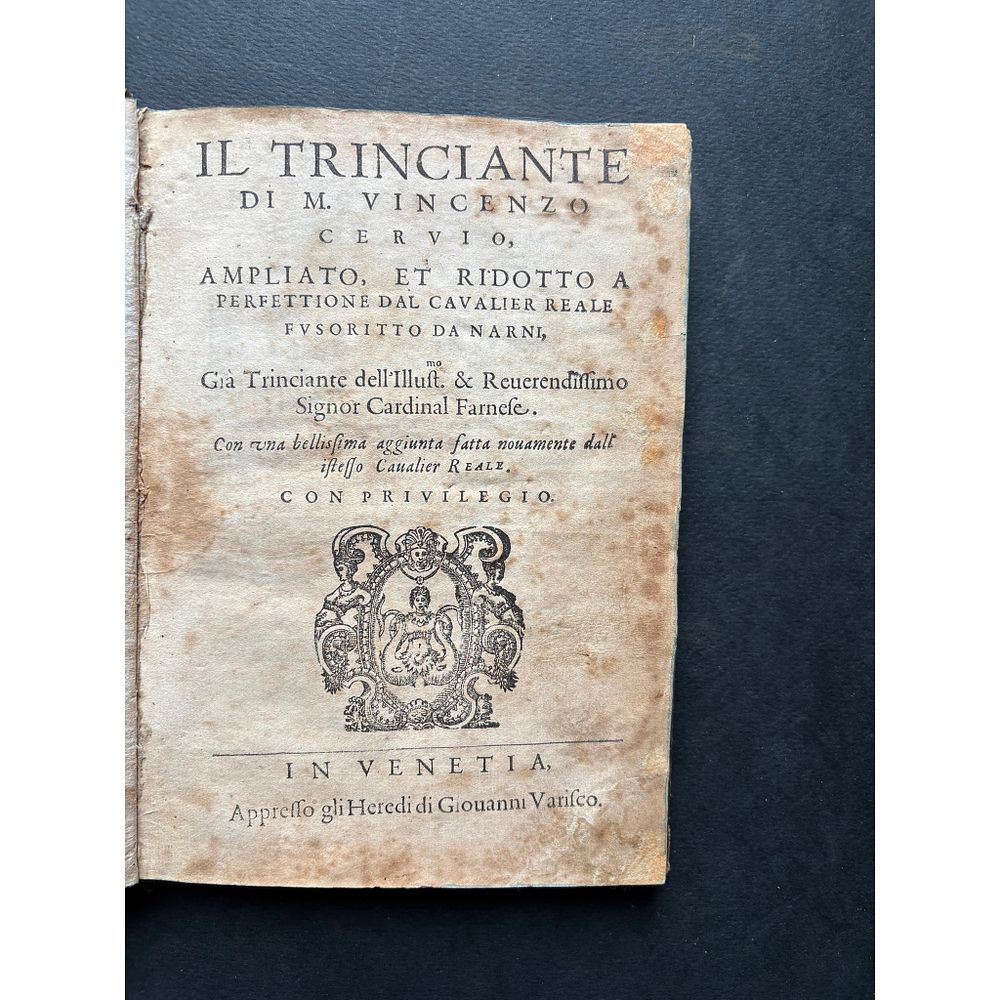
[GASTRONOMY, AGRICULTURE & FOOD HISTORY] - CERVIO, Vincenzo. - Il Trinciante - CERVIO, Vincenzo. Il Trinciante di M. Vincenzo Cervio, ampliato, et ridotto a perfettione dal Cavalier Reale Fusoritto da Narni... Con una bellissima aggiunta fatta novamente dall’istesso Cavalier Reale. Venice: Appresso gli Heredi di Giovanni Varisco, 1593. THE IMPORTANT SECOND VENETIAN EDITION, AND THE FIRST VENETIAN EDITION TO INCLUDE REALE FUSORITTO’S SUBSTANTIAL “AGGIUNTA”: ONE OF THE GREAT RENAISSANCE TREATISES ON THE ART, CEREMONY AND SPECTACLE OF CARVING AT THE TABLE. 4to (190 x 130 mm). [4] unnumbered leaves, 68 numbered leaves. Four woodcut illustrations in the text and three plates outside the text. The Aggiunta fatta al Trinciante del Cervio dal Cavalier Reale Fusoritto da Narni begins at fol. 45 and continues to fol. 68. Elegant eighteenth-century full calf, gilt edges. Some browning, occasionally more noticeable, but a genuine and attractive copy overall, preserving the complete illustrated apparatus. First published in Venice in 1581, Cervio’s Il Trinciante is one of the fundamental books on Renaissance gastronomy and courtly dining. Far more than a manual of carving, it documents an elaborate ceremonial art in which the trinciante — the professional carver serving at the tables of princes and cardinals — was expected to combine extraordinary manual dexterity with knowledge of anatomy, etiquette, presentation and courtly spectacle. Cervio describes in remarkable detail the correct methods for carving and serving an extraordinary variety of foods: domestic and game birds, four-footed animals, fish, fruits and other dishes. The accompanying woodcuts and plates illustrate both the animals themselves and the specialised knives and forks employed by the trinciante, transforming the work into an exceptional visual record of the material culture of the Renaissance table. THIS 1593 VENETIAN EDITION IS OF PARTICULAR IMPORTANCE FOR THE ADDITION OF THE NEW TREATISE BY REALE FUSORITTO DA NARNI, himself an accomplished trinciante in the service of leading ecclesiastical households. Beginning at fol. 45, Fusoritto’s Aggiunta considerably expands Cervio’s original text and further develops the ceremonial, practical and organisational aspects of aristocratic dining. The volume thus provides a remarkable insight into a world in which the preparation and presentation of food constituted a highly codified public performance: carving was executed before the assembled guests, and the elegance, precision and theatricality of the trinciante’s gestures formed an integral part of the magnificence of the banquet. AN IMPORTANT AND HIGHLY COLLECTABLE SIXTEENTH-CENTURY GASTRONOMIC BOOK, ESPECIALLY ATTRACTIVE IN ITS ELEGANT EIGHTEENTH-CENTURY FULL CALF BINDING WITH GILT EDGES. Vicaire, Bibliographie gastronomique, p. 159.