Bidspirit auction | [GASTRONOMY, AGRICULTURE & FOOD HISTORY]
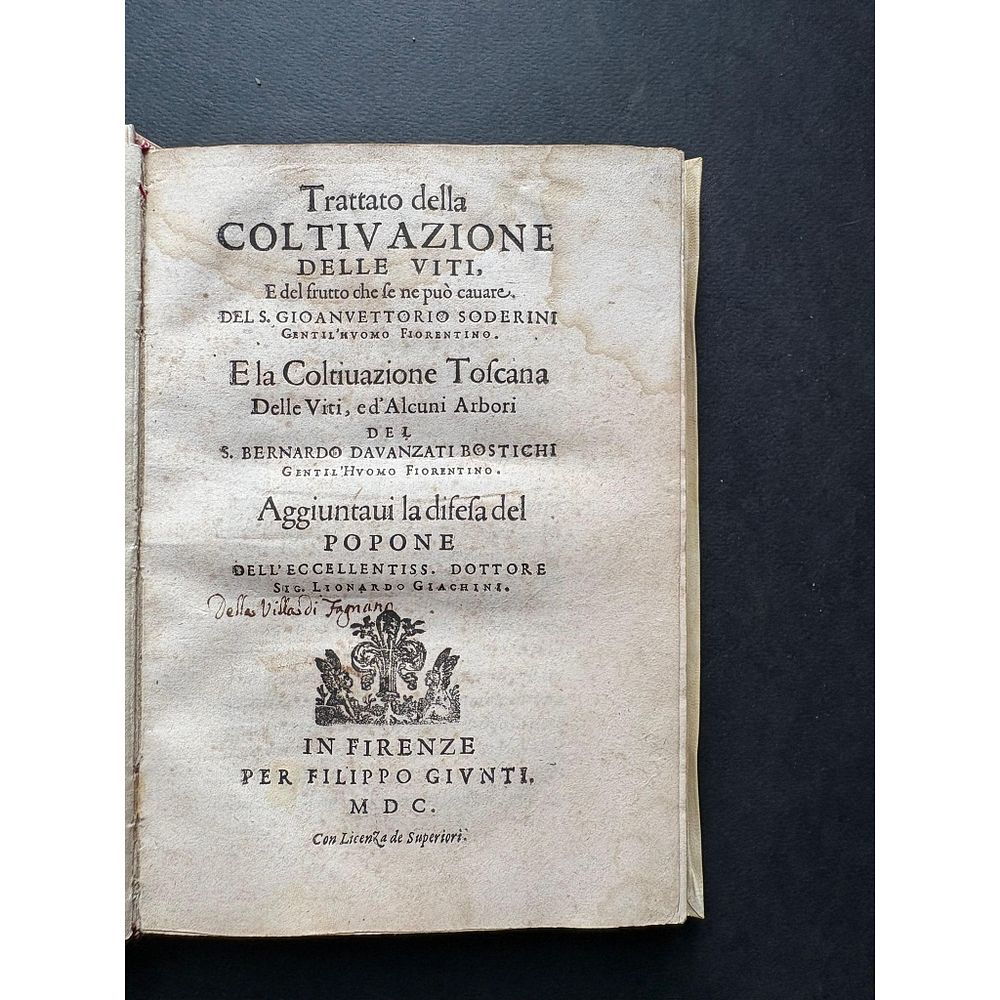
[GASTRONOMY, AGRICULTURE & FOOD HISTORY] - SODERINI, Giovan Vettorio (1526–1596) - Trattato della coltivazione delle viti - ***Note: This lot is located in Italy and requires an Italian export licence. We will manage the full application process for you. An additional fee of £50 applies.*** SODERINI, Giovan Vettorio (1526–1596). Trattato della coltivazione delle viti, e del frutto che se ne può cavare... E la Coltivazione toscana delle viti, e d’alcuni arbori del S. Bernardo Davanzati Bostichi... Aggiuntavi la Difesa del popone dell’eccellentiss. dottore Sig. Lionardo Giachini. Florence: Filippo Giunti, 1600. FIRST EDITION OF ONE OF THE FUNDAMENTAL RENAISSANCE TREATISES ON VITICULTURE AND WINE-MAKING, AND AN IMPORTANT LANDMARK IN THE EARLY ITALIAN LITERATURE OF WINE. 4to. [8], 128, [12], 45, [11], 19, [1] pp. Giunti device on the title-page and at the end. Twentieth-century vellum. A small dampstain affecting the first few leaves, otherwise a remarkably fresh, genuine and well-preserved copy. The rare first edition of Giovan Vettorio Soderini’s celebrated treatise on the cultivation of the vine and the production, treatment and preservation of wine, published posthumously only a few years after the author's death. Soderini was one of the most significant Italian agricultural writers of the late Renaissance. A Florentine nobleman and political opponent of the Medici, he spent the latter part of his life in enforced retirement on his estates, where prolonged observation and practical experience of Tuscan agriculture provided the foundation for his writings. The Trattato della coltivazione delle viti is his most celebrated work and represents an unusually systematic examination of vine-growing and oenology at the end of the sixteenth century. Soderini discusses the selection of soils and sites, the planting and propagation of vines, pruning, grafting, the influence of climate and exposure, the timing of the vintage and the treatment of the harvested grapes. Particular attention is devoted to the making and preservation of wine, its different qualities and characteristics, and the practical methods by which its flavour, aroma, colour and durability might be improved. The text is especially fascinating for its detailed observations on individual grape varieties and the wines produced from them. Soderini records numerous Tuscan and Italian grapes, making the work an important early source for the history of Italian ampelography. Some varieties mentioned by him remain identifiable in Italian vineyards today, giving the book considerable importance for the historical study of viticulture. Soderini combines empirical agricultural knowledge with beliefs characteristic of his age, including the influence of the moon and celestial conditions upon the vineyard and the vintage. The result is an exceptional document of the transition between traditional Renaissance agricultural practice and a more systematic observation of vine cultivation and wine production. The first edition was issued together with two further remarkable texts. Bernardo Davanzati Bostichi’s Coltivazione toscana delle viti, e d’alcuni arbori provides additional practical observations on Tuscan vineyards, fruit trees and agricultural practice, while Leonardo Giachini’s Difesa del popone offers a witty and learned defence of the melon, adding an engaging gastronomic dimension to the volume. Published by the celebrated Florentine Giunti press, this collection constitutes an important compendium of late-Renaissance Italian agriculture, viticulture and gastronomy. A RARE AND HIGHLY DESIRABLE FIRST EDITION OF A CLASSIC OF EARLY WINE LITERATURE, OF PARTICULAR INTEREST TO COLLECTORS OF VITICULTURE, OENOLOGY, GASTRONOMY AND RENAISSANCE SCIENCE. USTC 856956; Simon, Bibliotheca Vinaria, 622; Brunet V, 425.