Bidspirit auction | [GASTRONOMY, AGRICULTURE & FOOD HISTORY]
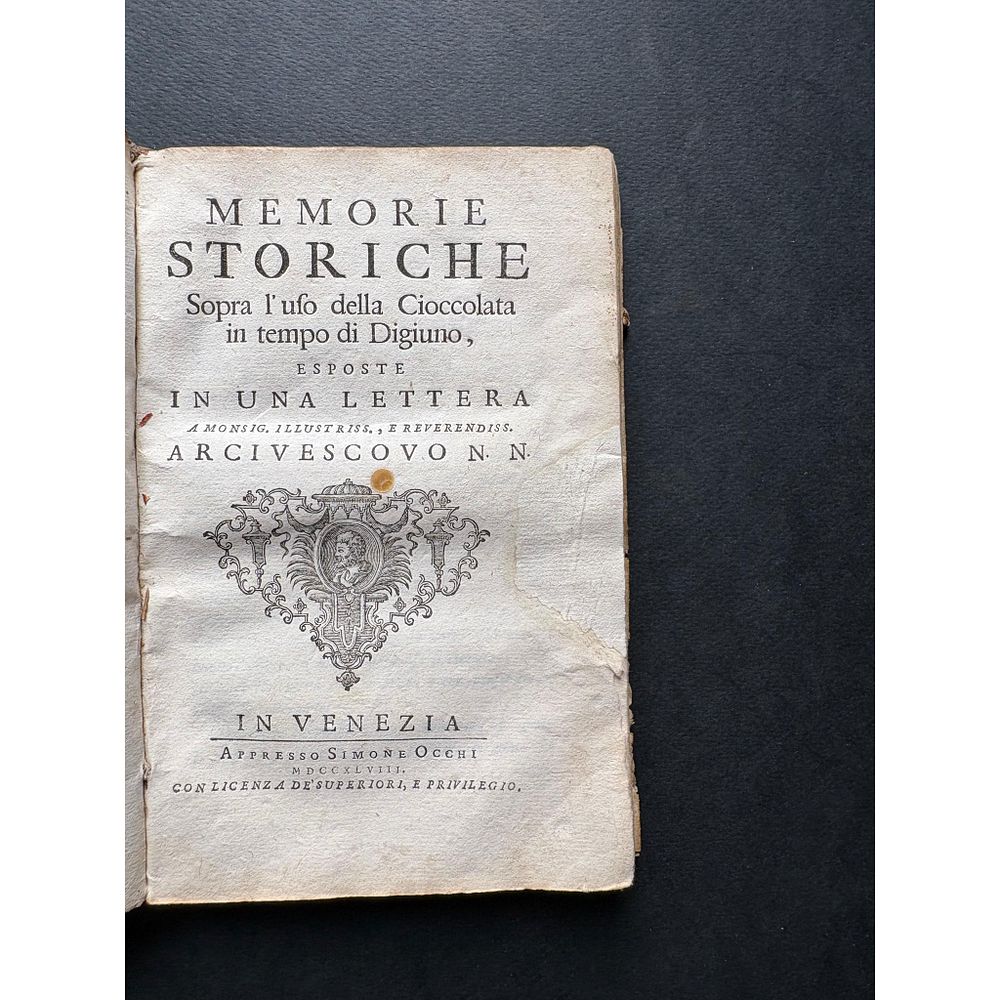
[GASTRONOMY, AGRICULTURE & FOOD HISTORY] - CONCINA, Daniele (1687–1756) - Memorie storiche sopra l'uso della cioccolata in tempo di digiuno - CONCINA, Daniele (1687–1756). Memorie storiche sopra l’uso della cioccolata in tempo di digiuno, esposte in una lettera a Monsig. Illustriss. e Reverendiss. Arcivescovo N. N. Venice: Appresso Simone Occhi, 1748. FIRST EDITION OF THIS RARE AND IMPORTANT EIGHTEENTH-CENTURY TREATISE ON CHOCOLATE, ITS HISTORY, MEDICINAL AND MORAL IMPLICATIONS, AND THE CELEBRATED CONTROVERSY OVER ITS CONSUMPTION DURING RELIGIOUS FASTING. 8vo (190 x 130 mm). [8], CXCVI pp. Half-title, woodcut ornament on title-page. Traces of an early restoration confined to the blank area of the title-page. An exceptionally fresh and clean copy internally, the paper remarkably crisp and well preserved; only two stains affecting pp. CX–CXI, without obscuring or impairing the legibility of the text. A VERY RARE FIRST EDITION OF ONE OF THE MOST CURIOUS ITALIAN BOOKS DEVOTED TO CHOCOLATE IN THE EIGHTEENTH CENTURY. The Dominican theologian Daniele Concina wrote the present work in the midst of a long-standing theological and medical controversy: could chocolate be consumed during periods of ecclesiastical fasting without breaking the fast? By the eighteenth century chocolate had evolved from an exotic product imported from the New World into one of Europe's most fashionable luxury beverages. Its increasing popularity, particularly among the aristocracy and clergy, inevitably raised questions concerning its nutritional properties. Was chocolate merely a drink, or was it sufficiently nourishing to constitute food? And, consequently, could its consumption be reconciled with the religious discipline of fasting? Concina adopts a decidedly rigorous position. He challenges the increasingly widespread tolerance of chocolate during fasting and systematically examines — and attempts to refute — the arguments advanced by writers who had defended its consumption. Of particular interest, however, is the author's historical account of chocolate itself, tracing its origins and its passage from the Americas into European culture. The work thus occupies an important place not only in the history of Catholic fasting and moral theology, but also in the early European literature of cacao, chocolate, dietetics and gastronomy. Published anonymously, Concina's authorship was subsequently identified bibliographically. The 1748 Venetian edition is the first edition, followed by another edition in 1749. AN IMPORTANT AND HIGHLY COLLECTABLE DOCUMENT IN THE EARLY HISTORY OF CHOCOLATE IN EUROPE, AND PARTICULARLY DESIRABLE IN SUCH REMARKABLY FRESH INTERNAL CONDITION. Goldsmiths’-Kress 08341.2.