Bidspirit auction | [GASTRONOMY, AGRICULTURE & FOOD HISTORY]
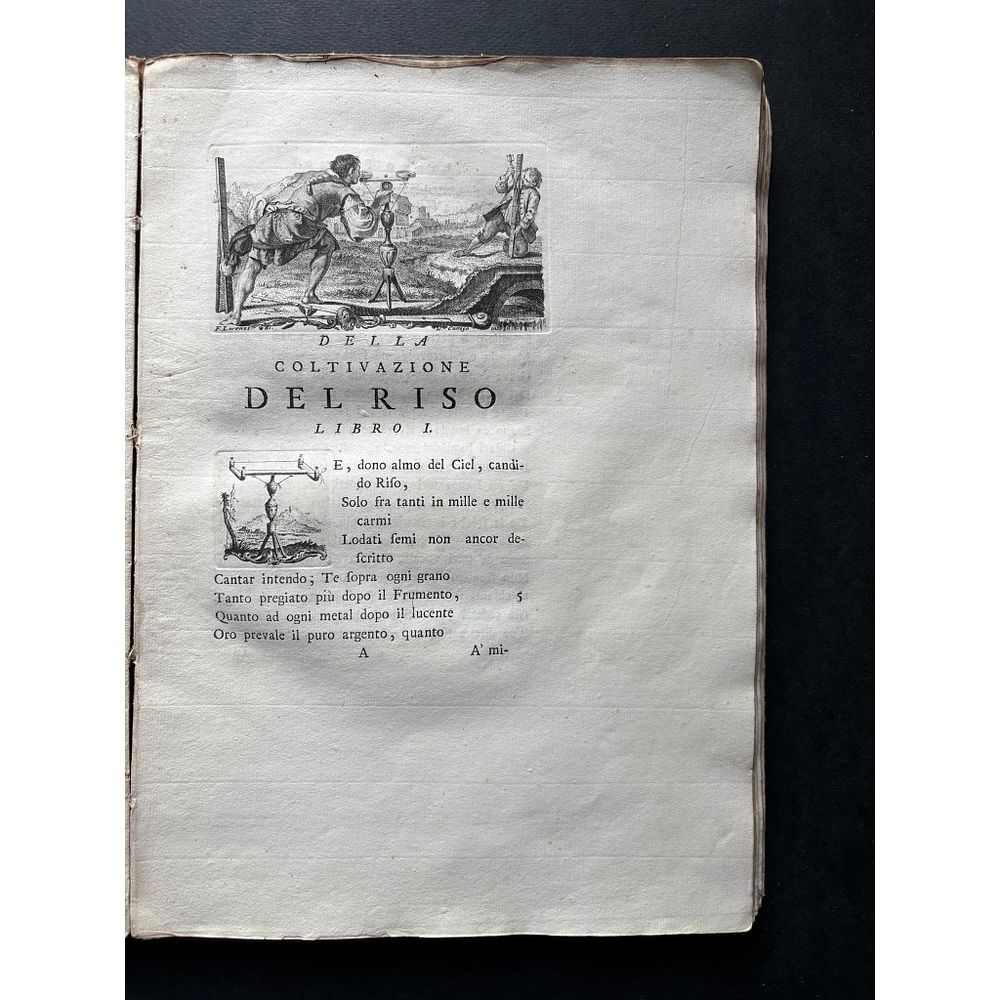
[GASTRONOMY, AGRICULTURE & FOOD HISTORY] - SPOLVERINI, Gian Battista (1695–1763) - La coltivazione del riso - ***Note: This lot is located in Italy and requires an Italian export licence. We will manage the full application process for you. An additional fee of £50 applies.*** SPOLVERINI, Gian Battista (1695–1763). La coltivazione del riso del Marchese Gian Battista Spolverini al Cattolico Re Filippo Quinto. Seconda edizione. Verona: per Agostino Carattoni, Stampatore del Seminario Vescovile, 1763. THE ELEGANT SECOND EDITION OF ONE OF THE MOST CELEBRATED EIGHTEENTH-CENTURY ITALIAN WORKS DEVOTED ENTIRELY TO RICE CULTIVATION — A REMARKABLE UNION OF AGRICULTURAL SCIENCE, GASTRONOMIC HISTORY AND GEORGIC POETRY. Large 4to (300 × 225 mm). [10], 209, [1] pp. Engraved allegorical frontispiece, large allegorical vignette on title-page, five finely engraved ornamental initials, four engraved headpieces and three tailpieces. Contemporary boards, the spine covered in contemporary marbled paper, with manuscript title written vertically. A PARTICULARLY ATTRACTIVE COPY, PRINTED ON STRONG, HEAVY PAPER, UNCUT AND PRESERVING ITS DECKLE EDGES, IN ITS UNSOPHISTICATED CONTEMPORARY BINDING. Rare second edition, following the first of 1758, of Spolverini’s celebrated didactic poem on rice cultivation, one of the most distinctive works of eighteenth-century Italian agricultural literature. Written in four books of blank verse and consciously inspired by the classical tradition of Virgil’s Georgics, Spolverini’s poem elevates the cultivation of rice — by then one of the increasingly important crops of northern Italy — into the subject of an ambitious literary and agricultural composition. The author discusses in considerable detail the preparation and selection of the land, irrigation and the management of water, sowing, cultivation, harvesting and processing of rice, combining practical agricultural knowledge with the refined literary language of eighteenth-century georgic poetry. The work possesses considerable documentary importance for the history of Italian agriculture. The flooded fields, systems of irrigation, seasonal labour, agricultural implements and techniques required for successful rice cultivation are described with unusual precision, providing a vivid picture of the transformation of the rural landscape of northern Italy. Rice, originally an exotic cereal, had by the eighteenth century become increasingly central to the economy and food culture of the Po Valley. Spolverini’s work therefore represents not only a literary achievement but also an important source for the history of food, agriculture and rice cultivation in Europe. Spolverini consciously positioned himself within the great Italian tradition of agricultural poetry, particularly that of Luigi Alamanni’s La coltivazione. His decision to devote an entire poem to rice — a subject scarcely treated by earlier Italian writers — gives the work a distinctive position within eighteenth-century agricultural literature. A FINE EXAMPLE OF EIGHTEENTH-CENTURY BOOK ILLUSTRATION The volume is further distinguished by its elegant decorative apparatus, beginning with the engraved allegorical frontispiece and continuing with the large allegorical vignette on the title-page, ornamental initials, headpieces and tailpieces. These illustrations transform what might otherwise have been a purely technical agricultural text into a refined illustrated book, combining the practical world of rural labour with the Arcadian and allegorical vocabulary characteristic of eighteenth-century Italian art. The pictorial programme is particularly appropriate to the character of the poem: agriculture is not represented merely as manual labour, but as a cultivated and almost classical activity, worthy of poetry, allegory and artistic celebration. The physical qualities of the present copy are especially desirable. Printed on strong paper, exceptionally broad-margined and entirely uncut, with the original deckle edges preserved throughout, it retains much of the appearance in which it would originally have left the printer. The contemporary boards, with their marbled-paper spine and manuscript title, further enhance its appealingly unsophisticated character. A HIGHLY DESIRABLE COPY OF A CLASSIC OF EARLY RICE LITERATURE, COMBINING AGRICULTURE, GASTRONOMY, POETRY AND EIGHTEENTH-CENTURY BOOK ILLUSTRATION — PARTICULARLY ATTRACTIVE ON STRONG PAPER, UNCUT WITH DECKLE EDGES, AND PRESERVED IN ITS CONTEMPORARY BINDING.