Bidspirit auction | [GASTRONOMY, AGRICULTURE & FOOD HISTORY]
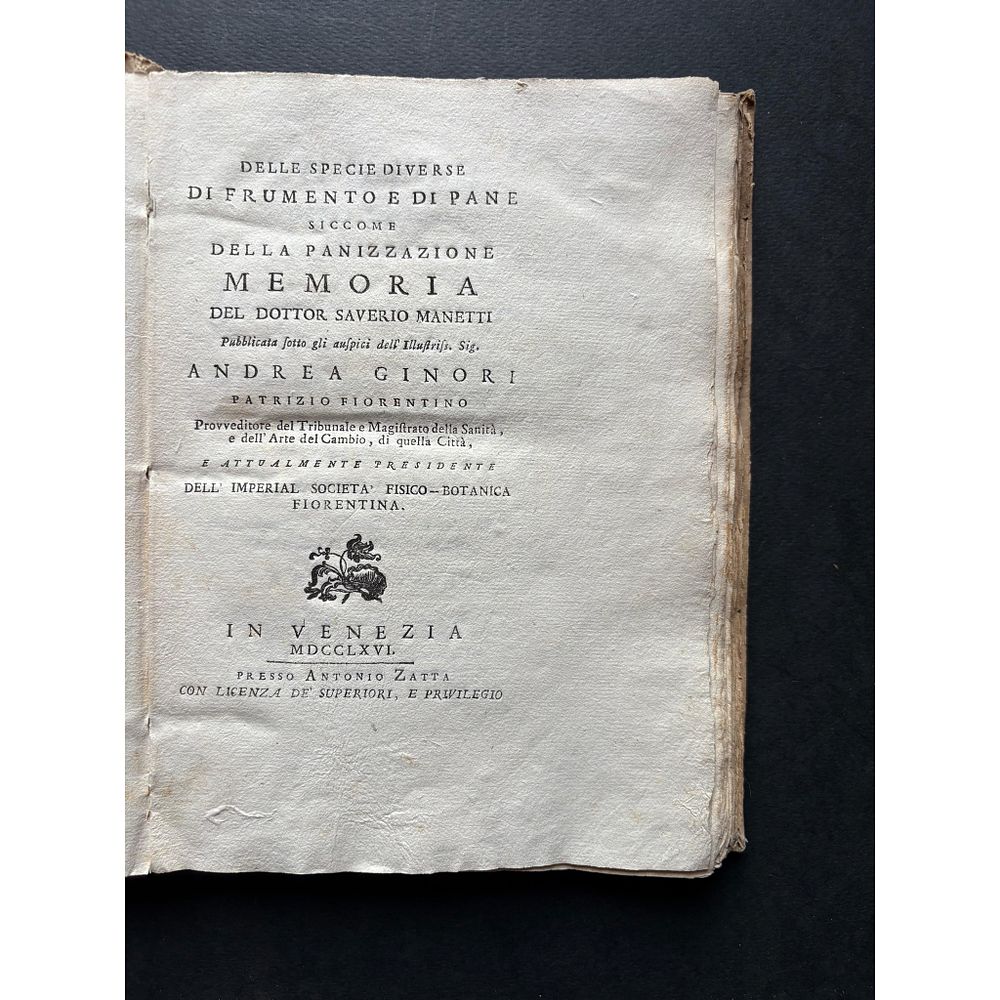
[GASTRONOMY, AGRICULTURE & FOOD HISTORY] - MANETTI, Saverio (1723–1785) - Delle specie diverse di frumento e di pane - ***Note: This lot is located in Italy and requires an Italian export licence. We will manage the full application process for you. An additional fee of £50 applies.*** MANETTI, Saverio (1723–1785). Delle specie diverse di frumento e di pane siccome della panizzazione, e di tutte quelle piante, e parti di esse singolarmente, che in occasione di carestia possono panizzarsi, o per alimento in altra maniera usate possono al pane supplire. Venice: Antonio Zatta, 1766. RARE SECOND EDITION OF ONE OF THE MOST IMPORTANT EIGHTEENTH-CENTURY ITALIAN TREATISES DEVOTED TO WHEAT, FLOUR, BREAD AND BREAD-MAKING, WRITTEN IN DIRECT RESPONSE TO THE GREAT FAMINE OF 1763–1766. 4to. [8], 237, [3] pp. Typographical ornament on title-page. Contemporary temporary boards (cartonatura coeva d’attesa), manuscript title to spine; binding naturally somewhat loose. A remarkably fresh, wide-margined and completely uncut copy, preserving its original deckle edges. The rare second edition, published in Venice only one year after the Florence first edition of 1765, of Saverio Manetti’s remarkable study of wheat, bread and the possibilities of producing substitutes for bread in periods of scarcity. Far more than a technical manual of baking, Manetti’s work stands at the intersection of gastronomy, botany, agriculture, economic history and public nutrition. Written against the background of the severe subsistence crisis which struck much of Italy between 1763 and 1766, it attempts to answer one of the most urgent questions of eighteenth-century European society: how could a population be fed when conventional wheat supplies failed? Manetti begins with an extensive examination of wheat and its different varieties, proceeding to flour, milling and the processes of bread-making. He discusses the principal kinds of bread, their preparation and baking, differences in quality, defects and adulterations, and breads produced in different regions and countries. Of particular interest is his systematic investigation of plants capable of replacing or supplementing wheat in periods of famine. Manetti considers rye, barley, maize, millet, oats and sorghum, together with legumes such as beans and vetches, and even the potato, at that time still far from universally accepted as a staple food in Italy. The book therefore constitutes an exceptionally early and revealing document of attempts to diversify European food resources and improve food security. The work is also fascinating from a specifically gastronomic point of view. Manetti discusses the different qualities of flour and their suitability for bread and pasta, various methods of manufacture and cooking, composite breads and unusual substitutes, preserving valuable information on eighteenth-century Italian eating habits. The 1766 text even provides an early printed occurrence of “tagliatelli sottili”, cited in modern historical studies of Italian culinary vocabulary. Saverio Manetti, physician and distinguished naturalist, was closely associated with the Accademia dei Georgofili, one of the earliest European institutions devoted to agricultural science. His scientific and botanical interests are clearly reflected throughout the present work: the problem of bread is approached not merely as a culinary question, but as a matter of agriculture, plant classification, economics and public welfare. The importance of the book lies precisely in this combination of scientific observation and immediate social necessity. It provides a vivid picture of food scarcity and popular nutrition in eighteenth-century Italy, while at the same time proposing practical means by which agriculture and the exploitation of alternative plants might mitigate future famines. A HIGHLY DESIRABLE COPY, PARTICULARLY ATTRACTIVE IN ITS UNSOPHISTICATED CONTEMPORARY TEMPORARY BINDING, ENTIRELY UNCUT, FRESH AND WITH GENEROUS DECKLE-EDGED MARGINS — A RARE SURVIVAL IN A CONDITION ESPECIALLY APPROPRIATE FOR A WORK OF THIS NATURE. Bitting 185; Vicaire 406; Westbury, pp. 138–140; B.IN.G. 1222.