Bidspirit auction | [GASTRONOMY, AGRICULTURE & FOOD HISTORY]
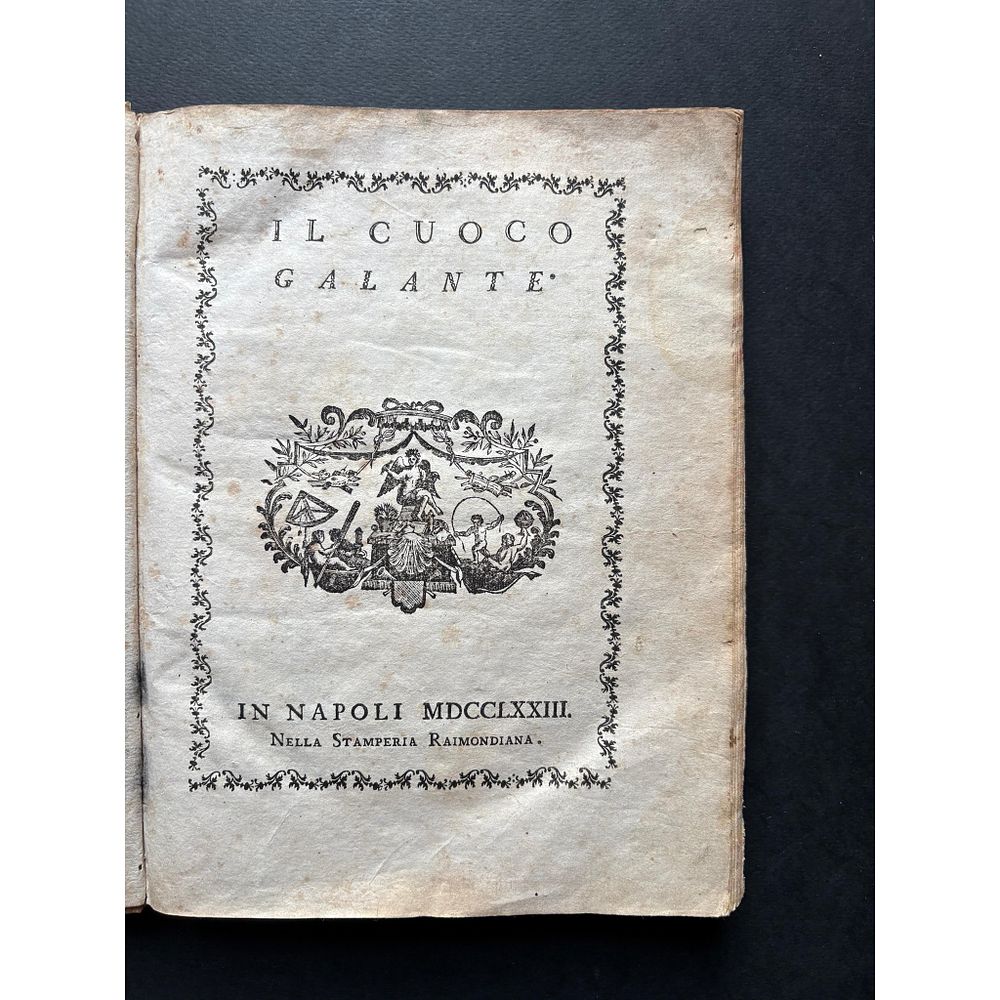
[GASTRONOMY, AGRICULTURE & FOOD HISTORY] - CORRADO, Vincenzo (1736–1836) - Il cuoco galante - CORRADO, Vincenzo (1736–1836). Il cuoco galante. Naples, nella Stamperia Raimondiana, 1773. AN EXCEPTIONALLY INTERESTING COPY OF THE VERY RARE FIRST EDITION, COMPLETE WITH BOTH FOLDING PLATES, WITH AN APPARENTLY AUTHORIAL MANUSCRIPT ADDITION AND 22 CONTEMPORARY BLANK LEAVES SPECIALLY BOUND IN FOR FURTHER RECIPES OR ADDITIONS — POSSIBLY VINCENZO CORRADO’S OWN WORKING COPY. 8vo. [8], 234 pp., with 2 folding engraved plates illustrating elaborate arrangements of dining tables, followed by 22 additional blank leaves bound in at the time of the contemporary binding. Contemporary vellum. Some light defects and occasional staining to the paper, but overall a good, genuine and highly appealing copy preserved in its original eighteenth-century binding. VERY RARE FIRST EDITION of one of the great classics of eighteenth-century Italian gastronomy and one of the foundational works of Neapolitan culinary literature. Published anonymously in Naples in 1773, Il cuoco galante is the celebrated masterpiece of Vincenzo Corrado, a lay member of the Celestine congregation of San Pietro a Majella, a man of considerable culture and one of the most important gastronomic figures active at the aristocratic courts of eighteenth-century Naples. OF EXCEPTIONAL INTEREST IS A CONTEMPORARY MANUSCRIPT ADDITION, APPARENTLY IN CORRADO’S OWN HAND, AT THE CONCLUSION OF THE DEDICATION. Immediately following the printed subscription: “Umilissimo, devotissimo ed obbligatissimo servitore, Il Cuoco Galante” the manuscript continues: “un monaco laico della Congregazione dei Celestini di S. Pietro in Majella.” The annotation is particularly significant in this anonymous first edition, since it identifies the still unnamed Cuoco Galante precisely through Corrado’s own position within the Celestine congregation of San Pietro a Majella. Its placement, directly continuing the printed subscription at the conclusion of the dedication, strongly suggests an authorial association with the present copy. Even more remarkable are the 22 blank leaves deliberately bound in at the end of the volume. These leaves do not form part of the normal printed collation of the first edition and, being integral to the contemporary binding, were evidently added when the book was first bound, almost certainly to provide space for additional recipes, corrections, observations or culinary experiments. The conjunction of these two highly unusual features — the apparently authorial manuscript continuation identifying the anonymous author and the substantial series of blank leaves expressly provided for additions — gives the present volume the compelling character of a possible personal or working copy prepared for Vincenzo Corrado himself. Corrado spent much of his professional life in the service of Michele Imperiali, Prince of Francavilla, at Palazzo Cellamare in Naples, where he was responsible for the organisation of elaborate meals and entertainments within one of the most sophisticated aristocratic households of the Bourbon capital. The Cuoco galante marks an important stage in the development of Italian culinary literature. Although firmly rooted in the sophisticated court cuisine of the eighteenth century, Corrado increasingly brought attention to ingredients, preparations and tastes characteristic of southern Italy. His discussions of vegetables, fish, pasta, rice, eggs, dairy products, pastries and other foods anticipate fundamental elements of the later Neapolitan and Mediterranean culinary tradition. Corrado’s importance lies also in his conception of cookery as an art of proportion, taste, elegance and presentation. The two folding engraved plates, showing elaborately laid dining tables, are an eloquent visual expression of this philosophy and constitute valuable evidence for aristocratic dining culture in eighteenth-century Naples. The immediate success of the book resulted in a second edition in 1778 and in several further, substantially enlarged editions during Corrado’s lifetime. The numerous reprints testify to the extraordinary popularity and influence of the work, while making copies of the original 1773 first edition considerably scarcer and more desirable. A REMARKABLE AND POSSIBLY UNIQUE ASSOCIATION COPY OF ONE OF THE FOUNDATIONAL TEXTS OF ITALIAN GASTRONOMY: THE RARE 1773 FIRST EDITION, COMPLETE WITH BOTH FOLDING PLATES, PRESERVED IN ITS CONTEMPORARY VELLUM BINDING, WITH AN APPARENTLY AUTHORIAL MANUSCRIPT IDENTIFICATION AND 22 CONTEMPORARY BLANK LEAVES SPECIALLY BOUND IN FOR ADDITIONAL RECIPES — STRONGLY SUGGESTIVE OF VINCENZO CORRADO’S OWN WORKING OR PERSONAL COPY.