Bidspirit auction | [GASTRONOMY, AGRICULTURE & FOOD HISTORY]
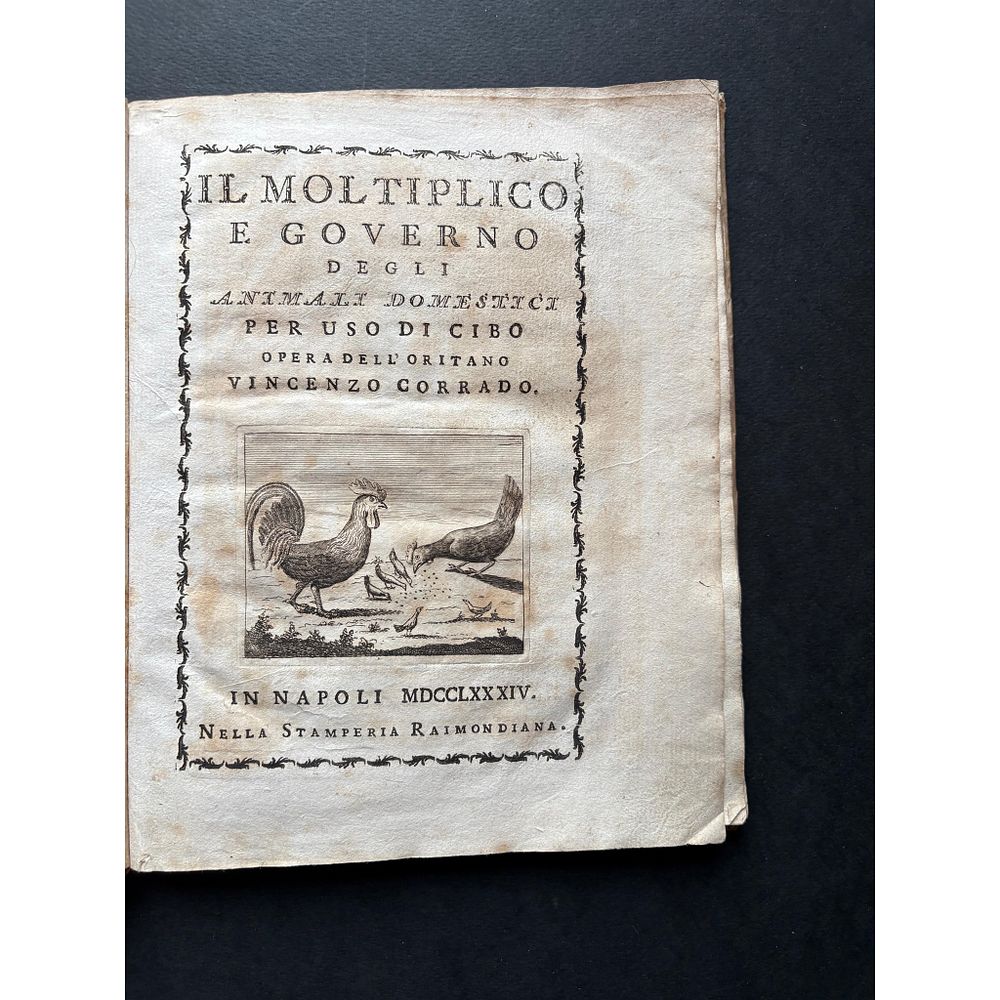
[GASTRONOMY, AGRICULTURE & FOOD HISTORY] - CORRADO, Vincenzo (1736–1836) - Il moltiplico e governo degli animali domestici - CORRADO, Vincenzo (1736–1836). Il moltiplico e governo degli animali domestici per uso di cibo. Opera dell’Oritano Vincenzo Corrado. Naples, nella Stamperia Raimondiana, 1784. RARE FIRST AND ONLY EDITION OF CORRADO’S CURIOUS TREATISE ON THE BREEDING AND MANAGEMENT OF DOMESTIC ANIMALS FOR THE TABLE — AN UNUSUAL COMPANION TO HIS CELEBRATED CUOCO GALANTE. 4to (230 × 180 mm). XVI, 42, [2] pp. Engraved portrait of Vincenzo Corrado as frontispiece; title-page within an ornamental border and with a large engraved vignette depicting domestic and farm animals; engraved headpieces, initials and ornaments. Occasional light foxing and a few faint scattered stains, otherwise a very good copy. Contemporary full vellum, smooth spine with gilt title within a decorative cartouche. FIRST AND ONLY EDITION. A rare and highly characteristic work by Vincenzo Corrado, one of the most original figures in eighteenth-century Italian gastronomic literature, devoted not to the preparation of food itself but to the breeding, multiplication and management of animals destined for the table. Published eleven years after the first edition of the Cuoco galante, the present treatise reveals another aspect of Corrado’s remarkably comprehensive conception of gastronomy. For him, good cookery began long before the kitchen: with the selection, breeding, feeding and proper management of the animals from which food was obtained. Corrado discusses the raising and care of a variety of animals intended for domestic consumption, including poultry, ducks, pheasants, goats and other small livestock, combining practical husbandry with the gastronomic outlook of an experienced professional cook. The work thus occupies a fascinating position between culinary literature, agricultural economy and eighteenth-century animal husbandry. Particularly attractive is the final section devoted to bees and the production of honey. Corrado emphasises the universal culinary usefulness of honey — as a condiment, in the preparation of fruit, sauces and pastries — and explicitly refers the reader back to recipes and methods already discussed in his Cuoco galante. The passage provides a revealing link between the present agricultural treatise and Corrado’s better-known gastronomic writings. The engraved portrait of Corrado at the beginning of the volume is of particular interest and is frequently absent from copies; at least one recorded example currently offered on the antiquarian market is described as lacking it. The work forms part of Corrado’s broader project to systematise every aspect of aristocratic food culture: from the sourcing and production of ingredients to their preparation, presentation and service. Seen in this context, Il moltiplico e governo degli animali domestici constitutes an important complement to the Cuoco galante and a remarkably early Italian attempt to connect animal husbandry directly with gastronomic practice. A VERY ATTRACTIVE COPY IN CONTEMPORARY VELLUM, COMPLETE WITH THE ENGRAVED PORTRAIT OF THE AUTHOR, OF ONE OF CORRADO’S RAREST AND MOST CURIOUS WORKS — AN IMPORTANT DOCUMENT IN THE HISTORY OF ITALIAN GASTRONOMY, FOOD PRODUCTION AND DOMESTIC HUSBANDRY. Bitting 101; Westbury 58; Paleari Henssler 103; B.IN.G. 557.