Bidspirit auction | [RELIGION & THEOLOGY] - DÍAZ
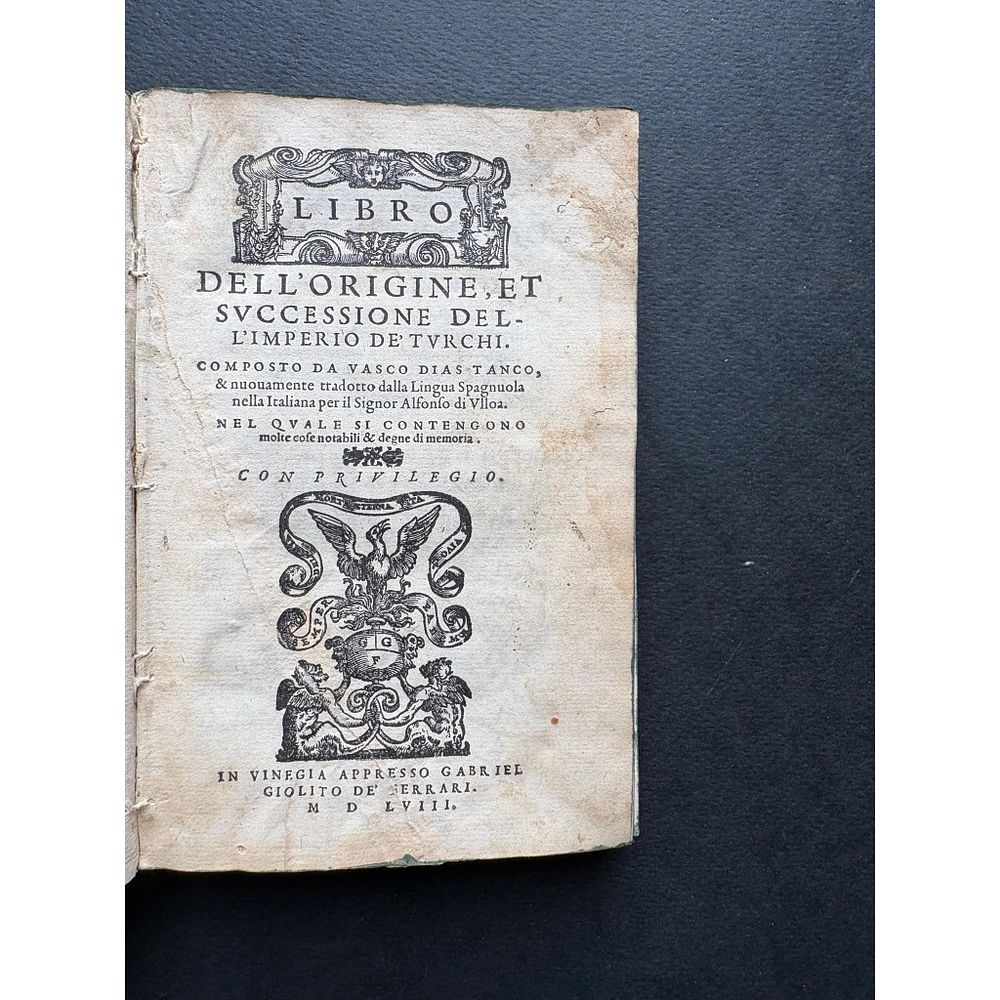
[RELIGION & THEOLOGY] - DÍAZ TANCO DE FREGENAL, Vasco. - Libro dell'origine et successione dell'Imperio de Turchi - DÍAZ TANCO DE FREGENAL, Vasco. Libro dell’origine, et successione dell’Imperio de Turchi. Composto da Vasco Dias Tanco, & nuovamente tradotto dalla lingua spagnuola nella italiana per il Signor Alfonso di Ulloa. Nel qual si contengono molte cose notabili & degne di memoria. Venice: Gabriele Giolito de’ Ferrari, 1558. 8vo (151 × 100 mm). 237, [3] pp., the final two leaves blank. Woodcut Giolito device on title and repeated at the end, woodcut headpieces, initials and ornaments. Eighteenth-century vellum, lettering-piece to spine, blue edges. Title slightly soiled at margin; otherwise a genuine and attractive copy. First edition in Italian. A rare first Italian edition of Vasco Díaz Tanco’s history of the origins, expansion and succession of the Ottoman Empire, translated and significantly adapted for the Venetian readership by Alfonso de Ulloa, one of the most active cultural mediators between Spain and Italy in the sixteenth century. The work first appeared in Spanish at Orense in 1547 under the strikingly polemical title Palinodia de la nephanda y fiera nación de los Turcos, y de su engañoso arte y cruel modo de guerrear. Díaz Tanco, a cleric, writer, printer and traveller, had spent several years in Italy and followed closely the advance of Ottoman power in the Mediterranean and southeastern Europe. His account describes the origins and succession of the Ottoman rulers, their military expansion, conquests, government and methods of warfare, while reflecting the intense anxiety created throughout Christian Europe by the rapid growth of Turkish power during the reigns of Selim I and Suleiman the Magnificent. The Spanish original is openly militant and vehemently anti-Ottoman. Díaz Tanco presents the Turks as an existential threat to Christian Europe and calls for unity among Christian rulers against their expansion. The Venetian edition of 1558, however, is considerably more subtle. Its translator, Alfonso de Ulloa, was a Spaniard resident in Venice and one of the most prolific translators, editors and cultural intermediaries of his generation. Working with leading Venetian publishers, including Giolito, Valgrisi and others, Ulloa played a major role in transmitting Spanish historical, political and literary works to an Italian audience. In translating Díaz Tanco, Ulloa adapted the work to the very different circumstances of Venice. The Republic’s relationship with the Ottoman Empire combined military rivalry with diplomacy, commercial necessity and long-established economic exchange. The inflammatory language of the Spanish original was consequently moderated, and even the title was transformed from the violent Palinodia de la nephanda y fiera nación de los Turcos into the far more neutral Libro dell’origine et successione dell’Imperio de Turchi. This transformation makes the 1558 edition particularly interesting as a document of Renaissance political culture. It demonstrates how perceptions of the Ottoman Empire could change according to the audience for whom a book was intended: from the image of an almost demonic enemy in the Spanish original to that of a formidable neighbouring empire whose history, institutions and military power demanded careful study. Díaz Tanco’s work itself drew upon the rich sixteenth-century European historiography of the Ottomans, including the writings of Paolo Giovio, while expanding the narrative with material on Turkish rulers, campaigns, territories and military organization. Published by Gabriele Giolito de’ Ferrari, one of the greatest Venetian printers of the Renaissance, the present edition also belongs to the flourishing mid-sixteenth-century market for histories of the Ottoman Empire at a moment when the political balance of the Mediterranean was one of the central concerns of European diplomacy. A rare and attractive first Italian edition of an important Renaissance account of the Ottoman Empire, particularly significant for Alfonso de Ulloa’s adaptation of a fiercely anti-Turkish Spanish text to the more complex political and commercial realities of sixteenth-century Venice.