Bidspirit auction | [ECONOMY SCIENCE] - TESAURO, Gaspare
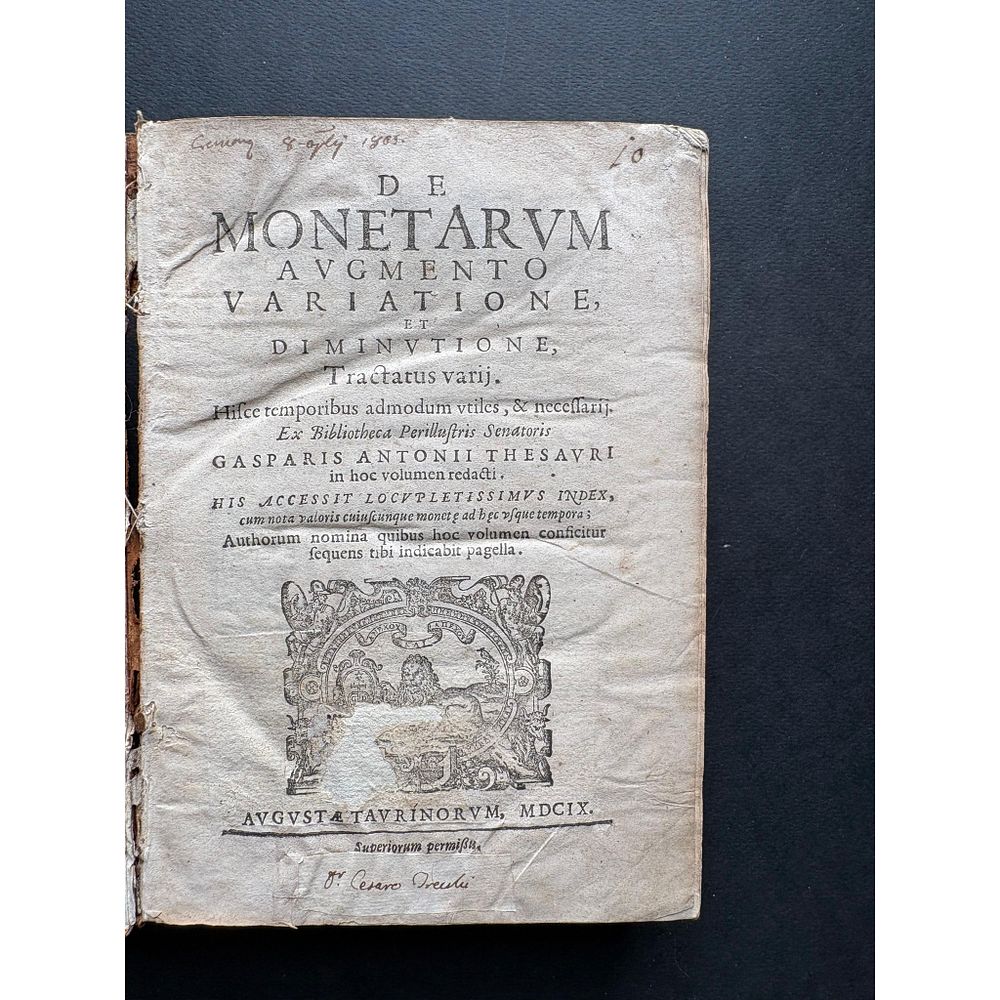
[ECONOMY SCIENCE] - TESAURO, Gaspare Antonio. - De monetarum augmento, variatione, et diminutione - ***Note: This lot is located in Italy and requires an Italian export licence. We will manage the full application process for you. An additional fee of £50 applies.*** TESAURO, Gaspare Antonio. De monetarum augmento, variatione, et diminutione, tractatus varii. Hisce temporibus admodum utiles, & necessarii. Ex bibliotheca perillustris senatoris Gasparis Antonii Thesauri in hoc volumen redacti. Turin: Giovanni Domenico Tarino, 1609. 4to (210 × 145 mm). [48], 914 [i.e. 912], [12] pp. Printer’s device on title-page. Slightly later half calf, gilt ornaments to spine, manuscript title to lower edge. Title-page restored, with small wormhole at inner margin; binding worn with losses to spine. First edition. A rare and important early collection of treatises on money, coinage, currency depreciation and the legal consequences of monetary alteration, assembled by the Piedmontese jurist and senator Gaspare Antonio Tesauro. The volume brings together fourteen texts by medieval and Renaissance authorities concerned with one of the most pressing economic problems of early modern Europe: the power of rulers to alter the value of money and the consequences of such interventions for prices, contracts, debts and commercial exchange. Among the principal works are Gabriel Biel’s De monetarum potestate et utilitate, Giovanni dell’Aquila’s Libellus de utilitate et potestate monetarum, Martino Garrati’s Tractatus de monetis, Alberto Bruni’s Tractatus augmenti et diminutionis monetae, Antonio Sola’s Tractatus de monetis, and Antonio Fabri’s Tractatus de variis nummariorum debitorum solutionibus. These authors address fundamental questions that lie at the origins of monetary theory: What gives money its value? To what extent may a sovereign alter that value? Must debts contracted under one monetary standard be repaid according to the nominal value of the coin or according to its intrinsic metallic content? And what happens when political authority deliberately debases or revalues the currency? Such problems were far from theoretical. During the Renaissance and early seventeenth century European states repeatedly altered the metallic content and official value of their coinage, producing serious difficulties in the settlement of older debts and contracts. The texts collected by Tesauro therefore stand at the intersection of law, economics and political authority. Particularly significant is the presence of Gabriel Biel, whose late-fifteenth-century discussion of the nature and function of money belongs to the important Scholastic tradition that examined the moral and political limits of monetary manipulation. The later jurists gathered here developed these questions in increasingly practical terms, addressing disputes arising from inflation, devaluation and changes imposed by sovereign governments. Gaspare Antonio Tesauro, a jurist and magistrate in the service of the Dukes of Savoy, assembled the collection from his own library. His legal experience within the Piedmontese judicial system made questions of monetary alteration and contractual obligation matters of immediate practical significance rather than purely academic speculation. Published at Turin in 1609, the volume provides an unusually rich survey of pre-modern European thinking on monetary policy before the emergence of classical political economy. It documents the gradual development of concepts concerning intrinsic and nominal value, debasement, inflation, public authority and the protection of creditors and debtors.A rare and substantial first edition of one of the most useful early collections devoted entirely to monetary theory and law, bringing together fourteen important texts on currency, debasement and the economic powers of the sovereign. Reference: Kress 117A.