Bidspirit auction | [HISTORY, POLITICS & HERALDRY] -
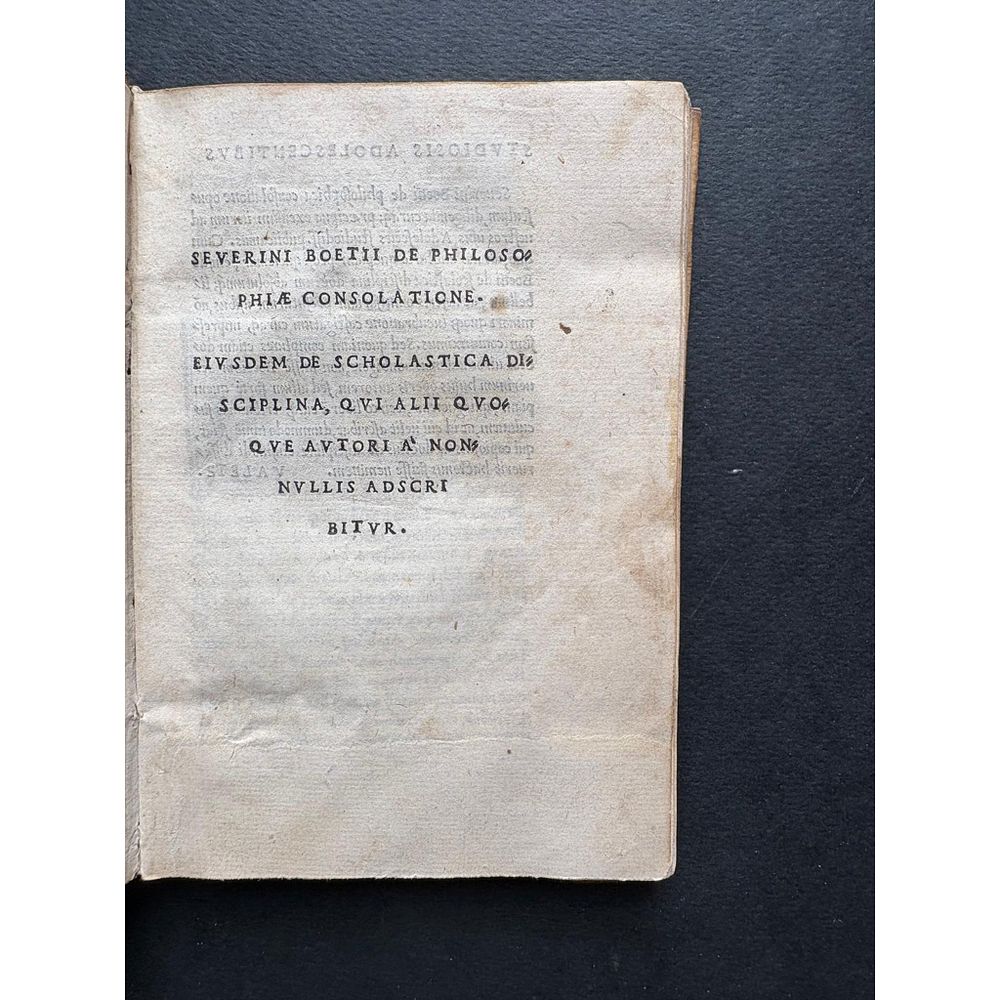
[HISTORY, POLITICS & HERALDRY] - BOETHIUS, Anicius Manlius Severinus (c. 480–524) - De philosophiae consolatione (De consolatione philosophiae) - BOETHIUS, Anicius Manlius Severinus (c. 480–524). Severini Boetii De philosophiae consolatione. Eiusdem De scholastica disciplina, qui alii quoque autori a nonnullis adscribitur. Venice: Melchiorre Sessa and Pietro Ravani, 1522. 8vo (150 × 105 mm). 80 numbered leaves. Printed in italic type. Contemporary limp vellum, manuscript title on upper cover. Small loss at foot of spine; otherwise a genuine and remarkably well-preserved copy in its original binding. Rare early sixteenth-century Venetian edition of Boethius’ De consolatione philosophiae, one of the most influential philosophical works transmitted from late antiquity to the European Middle Ages and Renaissance. Written while Boethius was imprisoned at Pavia and awaiting execution under the Ostrogothic king Theodoric, the Consolation takes the form of a dialogue between the condemned author and the allegorical figure of Lady Philosophy. Alternating prose and verse, the work examines some of the most enduring questions of Western thought: the instability of fortune, the nature of happiness, the existence of evil, divine providence, human freedom and the possibility of maintaining philosophical serenity in the face of catastrophe. The celebrated Wheel of Fortune lies at the heart of Boethius’ meditation. Earthly wealth, power, reputation and success are shown to be inherently unstable; true happiness must instead be sought in what cannot be taken away by external circumstance. From this starting point Boethius develops a sophisticated discussion of the relationship between providence and free will, attempting to reconcile divine foreknowledge with human moral responsibility. Few books exercised a deeper influence upon medieval intellectual culture. The Consolation circulated in hundreds of manuscripts, was translated and commented upon throughout Europe and became one of the principal channels through which elements of Greek philosophical thought entered the Latin Middle Ages. Its readers and translators included some of the central figures of European literature, from King Alfred and Chaucer to Dante and later Renaissance humanists.The present Venetian edition is particularly attractive for its compact format and elegant cursive typography, reflecting the increasing demand in the early sixteenth century for portable editions of the classical and philosophical canon. It is accompanied by the De scholastica disciplina, a medieval pedagogical treatise long attributed to Boethius but now recognized as the work of Pseudo-Boethius. Significantly, the 1522 title-page itself already acknowledges uncertainty concerning the attribution with the words “qui alii quoque autori a nonnullis adscribitur.” Modern bibliographical authorities likewise classify the work as Pseudo-Boethian.