Bidspirit auction | [PHILOSOPHY] - DESCARTES, RENÉ (1596–1650) -
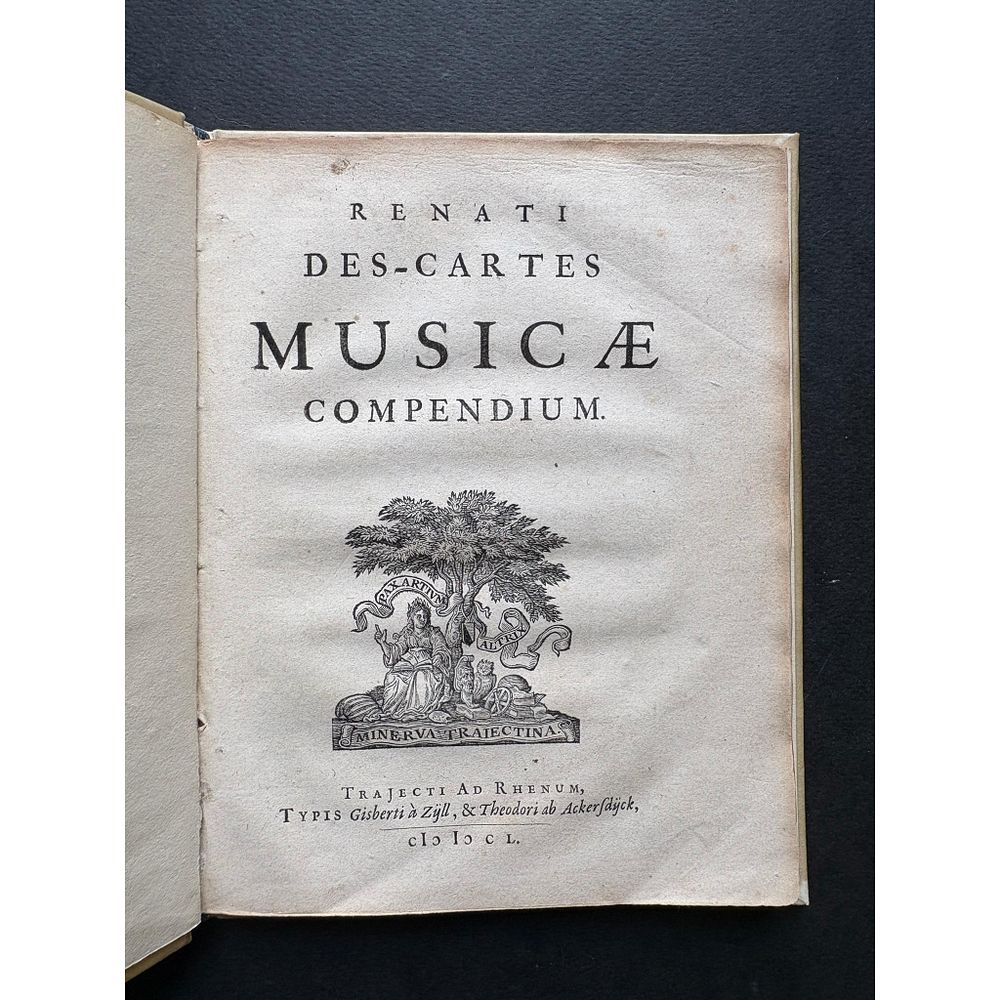
[PHILOSOPHY] - DESCARTES, RENÉ (1596–1650) - Musicae compendium - DESCARTES, RENÉ (1596–1650). Renati&am p;am p;am p;nb sp;Des-Cartes Musicae compendium. T rajecti ad Rhenum [Utrecht]: T ypis Gisberti à Zijll & amp; amp; amp; amp; Theodori ab Ackersdijck, 1650. Small 4to. 58, [2 blank] ; ; ; ;pages. Collation: A–G⁴ H¹.&am p;am p;am p;nb sp;Large engraved printer's device& amp; amp; amp; nbsp;on the title-page, woodcut initial and ornament, numerous musical examples, mathematical diagrams and geo metrical figures throughout the& ; ; ;nbs p;text. Contemporary full vellum&am p;am p;am p;nb sp;binding. A particularly attracti ve, well-preserved copy. RARE FIRST EDITION OF DESCART ES' EARLIEST KNOWN WORK, A LANDMARK IN THE HISTOR Y OF MUSICAL THEORY, MATHEMATICS AND THE DEVELOPME NT OF CARTESIAN PHILOSOPHY. Written in 1618, when Descart es was only twenty-two years&a mp;a mp;a mp;n bsp;old, the Musicae compendium was&am p;am p;am p;nb sp;composed for the Dutch math ematician and natural philosopher&a mp;a mp;a mp;n bsp;Isaac Beeckman (1588–1637), with whom Descartes had developed a close intellectual ; ; ; ;friendship. Although conceived mor e than three decades earlier, the treatise remained unpubli shed until 1650, the year ; ; ; ;of Descartes' death. The work represents one of&am p;am p;am p;nb sp;the earliest systematic attempts to explain musical harmony&am p;am p;am p;nb sp;through mathematical relationships&am p;am p;am p;nb sp;and physical principles. Rather& amp; amp; amp; nbsp;than approaching music solely& amp; amp; amp; nbsp;as an artistic discipline, Descartes investigates the na ture of sound, consonance, dissonance, rhythm and musical intervals& amp; amp; amp; nbsp;through numerical proportions and geometrical analysis. Particularly significant is his&am p;am p;am p;nb sp;consideration of the relationshi p between the physical propert ies of sound and human pe rception. Music, in Descartes' conception, is not merely an arrange ment of mathematical proportions&am p;am p;am p;nb sp;but a phenomenon capable of producing pleasure and emotio nal responses in the listener. These ideas anticipate essent ial elements of his later ; ; ; ;philosophical investigations into sensation, perception and the passions&a mp;a mp;a mp;n bsp;of the soul. The Musicae compendium occupies&am p;am p;am p;nb sp;an exceptional position in Descartes' intellectual development, revealing the early foundatio ns of the analytical and rationalist method that would subsequently transform European phi losophy and natural science. Published posthumously in its ; ; ; ;original Latin, this first edition is an important document in the& ; ; ;nbs p;history of seventeenth-century sc ientific thought and a fundame ntal contribution to the mathe matical theory of music. Bibliography: Guibert, Bibliographie des œuvres de&a mp;a mp;a mp;n bsp;René Descartes, p. 182, no. 1; Tchemerzi ne II, p. 797; Van Otegem, A Bibliography of the Wo rks of Descartes (1637–1704), pp. 444–445; USTC 1027547. The survival of the present copy in its contemporary limp vellum binding, with the manuscript title still visible on the upper cover, gives the volume particular appeal as an unusually authentic example of an early Renaissance reading copy. A rare, genuine and beautifully preserved Venetian edition of one of the foundational works of European philosophical literature, retaining its contemporary binding and combining Boethius’ great meditation on fortune and providence with the traditional Pseudo-Boethian treatise on scholastic discipline. References: Graesse I, 464; BMC, Short-Title Catalogue of Books Printed in Italy, p. 114; not in Adams.