Bidspirit auction | [PHILOSOPHY] - DESCARTES, René (1596–1650)
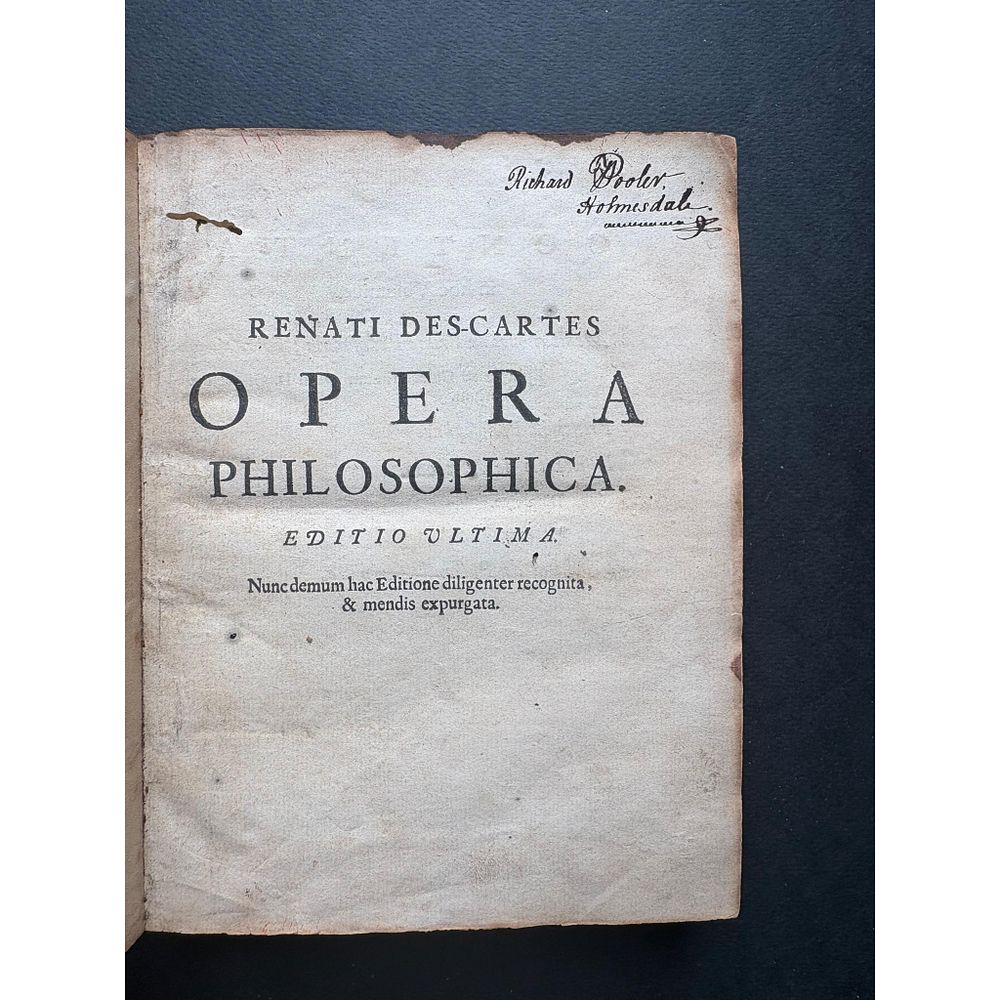
[PHILOSOPHY] - DESCARTES, René (1596–1650) - Opera philosophica - DESCARTES, René (1596–1650) Renati Des-Cartes Opera philosophica. Editio ultima, comprising: Principia philosophiae. Ultima editio cum optima collata, diligenter recognita, & mendis expurgata; Specimina philosophiae: seu Dissertatio de methodo rectè regendae rationis, & veritatis in scientiis investigandae: Dioptrice, et Meteora; Passiones animae, per Renatum Descartes… Amsterdam: ex typographia Blaviana, 1692. 4to, comprising [40], 222, [2]pp.; [16], 248 pp.; [24], 92 pp, [4] each work retaining its separate title-page. Numerous woodcut diagrams and typographical ornaments; engraved portrait of Descartes preceding the Principia. Contemporary full calf, richly gilt spine. Provenance: Richard Pooler, Holmesdale, ownership inscription to title-page. AN IMPORTANT CONTEMPORARY COLLECTION OF THREE FUNDAMENTAL CARTESIAN WORKS, INCLUDING THE PRINCIPIA PHILOSOPHIAE, THE SPECIMINA PHILOSOPHIAE, AND THE PASSIONES ANIMAE, ALL PRINTED AT AMSTERDAM BY THE BLAVIAN PRESS IN 1692. The Principia philosophiae, first published in 1644, represents Descartes’ most systematic presentation of his natural philosophy, seeking to explain the physical universe through matter, motion and mechanical laws. The present edition is explicitly described on its title-page as the Ultima editio, “diligently revised and purged of errors.” The accompanying Specimina philosophiae brings together the Discours de la méthode, Dioptrique and Météores in their Latin form, while the Passiones animae presents Descartes’ final major philosophical treatment of the passions and their relation to the body. The three works together offer an unusually coherent survey of Descartes’ mature philosophical programme: method and scientific reasoning, mathematical physics and optics, and finally the relationship between mind, body and human emotion. The 1692 Blaviana printing belongs to the important late-seventeenth-century dissemination of Cartesian philosophy throughout the European intellectual world. The volume is particularly attractive for its contemporary provenance, with the ownership inscription of Richard Pooler of Holmesdale, a provenance found in other seventeenth-century scientific and philosophical books. The binding is in contemporary full calf with gilt spine. The opening leaves show a small wormhole, confined to the preliminary pages and without loss of text; otherwise with the expected light age-toning and minor signs of use. A distinguished contemporary gathering of three central Cartesian texts, preserving an early English provenance and an unusually complete representation of Descartes’ philosophical and scientific thought.