Bidspirit auction | [CLASSICS & LITERATURE] - VERGILIUS
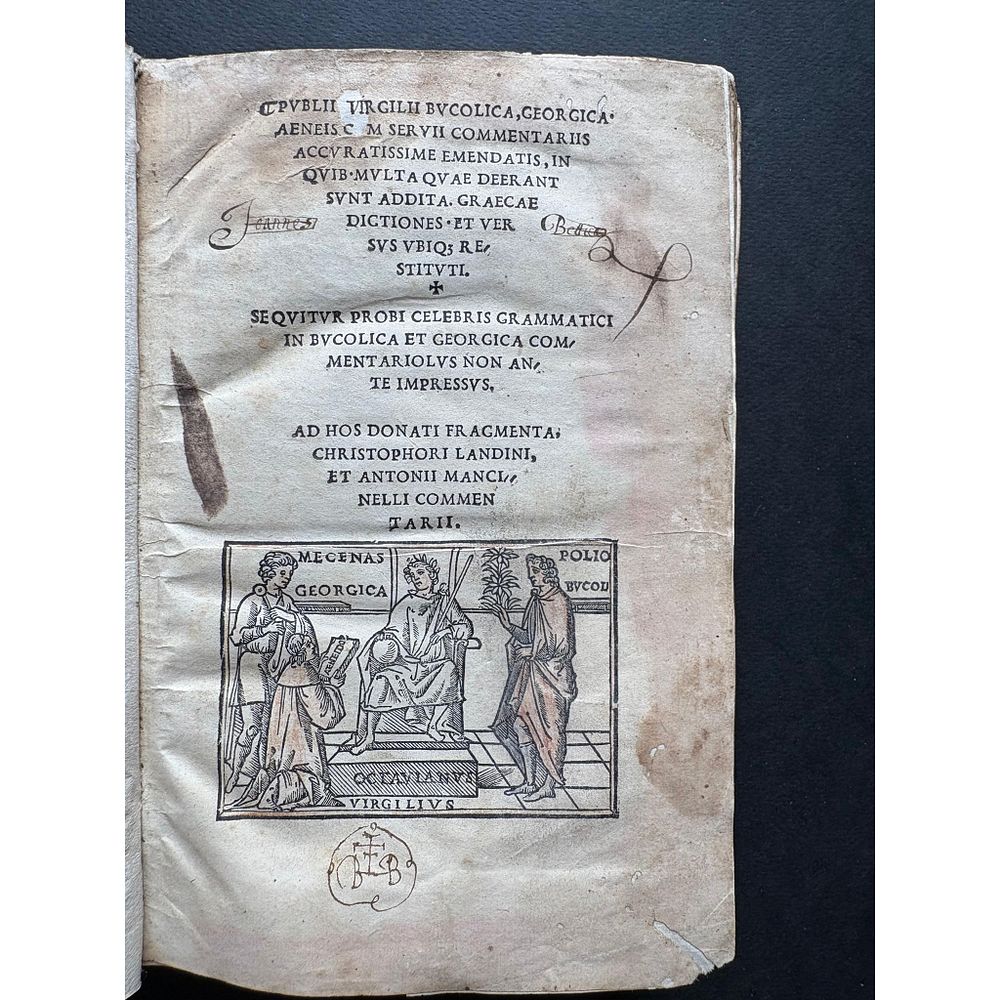
[CLASSICS & LITERATURE] - VERGILIUS MARO, Publius (70–19 BC). - Publii Vergilii Bucolica, Georgica, Aeneis, cum Servii commentariis - ***Note: This lot is located in Italy and requires an Italian export licence. We will manage the full application process for you. An additional fee of £50 applies.*** VERGILIUS MARO, Publius (70–19 BC). Publij Vergilij Bucolica, Georgica. Aeneis cum Servij commentariis accuratissime emendatis, in quibus multa quae deerant sunt addita. Graecae dictiones et versus ubique restituti. Sequitur Probi celebris grammatici in Bucolica et Georgica commentariolus non ante impressus. Ad hos Donati fragmenta, Christophori Landini, et Antonii Mancinelli commentarii. Venice: Bernardino Stagnino, 30 June 1507. 4to (202 × 132 mm). [492] leaves. Woodcut vignette on title and further woodcut illustrations in the text. Text surrounded by the extensive commentary of Servius and other Renaissance and ancient commentators. Contemporary limp vellum, remains of ties. Covers somewhat dust-soiled; endleaves renewed. Title-page with marginal restoration; light dampstaining to the inner margins of some central gatherings; small wormtrack to the lower outer corner of gatherings 3I–3K; minor restorations to the colophon. Early manuscript inscriptions on title and further early annotations on the verso of the colophon. A rare and important Venetian edition of the complete works of Virgil, combining the Bucolics, Georgics and Aeneid with one of the richest traditions of ancient and Renaissance commentary. Edited by the Venetian humanist Giovanni Battista Egnazio, the volume brings together the fundamental commentary of Maurus Servius Honoratus with the observations of Cristoforo Landino and Antonio Mancinelli, fragments attributed to Aelius Donatus, and a life of Virgil traditionally associated with Donatus. Of particular bibliographical importance is the inclusion of the commentaries attributed to the ancient grammarian Probus on the Bucolics and Georgics, here announced on the title-page as “non ante impressus” and generally regarded as their first appearance in print. Their publication within Egnazio’s edition gave scholars access to material transmitted from manuscript sources and considerably enriched the humanist apparatus surrounding Virgil’s text. The edition is also distinguished by its woodcut illustrations, including the title vignette showing Virgil presenting his poetry to Augustus and a series of narrative and pastoral scenes accompanying the text. These illustrations place the volume within the flourishing Venetian tradition of illustrated classical literature at the beginning of the sixteenth century. The commentary of Servius, composed in late antiquity, was of fundamental importance for Renaissance readers of Virgil. Preserving a vast body of grammatical, historical, mythological and antiquarian information, it frequently transmits material otherwise lost and remains indispensable for the interpretation and textual history of the poet. Virgil himself occupied a unique position in Renaissance culture. The Bucolics established the classical model for pastoral poetry; the Georgics joined poetry with agriculture, nature and philosophical reflection; and the Aeneid provided Europe with its supreme Latin epic of empire, destiny and human suffering. Together they formed a central element of humanist education and exercised an immense influence on European literature from Dante and Petrarch through the Renaissance and beyond. The present edition is especially attractive for preserving its contemporary limp-vellum binding and early manuscript annotations, evidence of the active reading and scholarly use characteristic of Renaissance editions of the classics. A rare and substantial early sixteenth-century edition of Virgil, notable for its extensive Servian and humanist commentary, its illustrated apparatus, and the first printed appearance of the pseudo-Probian commentaries on the Bucolics and Georgics.