Bidspirit auction | [CLASSICS & LITERATURE] - APULEIUS,
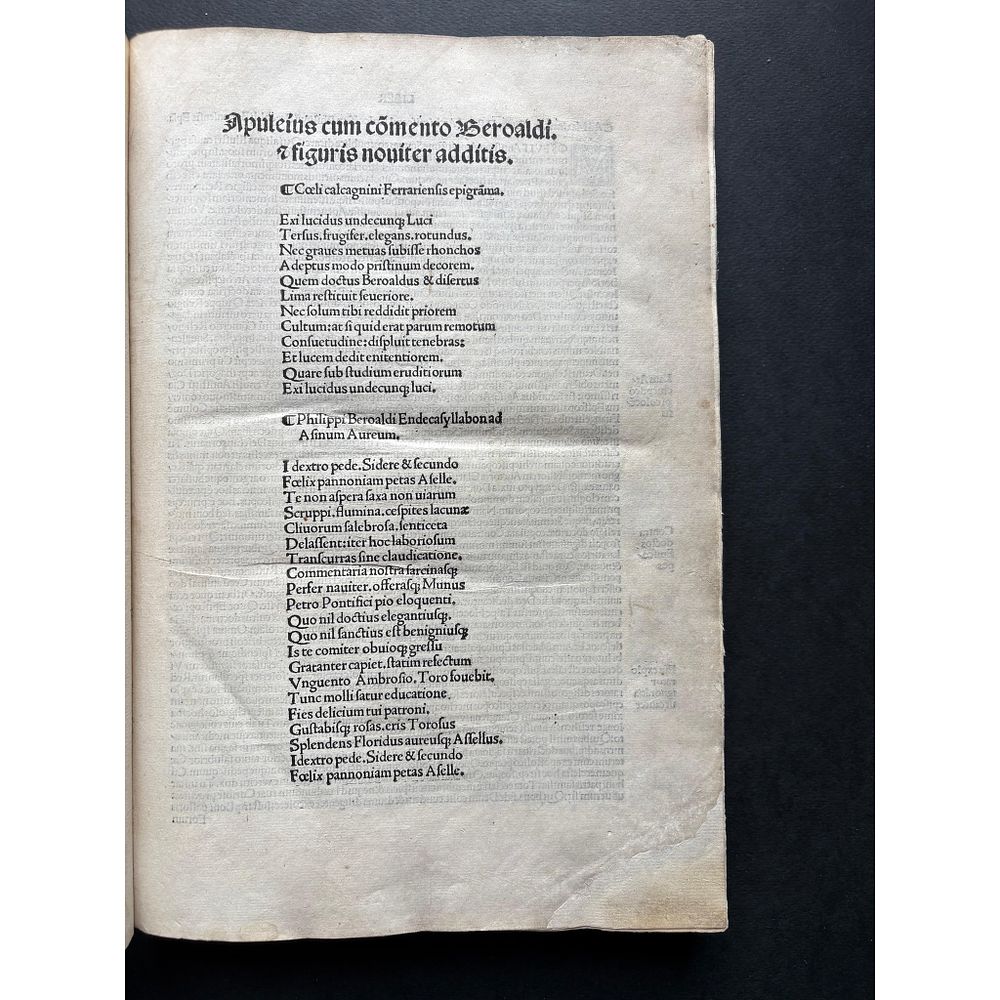
[CLASSICS & LITERATURE] - APULEIUS, Lucius (c. 125–after 170) - Apuleius cum commento Beroaldi - ***Note: This lot is located in Italy and requires an Italian export licence. We will manage the full application process for you. An additional fee of £50 applies.*** APULEIUS, Lucius (c. 125–after 170), with the commentary of Filippo Beroaldo (1453–1505). Apuleius cum commento Beroaldi et figuris noviter additis. Venice: Philippus Pincius Mantuanus, 16 September 1510. Folio (315 × 212 mm). 236 leaves. Text in Roman type surrounded by the extensive commentary of Filippo Beroaldo; numerous historiated woodcut initials on black ground and 37 woodcut illustrations in the text. Modern full brown calf in Renaissance style, covers decorated with gilt and blind fillets, spine with five raised bands. Washed; blank corner of four leaves skilfully restored; small wormhole. Complete. An attractive copy of this important early illustrated edition of Apuleius’ Metamorphoses, or The Golden Ass, generally regarded as the first illustrated edition of the work and the first to combine Beroaldo’s celebrated commentary with the cycle of 37 woodcuts. The Metamorphoses is one of the great survivals of classical literature and the only Latin novel from antiquity to have come down to us complete. Written in the second century AD, it recounts the extraordinary adventures of Lucius, a young man whose fascination with magic results in his accidental transformation into an ass. Retaining his human consciousness, he passes through a succession of comic, violent, erotic and fantastic episodes before ultimately recovering his human form through the intervention of the goddess Isis. The novel is remarkable for the richness and variety of the stories embedded within it. Most celebrated among them is the tale of Cupid and Psyche, one of the most enduring myths transmitted from antiquity and a narrative that would inspire generations of painters, sculptors, writers and poets from the Renaissance onwards. Magic and religious initiation are central to the work. Lucius’ transformation begins through illicit curiosity concerning magical practices, while the final book radically changes the tone of the narrative, culminating in his initiation into the mysteries of Isis. This combination of metamorphosis, magic, philosophy and mystery religion contributed greatly to Apuleius’ fascination for Renaissance readers and later writers interested in the hidden correspondences between the physical and spiritual worlds. The present edition is equally significant for the extensive commentary of the great Bolognese humanist Filippo Beroaldo. First published in 1500, Beroaldo’s commentary became the dominant Renaissance interpretation of Apuleius and was repeatedly reprinted throughout Europe. Far more than a linguistic commentary, it treats antiquities, mythology, religion, philosophy, customs and language, transforming the ancient novel into a rich repository of classical culture for the humanist reader. The 37 woodcuts provide an important visual interpretation of the narrative, illustrating Lucius’ transformation and adventures, the episodes of Cupid and Psyche, and other principal scenes. Their integration with the text and Beroaldo’s surrounding commentary makes the volume a particularly characteristic example of the richly annotated and illustrated classical books produced in Venice during the early sixteenth century. The extraordinary Renaissance fortune of The Golden Ass would extend far beyond classical scholarship. Its structure of stories within stories, its mixture of realism and fantasy, and its themes of curiosity, transformation and redemption left a lasting mark on European narrative literature and visual culture. An important and richly illustrated Renaissance edition of one of antiquity’s most remarkable literary works, combining the complete Latin text of The Golden Ass with Filippo Beroaldo’s influential humanist commentary and a full cycle of 37 woodcut illustrations.