Bidspirit auction | [CLASSICS & LITERATURE] - ARIOSTO,
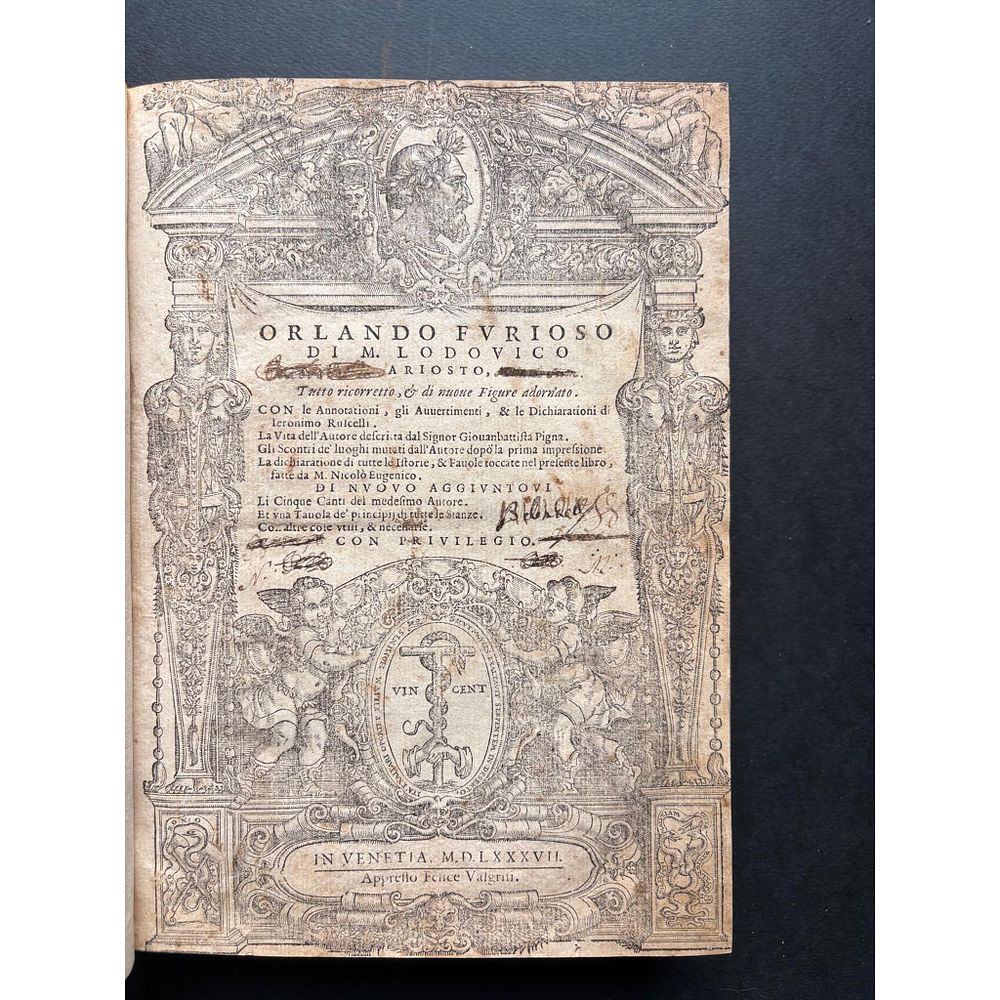
[CLASSICS & LITERATURE] - ARIOSTO, Ludovico (1474–1533) - Orlando furioso - ***Note: This lot is located in Italy and requires an Italian export licence. We will manage the full application process for you. An additional fee of £50 applies.*** ARIOSTO, Ludovico (1474–1533). Orlando furioso, tutto ricorretto, et di nuove figure adornato. Con le annotationi, gli avvertimenti, et le dichiarationi di Ieronimo Ruscelli. La vita dell’autore descritta dal Signor Giovanbattista Pigna... Di nuovo aggiuntovi li cinque canti del medesimo autore. Venice: Felice Valgrisi [printed by Valerio Bonelli], 1587. 4to (245 × 170 mm). [16], 654, [34] pp. Title within an elaborate woodcut architectural border incorporating a portrait of Ariosto and printer’s device; numerous ornamental woodcut initials and headpieces; 51 fine full-page woodcut illustrations, one preceding each of the 46 cantos of the Orlando furioso and five further illustrations accompanying the Cinque canti. Eighteenth-century vellum, gilt decoration and manuscript title to spine. Some browning, occasional staining and soiling, marginal dampstaining to gatherings B–C and 2T; title and some leaves slightly cropped; final blank wanting. Minor rubbing and chipping to binding. Provenance: Belondell, early ownership inscription on title; a further early inscription cancelled; occasional contemporary annotations and underlining. A richly illustrated and highly attractive late sixteenth-century edition of Ariosto’s masterpiece, accompanied by Girolamo Ruscelli’s extensive critical apparatus and by the five additional cantos published after the poet’s death. Felice Valgrisi’s illustrated Orlando furioso, first issued in 1556 under the editorship of Girolamo Ruscelli, represents one of the landmarks of Renaissance illustrated book production. The present 1587 edition belongs to the mature and most complete form of this celebrated editorial tradition, combining Ariosto’s text with commentary, allegorical explanations, linguistic observations, a life of the poet by Giovanni Battista Pigna, and the Cinque canti. The extraordinary series of full-page woodcuts is the principal visual feature of the edition. Each canto opens with a densely composed image in which several successive episodes are represented simultaneously within a single landscape. Rather than illustrating one isolated moment, the artist compresses the narrative movement of an entire canto into a complex visual field, mirroring Ariosto’s own technique of interweaving multiple stories and characters. The designs were traditionally associated with the Ferrarese painters Dosso Dossi and Battista Dossi, both closely connected with the courtly environment in which Ariosto worked. Modern scholarship, however, treats the attribution with greater caution and regards the cycle as more probably the product of an anonymous artist or workshop working for Valgrisi. Whatever their precise authorship, the illustrations proved enormously influential and established a new model for the visual interpretation of narrative poetry in Renaissance printing. The edition is further distinguished by the extensive annotations of Girolamo Ruscelli, one of the most active editors and literary commentators of sixteenth-century Venice. His apparatus explains difficult passages, historical and mythological references, textual variants and allegorical meanings, transforming the volume into both a literary text and a sophisticated Renaissance commentary on Ariosto. The Cinque canti, preserved here with their own series of illustrations, constitute an important posthumous supplement to the Furioso. Composed at an uncertain date, probably during the period in which Ariosto was revising his poem, they were never incorporated into the definitive 1532 text and were first published after his death in 1545. They extend the Carolingian narrative through the treachery of Gano di Maganza and the machinations of Alcina. First published in 1516 and brought to its definitive forty-six-canto form in 1532, the Orlando furioso became one of the supreme literary achievements of the Italian Renaissance. Its extraordinary fusion of chivalric epic, irony, romance, fantasy and psychological insight exerted an immense influence upon European literature, visual art and music. The present edition is particularly appealing for the completeness of its celebrated illustrative cycle and for the survival of contemporary or early ownership inscriptions, annotations and underlining, evidence of the active reading of Ariosto in the generations immediately following his death. A handsome and richly illustrated Renaissance edition of one of the masterpieces of European literature, preserving the complete Valgrisi cycle of 51 full-page woodcuts together with Ruscelli’s important commentary and Ariosto’s posthumously published Cinque canti. References: EDIT16 CNCE 2820; Agnelli-Ravegnani, Annali delle edizioni ariostee, I, pp. 161–163.