Bidspirit auction | [CLASSICS & LITERATURE] - CERVANTES
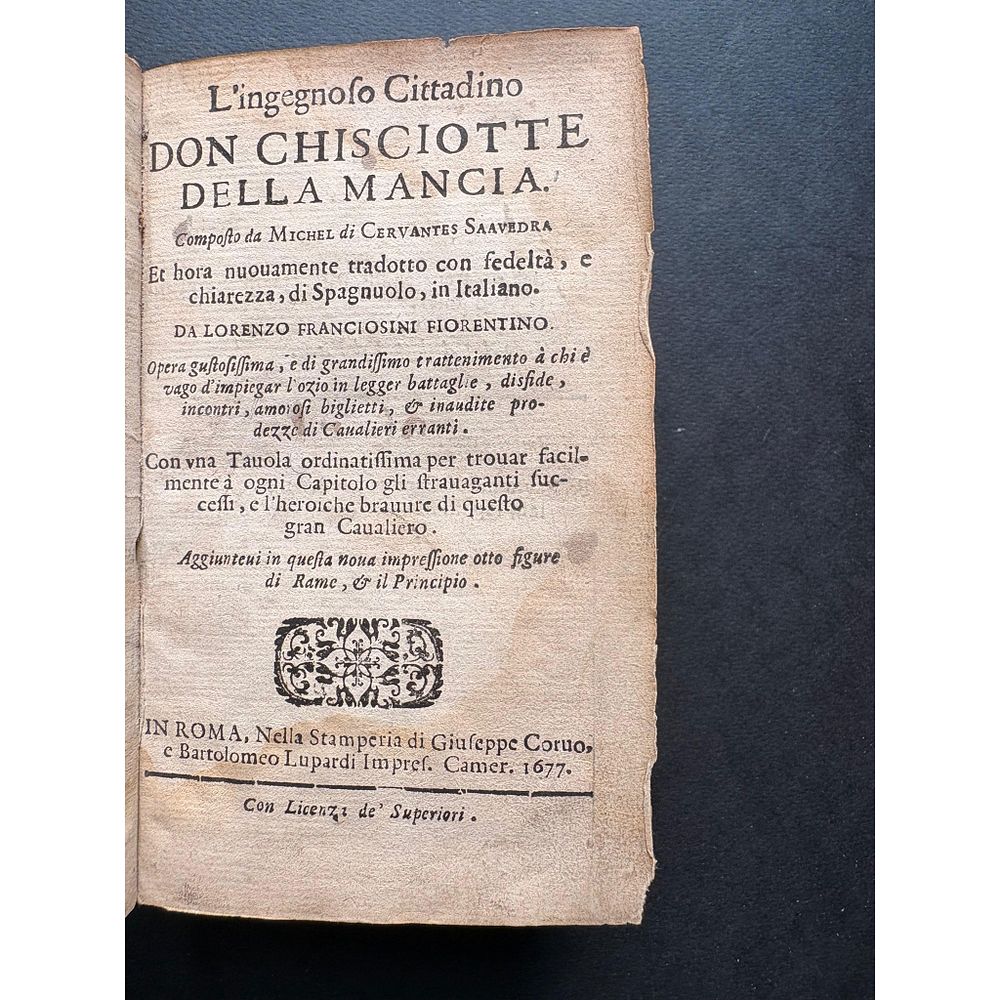
[CLASSICS & LITERATURE] - CERVANTES SAAVEDRA, Miguel de (1547–1616) - L'ingegnoso cittadino Don Chisciotte della Mancia - ***Note: This lot is located in Italy and requires an Italian export licence. We will manage the full application process for you. An additional fee of £50 applies.*** CERVANTES SAAVEDRA, Miguel de (1547–1616). L’ingegnoso cittadino Don Chisciotte della Mancia. Composto da Michel di Cervantes Saavedra, et hora nuovamente tradotto con fedeltà, e chiarezza, di Spagnuolo, in Italiano da Lorenzo Franciosini Fiorentino. Rome: Giuseppe Corvo and Bartolomeo Lupardi, 1677. 2 parts in 2 volumes, 8vo (160 × 105 mm). Vol. I: [20], 688 pp., engraved frontispiece and 8 engraved plates. Vol. II: [16], 730, [2] pp., engraved frontispiece and 8 engraved plates. Contemporary full vellum, sprinkled edges. Hinges with some wear, endleaves restored. Plate facing p. 72 in vol. I with tear and loss to upper outer corner; engraved frontispiece of vol. II torn with some loss. Some pale dampstaining, occasional light browning and foxing, otherwise a good copy. An important seventeenth-century Roman edition of Don Quixote in the celebrated translation of Lorenzo Franciosini, the first complete Italian translator of Cervantes’ masterpiece. Franciosini’s translation occupies a fundamental place in the European reception of Don Quixote. The first part appeared at Venice in 1622, only seventeen years after the Spanish first edition, followed by the second part in 1625. It was the first translation of Cervantes’ novel into Italian and remained the principal Italian version for generations. The present Roman edition is particularly attractive for its extensive engraved illustration. Its title-page explicitly announces the addition of “otto figure di rame, & il principio”; each volume preserves an engraved frontispiece together with eight narrative plates, providing a substantial visual interpretation of Don Quixote’s adventures. These engravings translate some of the novel’s most memorable episodes into the visual language of the late seventeenth century: the absurd heroism of the knight-errant, the contrast between Don Quixote and Sancho Panza, and the constant tension between imagined chivalric grandeur and everyday reality. Published in two substantial volumes, the edition contains both parts of the novel and belongs to the relatively limited series of Italian seventeenth-century printings through which Cervantes entered Italian literary culture. Modern scholarship notes that the Franciosini translation enjoyed a long afterlife and remained the principal Italian text of Don Quixote until the appearance of new translations in the nineteenth century. Franciosini himself was one of the most important Italian Hispanists of the seventeenth century, a lexicographer and grammarian whose intimate knowledge of Spanish allowed him to render Cervantes for an Italian readership at a remarkably early date. His version, though sometimes free in its phrasing, was enormously important in establishing the vocabulary, tone and identity of Don Quixote in Italy. The novel itself needs little introduction. One of the foundational works of modern European literature, Don Quixote transformed the conventions of chivalric romance into an unprecedented meditation on fiction, reality, identity and the power of reading. Its influence upon the development of the modern novel was immense. The preservation of both volumes in contemporary vellum, together with the full sequence of engraved plates, gives the present copy particular appeal as an early Italian illustrated witness to the European fortune of Cervantes. An attractive and substantially complete seventeenth-century Italian Don Quixote, preserving the influential translation of Lorenzo Franciosini and its extensive suite of engraved illustrations. References: Rius 780–781; Givanel, Catalogo de la Colección Cervantina; Benages y Fonbuena 819–820.