Bidspirit auction | [CLASSICS & LITERATURE] - PETRARCA,
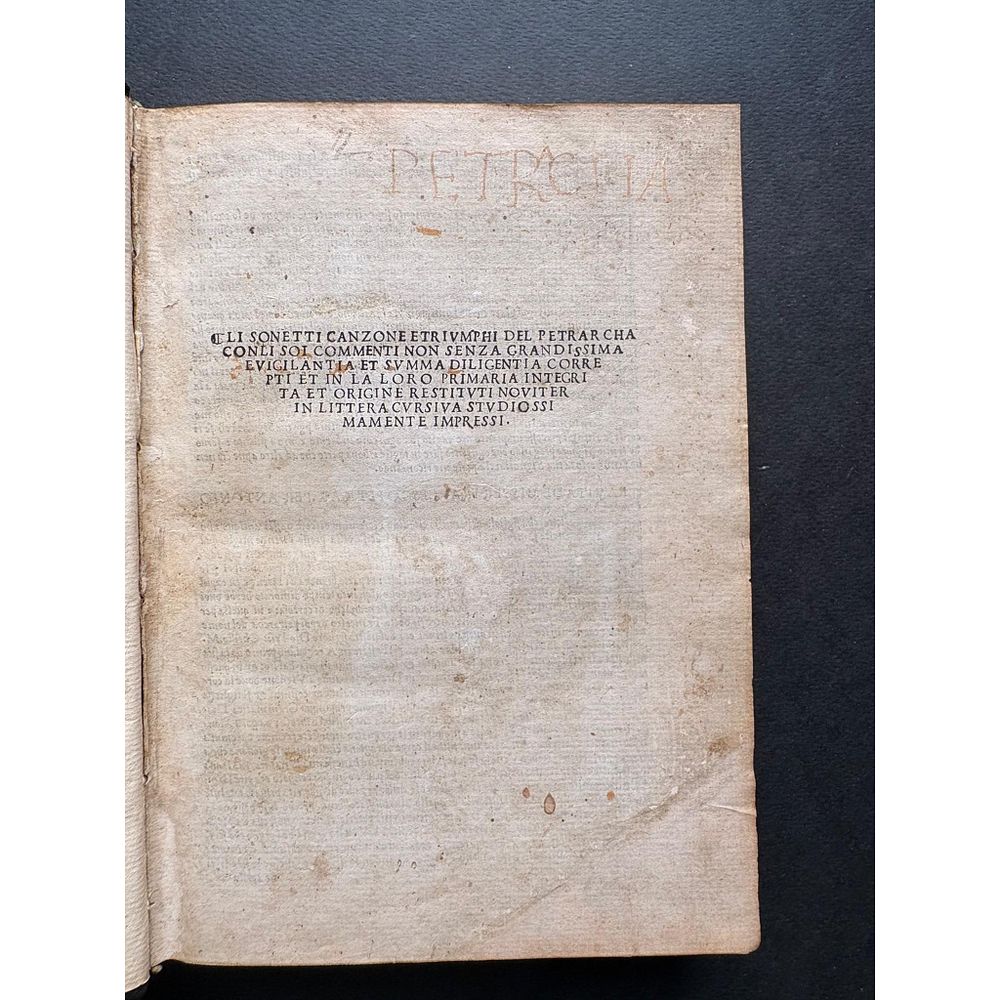
[CLASSICS & LITERATURE] - PETRARCA, Francesco (1304–1374) - Li sonetti, canzone e triumphi del Petrarcha - ***Note: This lot is located in Italy and requires an Italian export licence. We will manage the full application process for you. An additional fee of £50 applies.*** PETRARCA, Francesco (1304–1374). Li sonetti, canzone, triumphi del Petrarcha con li soi commenti, non senza grandissima evigilantia et summa diligentia correpti et in la loro primaria integrita et origine restituti, noviter in littera cursiva studiosissimamente impressi. [Bound with:] Triomphi di meser Francesco Petrarcha con la loro optima spositione. Venice: Gregorio de Gregorii, May 1519; Bernardino Stagnino, June 1519. 2 parts in one volume, 4to (212 × 144 mm). 158, [6], 184 leaves. Printed in italic type, with ornamental woodcut initials and seven fine full-page woodcuts. Later half calf over decorated boards. A8 slightly shorter at upper margin; purple staining to lower corner of first and final leaves; some browning, foxing and dampstaining, occasional small holes and tears, with a larger repaired tear towards the end. Early ownership inscription on title, occasional contemporary or early manuscript annotations, traces of stamps at O1. An important and richly illustrated Venetian edition of Petrarch’s Canzoniere and Trionfi, bringing together the poet’s vernacular masterpieces with the celebrated Renaissance commentaries of Francesco Filelfo, Girolamo Squarciafico and Bernardo Ilicino. The first part contains Petrarch’s Rerum vulgarium fragmenta — the collection universally known as the Canzoniere — accompanied by the commentary begun by the great humanist Francesco Filelfo and continued by Girolamo Squarciafico. The second contains the Trionfi with the influential commentary of Bernardo Ilicino, or Bernardo Lapini da Siena. This extensive exegetical apparatus is fundamental to the importance of the edition. Renaissance readers encountered Petrarch not simply as a lyric poet, but as an author whose poetry required historical, mythological, philosophical and moral interpretation. The commentaries surrounding the verse on the printed page transformed Petrarch into one of the central classical authorities of Italian humanist culture. The Canzoniere, centred upon the poet’s love for Laura, established a new language for European lyric poetry. Its analysis of desire, memory, spiritual conflict and the passage of time became the principal model for love poetry throughout Renaissance Europe and gave rise to the immense phenomenon of Petrarchism. The Trionfi enjoyed an equally extraordinary early reputation. Written as a sequence of allegorical visions — the Triumphs of Love, Chastity, Death, Fame, Time and Eternity — the poem presents human existence as a succession of victories in which each earthly power is ultimately overcome by a greater one, culminating in Eternity and the divine order. The seven full-page woodcuts give visual form to this allegorical universe and are among the principal attractions of the edition. The illustrations to the Trionfi belong to a long Renaissance iconographic tradition in which Petrarch’s abstract moral progression was transformed into magnificent triumphal processions inspired by the imagery of ancient Rome. The volume is also noteworthy for its typography. Printed in elegant italic type, with Petrarch’s verse visually distinguished from the surrounding commentary, it reflects the increasingly sophisticated design of Venetian literary printing during the early sixteenth century. The two parts were produced within a month of one another by two important Venetian printers: the Sonetti e Canzoni by Gregorio de Gregorii in May 1519 and the Trionfi by Bernardino Stagnino in June. Their union forms a substantial and visually impressive edition of Petrarch’s complete vernacular poetic corpus. The early ownership inscription and manuscript annotations preserved in the present copy provide additional evidence of its contemporary or early reception and use. A handsome and extensively illustrated Renaissance edition of Petrarch, combining the Canzoniere and Trionfi with the major humanist commentaries through which his poetry was read and interpreted in sixteenth-century Italy.