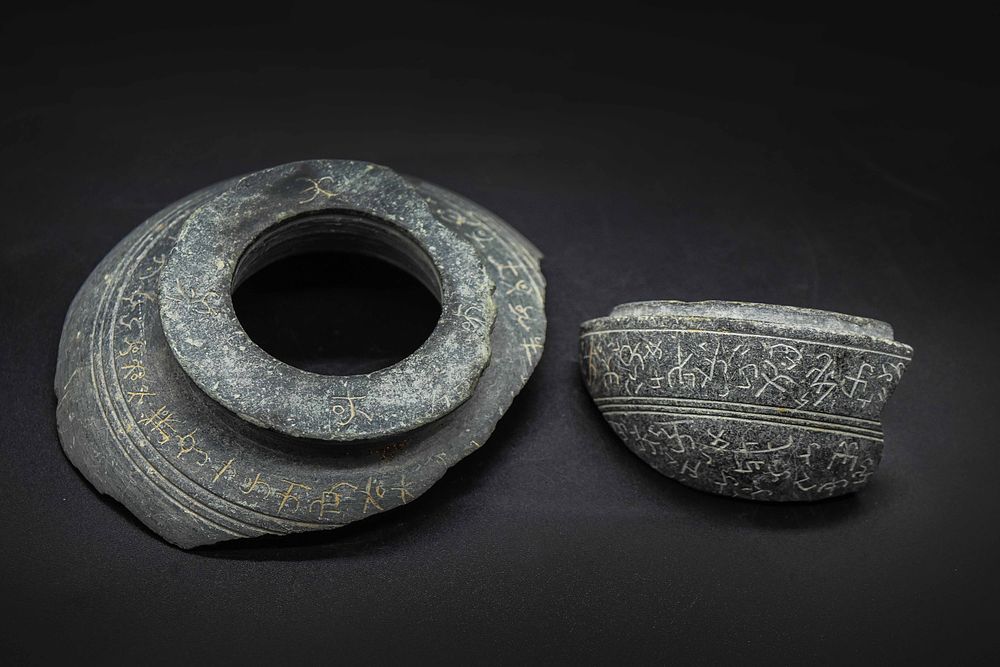
Bidspirit auction | Important Stone Pot with Kharosthi
Important Stone Pot with Kharosthi (Gandhari Lipi) Inscription, Indian, Ancient Gandhara - Ritual stone vessel or reliquary pot (likely schist or grey chlorite) Gandhara region (modern-day northern Pakistan and eastern Afghanistan), c. 2nd century BCE to 2nd century CE This Gandhara stone pot, originating from the Gandharan region (modern-day northwest Pakistan and eastern Afghanistan), is a remarkable artifact of both Buddhist heritage and early Indo-Aryan writing systems. It features an inscription in Kharosthi script—also known as Gāndhārī Lipi ()—which was used primarily from the 3rd century BCE to the 3rd century CE. Carved or incised into schist or steatite stone, the pot likely served as a ritual or reliquary vessel, possibly to enshrine Buddhist relics (śarīra). The Kharosthi script inscribed on it is written from right to left, derived from the Aramaic script and adapted to the local Gāndhārī Prakrit language. Such inscriptions typically record donations by devotees, royal dedications, or details of Buddhist teachings or relics. This script and pot reflect the cultural synthesis of Persian, Hellenistic, and Indian influences during the rule of Indo-Greek, Indo-Scythian, and Kushan dynasties. The presence of Kharosthi writing confirms the artifact’s authenticity and aligns it with the early Buddhist manuscript tradition found in Gandhara. Represents one of the earliest Indo-Aryan scripts used in Buddhist literature. Offers insight into religious, linguistic, and socio-political life in ancient Gandhara. Valuable to scholars for studying the spread of Buddhism, early writing systems, and epigraphic traditions in South Asia. Gandhari script: Kharosthi script (Gāndhārī: , romanized: kharoṣṭhī lipi), also known as the Gandhari script (, gāndhārī lipi), was an ancient Indic script originally developed in the Gandhara Region of north-western Indian subcontinent, between the 5th and 3rd century BCE. used primarily by the people of Gandhara alongside various parts of South Asia and Central Asia. it remained in use until it died out in its homeland around the 5th century CE. It was also in use in Bactria, the Kushan Empire, Sogdia, and along the Silk Road. There is some evidence it may have survived until the 7th century in Khotan and Niya, both cities in East Turkestan, now in Xinjiang, China.