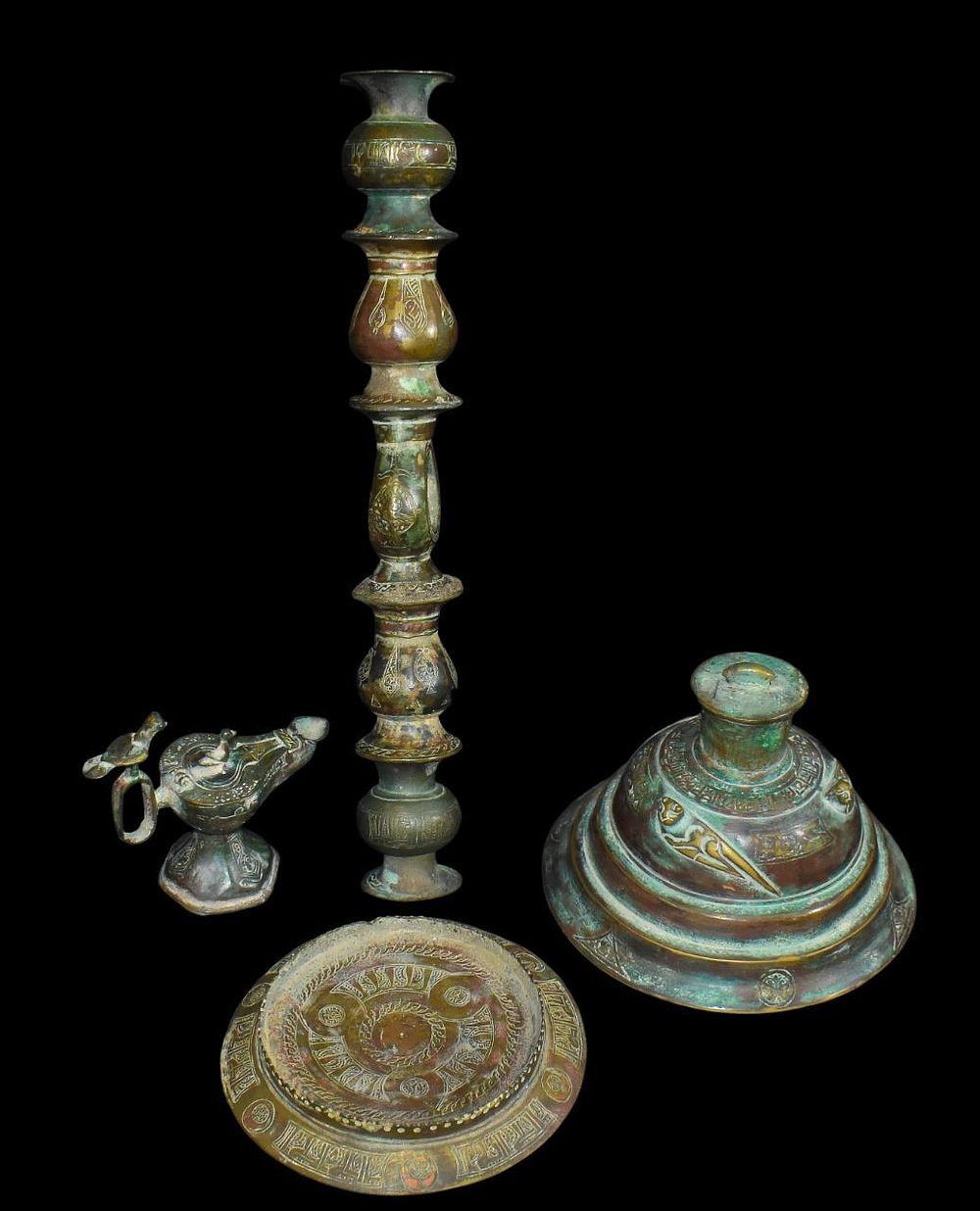
Bidspirit auction | Timurid Empire Bronze Oil Lamp
Timurid Empire Bronze Oil Lamp and Stand: Engraved Calligraphy and Motifs, Eastern Islamic, Persian - This stunning bronze oil lamp and stand from the Timurid Empire exemplify the intricate artistry and cultural richness. Engraved with intricate calligraphy, possibly including verses from the Quran, along with floral and geometric motifs that are hallmarks of Timurid art. The accompanying stand is designed to elevate the lamp, adorned with complementary engravings and motifs that enhance its overall aesthetic. This oil lamp serves both practical and decorative purposes, providing light while being a striking piece of art. The Timurid Empire was known for its cultural and artistic achievements, with Samarkand as a major center of art and scholarship. This lamp reflects the empire's commitment to beauty and craftsmanship. The Timurid Empire is renowned for its exquisite art and architecture, including intricate metalwork. An engraved brass oil lamp from this period would likely feature elaborate calligraphy and geometric motifs, reflecting the artistic styles of the time. The Timurids were the final great dynasty to emerge from the Central Asian steppe. In 1370, the eponymous founder, Timur (Tamerlane), who belonged to a Turko-Mongol tribe settled in Transoxiana, became master of this province and established Samarqand as his capital. Within thirty-five years, he subjugated all of Central Asia, greater Iran, and Iraq, as well as parts of southern Russia and the Indian subcontinent. To the west, Timurid forces defeated the Mamluk army in Syria and that of the Ottomans at Ankara (1400-1402). In 1405, while preparing to invade China, Timur died. The vast empire he carved proved to be difficult to keep; his son and successor, Shah Rukh (r. 1405-47), barely managed to maintain the empire's boundaries, and subsequent Timurid princes sought to establish their own kingdoms, weakening the empire with internal strife. Eventually only Khurasan and Transoxiana remained Timurid, and during the remaining years of the dynasty, these were ruled by separate branches of the Timurid family.