Bidspirit auction | Neo Babylonian Agate Duck Weight
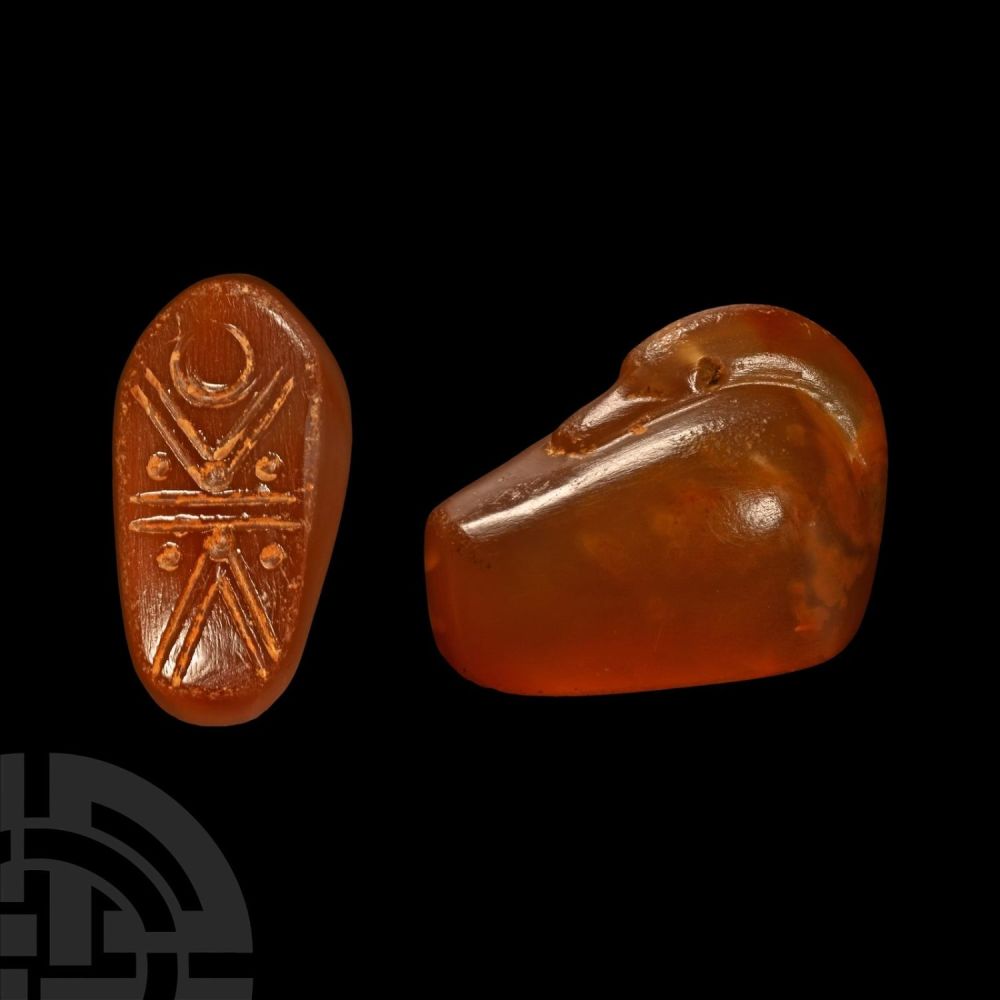
Neo Babylonian Agate Duck Weight with Engraving - Mid 1st millennium B.C. Modelled as a duck with its head resting along its voluminous back, base engraved with a crescent, dots, lines and triangles. Cf. Christie's A Peaceable Kingdom/ The Leo Mildenberg Collection of Ancient Animals, London, 2004, item 164; Kozloff, A.P., Animals in Ancient Art, from the Leo Mildenberg collection, Cleveland, 1981, fig.12bis. 11.8 grams, 28 mm (1 1/8 in.). Collected from 1969-1999.From the collection of the late Mr S.M., London, UK. There are references to keeping ducks in ancient Egypt and Mesopotamia from the third millennium B.C. onwards. One of the most common shapes for Near Eastern weights was 'the sleeping duck'. Representation demonstrates that the duck served chiefly as a meat source, even though a certain cultic significance must also be presumed: the crescent here engraved could be connected with the cult of Ishtar.